
Ecommerce SEO is defined as the practice of optimizing an online store's pages, structure, and content so that product listings appear in unpaid search results in front of shoppers who are ready to buy. Unlike general website SEO, this discipline targets transactional queries, meaning searches where the user already intends to purchase. Google Search Console data confirms that organic search visibility directly connects to product page rankings and buyer intent alignment. Platforms like Shopify, WooCommerce, and BigCommerce all support SEO configurations, but the strategy behind those configurations is what separates stores that grow from stores that stagnate. For small to mid-sized ecommerce businesses, understanding this discipline is the first step toward sustainable, paid-ad-free revenue growth.
What is ecommerce SEO and how does it work?
Ecommerce SEO works by making every layer of an online store more readable and relevant to search engines while simultaneously serving the needs of real shoppers. The process covers product pages, category pages, internal linking, site speed, mobile experience, and structured data. SEO benefits translate to measurable business outcomes beyond traffic alone, including brand trust, conversion rate improvement, and long-term sales growth. That last point matters more than most store owners realize. Traffic without conversion intent is just noise.
The role of SEO in e-commerce is fundamentally different from its role in a blog or service website. A blog optimizes for information. An ecommerce store optimizes for decisions. Every page must answer a buyer's question at the exact moment they are asking it. When a shopper types "black leather wallet under $50" into Google, the stores that have aligned their product titles, descriptions, and structured data to that query are the ones that appear. The ones that haven't are invisible, regardless of how good their products are.

Pro Tip: Use Google Search Console's Performance report to identify which product queries already bring impressions but low clicks. These are your fastest SEO wins. Rewrite the title tags and meta descriptions for those pages first.
How to build an ecommerce SEO strategy step by step
A structured approach separates stores that see consistent organic growth from those that chase algorithm updates. Follow these steps in order.
-
Run a full SEO audit. Before adding content or chasing keywords, assess what you already have. An audit of site performance and competitor gaps reveals broken links, duplicate content, missing meta tags, and crawl errors that silently suppress rankings. Tools like Screaming Frog and Google Search Console surface these issues quickly.
-
Conduct keyword research focused on buyer intent. Generic keywords like "shoes" are dominated by major retailers. Small to mid-sized stores win by targeting specific, transactional phrases like "waterproof hiking boots for wide feet." Use tools like Ahrefs or Semrush to find product-focused keywords with manageable competition and clear purchase intent.
-
Improve site architecture for crawlability. Search engines follow links to discover pages. If your category structure buries products five clicks deep, Google may never index them. A flat architecture, where any product is reachable within three clicks from the homepage, maximizes crawl efficiency and distributes ranking signals effectively.
-
Create intent-led content aligned with the buyer journey. Product descriptions, buying guides, and comparison pages each serve a different stage of the purchase decision. A shopper researching "best standing desk for home office" needs a comparison guide. A shopper searching "buy FlexiSpot E7 Pro" needs a product page with price, specs, and a clear call to action. Matching content format to search intent is what drives conversions, not just rankings. For a broader look at how content strategy fits into this, the guide on ecommerce strategy for SMBs covers the full picture.
-
Monitor, measure, and refine continuously. SEO is not a one-time project. Rankings shift, competitors update their pages, and Google's algorithms evolve. Set a monthly review cadence using Google Search Console, Google Analytics 4, and your chosen rank tracking tool to catch drops early and identify new opportunities.
Pro Tip: When building your keyword list, filter by "People Also Ask" questions in Google's SERPs. These reveal the exact language your buyers use, and answering them directly on product or category pages can earn featured snippet placements.
Technical SEO challenges unique to ecommerce sites
Technical SEO is the foundation that everything else rests on. Without it, even the best content and keyword strategy produces limited results. Technical SEO is foundational for ecommerce, requiring specific attention to crawlability, indexability, and structured data at catalog scale.
The most common technical challenges ecommerce stores face include:
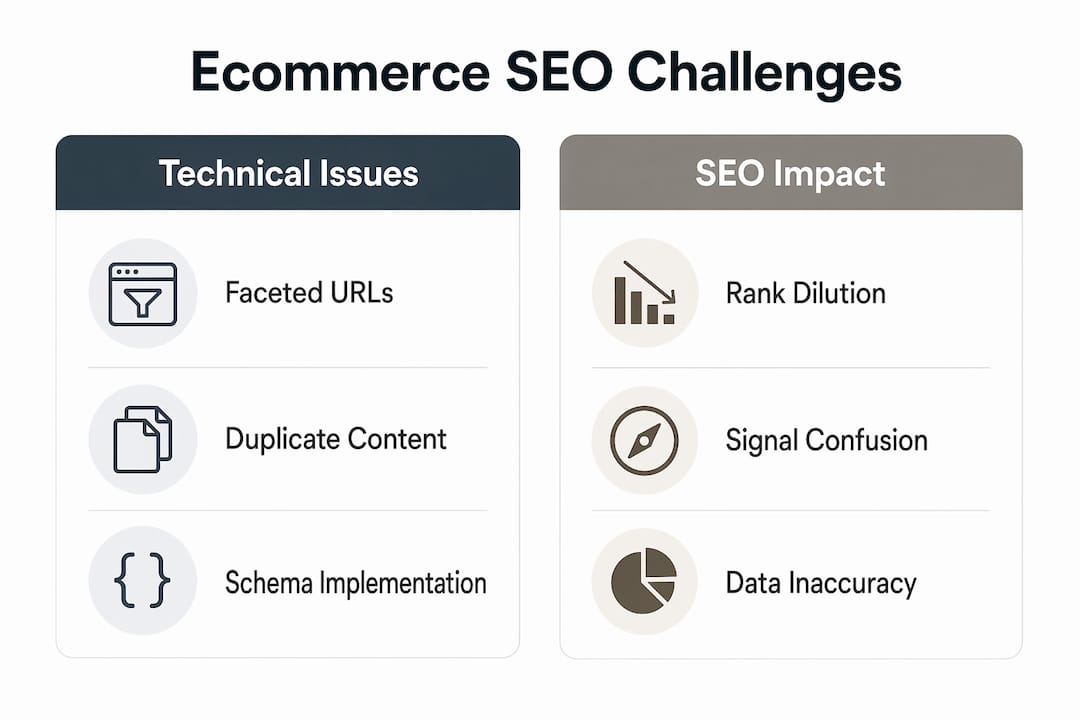
- Faceted navigation and duplicate URLs. Filter systems that generate URLs like "/shoes?color=black&size=10` create hundreds of near-identical pages. Canonical tags and URL parameter management consolidate ranking signals and prevent crawl budget waste.
- Product schema markup. Structured data tells Google exactly what a product is, what it costs, whether it is in stock, and what customers think of it. Product schema triggers rich results in SERPs, displaying price, ratings, and availability directly in search listings, which increases click-through rates significantly.
- Page speed and mobile optimization. Faster pages and mobile-friendly designs improve both user experience and search rankings. Google uses Core Web Vitals as ranking signals, meaning a slow product page costs you both rankings and sales.
- Inventory and pricing updates. When a product goes out of stock or changes price, the structured data on that page must reflect the change immediately. Stale data causes rich snippet losses and erodes buyer trust.
| Technical issue | SEO impact | Fix |
|---|---|---|
| Faceted navigation URLs | Duplicate content, diluted signals | Canonical tags, noindex filters |
| Missing product schema | No rich results in SERPs | Add JSON-LD structured data |
| Slow page load speed | Lower rankings, higher bounce rate | Compress images, use a CDN |
| Out-of-stock pages with no redirect | Crawl waste, lost link equity | 301 redirect or update with alternatives |
Pro Tip: Scaling product schema across thousands of SKUs manually is not realistic. Automated schema data models that tie your product feed, JSON-LD, and visible page content together prevent data drift and keep rich results eligibility intact as your catalog grows.
How ecommerce SEO differs from regular SEO
Ecommerce SEO targets transactional, product-specific queries rather than the broader informational intent that standard SEO often pursues. This distinction shapes every decision, from keyword selection to page structure to content format.
The key differences are worth understanding clearly:
- Search intent. Regular SEO often targets "how to" and "what is" queries. Ecommerce SEO targets "buy," "price," "review," and "best" queries. The buyer is further along in their decision process and needs less persuasion, but more precision.
- Structured data requirements. A blog post needs a title and a meta description. A product page needs schema markup covering price, availability, brand, reviews, shipping, and return policy. The technical bar is significantly higher.
- Catalog scale. A service business might have 10 pages to optimize. An ecommerce store might have 10,000 product pages. The systems and processes required to maintain SEO quality at that scale are fundamentally different.
- Conversion focus. Every ecommerce SEO decision connects directly to revenue. A ranking improvement on a product page has an immediate, measurable sales impact. This makes ecommerce SEO a performance discipline, not just a visibility exercise.
- AI interpretation of product data. Search engines increasingly use AI to interpret product attributes, match them to buyer queries, and decide which listings appear in AI-generated shopping summaries. Clean, accurate product data is no longer optional.
For practical guidance on presenting products effectively to both search engines and buyers, the article on product listing tips covers the specifics in detail.
How AI-driven search is reshaping ecommerce SEO in 2026
The search results page looks fundamentally different in 2026 than it did three years ago. SEO now includes optimizing for AI overviews and conversational discovery beyond traditional blue links. Google's AI Overviews, Perplexity's shopping summaries, and ChatGPT's product recommendations all pull from structured data and authoritative content. If your store is not feeding these systems clean, accurate information, you are not appearing in them.
The practical implications for ecommerce businesses are significant:
- Structured data is now a competitive advantage. Stores with complete, accurate product schema appear in AI-generated product carousels and shopping summaries. Stores without it do not.
- Conversational queries require intent-led content. A shopper asking an AI assistant "what is the best non-stick pan for induction cooktops under $80" expects a specific answer. Stores that have created content addressing that exact question in clear, factual language are the ones that get cited.
- Data accuracy is non-negotiable. Rich results require consistent data matching visible page content, with strict requirements on shipping, returns, and variant handling. A price discrepancy between your schema and your page can cost you rich snippet eligibility entirely.
- Continuous updating is required. AI systems favor fresh, accurate data. Stores that update their product information regularly, including seasonal pricing, stock levels, and policy changes, maintain their visibility advantage.
The shift toward AI-driven search does not replace traditional SEO. It adds a layer. Stores that master both will have a significant advantage over those that treat SEO as a static checklist.
Key takeaways
Ecommerce SEO requires technical precision, intent-led content, and continuous data accuracy to drive organic sales growth at any catalog scale.
| Point | Details |
|---|---|
| Definition and purpose | Ecommerce SEO optimizes product pages and site structure to attract high-intent, unpaid shoppers. |
| Strategy foundation | Start with an SEO audit, then build keyword research and site architecture before creating content. |
| Technical SEO priority | Canonical tags, product schema, and page speed are non-negotiable for catalog-scale stores. |
| Ecommerce vs. regular SEO | Ecommerce targets transactional queries and requires structured data precision that general SEO does not. |
| AI search adaptation | Clean structured data and intent-led content are now required for visibility in AI-generated results. |
Why most ecommerce SEO efforts fall short
After working with ecommerce businesses across retail, beauty, and specialty product categories, the pattern of failure is consistent. Store owners invest in content or paid ads before fixing the technical foundation. They publish product descriptions without schema. They let faceted navigation generate thousands of duplicate URLs without canonical tags. They assume that being on Shopify or WooCommerce means technical SEO is handled automatically. It is not.
The most damaging mistake I see is treating SEO as a launch task rather than an ongoing discipline. Rankings earned in January can disappear by March if a competitor updates their schema, a pricing change breaks a rich snippet, or a site migration introduces redirect errors. The stores that sustain organic growth treat SEO the way they treat inventory management: as a continuous operational function, not a one-time project.
The other underestimated factor is buyer behavior evolution. Shoppers in 2026 discover products through AI assistants, voice search, and social-driven queries in addition to traditional Google searches. An ecommerce SEO strategy that only optimizes for desktop Google search is already incomplete. The businesses that will win organic traffic over the next three years are the ones building structured, accurate, intent-aligned product data that feeds every discovery surface simultaneously.
— Tran
How Sourcesnova helps ecommerce businesses grow through SEO
Sourcesnova works directly with small to mid-sized ecommerce brands that need real SEO results, not reports full of metrics that do not connect to revenue. The team starts with a technical SEO audit that identifies crawl issues, schema gaps, and site architecture problems before touching a single piece of content. From there, Sourcesnova builds a keyword and content strategy aligned with your buyers' actual purchase intent, not generic traffic targets.
If you are running an ecommerce store and organic search is not delivering consistent sales, the issue is almost always fixable with the right diagnosis. Visit Sourcesnova's website to learn how the team approaches ecommerce SEO for growing businesses. No jargon, no bloated retainers. Just a clear plan and hands-on execution that connects directly to your bottom line.
FAQ
What is ecommerce SEO in simple terms?
Ecommerce SEO is the process of optimizing an online store so that product and category pages appear in unpaid search results when shoppers search for items you sell. The goal is to attract buyers who are already looking to purchase, without paying for each click.
How long does ecommerce SEO take to show results?
Most ecommerce stores begin seeing measurable ranking improvements within three to six months of implementing technical fixes and content updates. Competitive product categories may take longer, but technical SEO corrections often produce faster gains than content alone.
Why does ecommerce SEO matter for small businesses?
For small ecommerce businesses, organic search traffic reduces dependence on paid advertising and builds a sustainable, lower-cost customer acquisition channel. SEO benefits include increased brand visibility, buyer trust, and conversion rates that compound over time.
What is the role of structured data in ecommerce SEO?
Structured data, specifically product schema markup, tells search engines the price, availability, ratings, and shipping details for each product. This information triggers rich results in Google SERPs, which increase click-through rates and are now required for visibility in AI-generated shopping summaries.
Do I need a separate SEO strategy for AI search?
Yes. AI-driven search surfaces like Google AI Overviews and Perplexity require clean, accurate structured data and intent-led content to include your products in generated recommendations. A traditional keyword-only strategy does not feed these systems the product-level detail they need to cite your store.