
Most business decisions feel like guesses until you have real data behind them. That's exactly where market research comes in. Understanding what is market research, and how to use it, separates businesses that grow from those that stall. Many owners assume it requires a large budget or a research firm. It doesn't. Market research is simply the practice of gathering and analyzing information about your customers, competitors, and market conditions to make smarter decisions. Done right, it turns uncertainty into confidence and opinions into evidence.
Table of Contents
- Key takeaways
- What market research is and why it matters
- Market research methods that actually work
- How market research shapes real business decisions
- Common misconceptions about market research
- A step-by-step framework to conduct market research
- My take on market research after years in the field
- How Sourcesnova helps you turn research into results
- FAQ
Key takeaways
| Point | Details |
|---|---|
| Market research reduces risk | Replacing assumptions with data helps you allocate resources more efficiently and avoid costly mistakes. |
| Primary and secondary research both matter | Surveys and interviews give you direct insights; public data and industry reports provide fast, free context. |
| Simple methods work | A short customer conversation or a quick survey can yield insights that expensive studies miss. |
| Research should be ongoing | Treating market research as a continuous process prevents decisions based on outdated assumptions. |
| Small businesses have a real edge | Direct customer access lets smaller teams gather richer, faster qualitative insights than large corporations often can. |
What market research is and why it matters
The clearest market research definition is this: a structured process of collecting, analyzing, and interpreting information about a market, including its customers, competitors, and overall conditions. The goal is to turn raw data and observed market trends into decisions that are grounded in evidence rather than instinct.
Market research serves two main functions. First, it answers specific questions: Who is your customer? What do they need? What are they currently buying instead of your product? Second, it monitors ongoing shifts so you can adapt before your competitors do. Both functions are critical, and neither requires a research department to execute.
Good market research falls into two broad categories:
- Primary research: Data you collect directly. This includes customer surveys, one-on-one interviews, focus groups, and direct observation of buying behavior.
- Secondary research: Data others have already gathered. Government reports, industry publications, census data, competitor reviews, and trade association reports all qualify.
Research confirms that businesses conducting market research consistently are 2.5 times more likely to report strong financial performance and 6 times more likely to be profitable year-over-year. That number alone should settle any debate about whether research is worth the time.
"Market research mitigates risk and reduces uncertainty, replacing gut feelings with evidence to allocate resources more efficiently." — HubSpot Marketing
The importance of market research comes down to one thing: it gives you permission to act with confidence. Without it, you are investing time and money based on what you think the market wants. With it, you know.
Market research methods that actually work
Understanding the methods available to you makes the process far less intimidating. The right approach depends on your question, your budget, and your timeline.
Primary research methods
Primary research, or what is primary research in plain terms, means going directly to the source. You collect original data that doesn't exist anywhere yet.
- Customer surveys: Short, focused questionnaires sent by email or embedded on your website. Five to ten targeted questions can reveal purchase motivations, pain points, and unmet needs.
- One-on-one interviews: A 20-minute call with a current or former customer often produces more useful insight than a hundred survey responses. The follow-up questions you can ask in real time are the real value.
- Focus groups: Small group conversations guided by a moderator. Useful for testing messaging, pricing reactions, or new product concepts before you invest in development.
- Direct observation: Watching how customers behave in a store, on your website via session recordings, or during a product demo reveals patterns they might never articulate in a survey.
Secondary research methods
Secondary research is your starting point. It's fast, often free, and gives you the context to make your primary research more precise.
| Method | Use case | Cost | Time |
|---|---|---|---|
| Government data (Census, BLS) | Demographic analysis, market sizing | Free | 1 to 2 hours |
| Industry reports | Market trends, competitive benchmarks | Free to moderate | 2 to 4 hours |
| Competitor review analysis | Customer sentiment, gaps in competitor offerings | Free | 1 to 3 hours |
| Google Trends | Search demand and seasonal patterns | Free | 30 minutes |
| Trade publications | Niche industry shifts | Free to low | 1 to 2 hours |
A hybrid approach combining free secondary data with targeted primary research is both practical and effective for small businesses. Start with secondary data to understand the landscape, then conduct a short round of customer interviews to validate or challenge what you found.
Pro Tip: Before you build a survey, spend 30 minutes reading the one-star and five-star reviews of your top competitors on Google or Amazon. The language customers use to praise or criticize a competing product tells you exactly what your messaging should address.
How market research shapes real business decisions
Knowing the market research definition is one thing. Seeing how it changes actual decisions is where it gets useful.
Product development is the highest-stakes application. 40% of new products fail within two years of launch, often because the team assumed they knew what customers wanted without verifying it. Research before a launch, even a short round of customer interviews, dramatically reduces that risk. Connecting your findings to the product launch process can help you identify flaws before they become expensive mistakes.

Market research also directly shapes your marketing goals and messaging. When you know what language your customers use to describe their own problems, you can write copy that feels like it's reading their mind. That's not a creative trick. It's research applied to communication.
Here's where market research drives specific improvements:
- Pricing strategy: Customer interviews reveal what buyers consider fair and what triggers hesitation, giving you a real pricing range rather than a guess.
- Channel selection: Survey data showing where your customers spend time online tells you whether to invest in email, social media, or search before you spend a dollar.
- Competitive positioning: Analyzing competitor weaknesses through customer reviews lets you build messaging that fills gaps your competitors are ignoring.
- Product prioritization: Knowing which features customers value most helps you focus development time and budget on what will actually move purchasing decisions.
Market research should be continuous and integrated into planning stages rather than treated as a one-time task. Businesses that check in with their customers quarterly, even informally, make fewer expensive course corrections annually.
Common misconceptions about market research
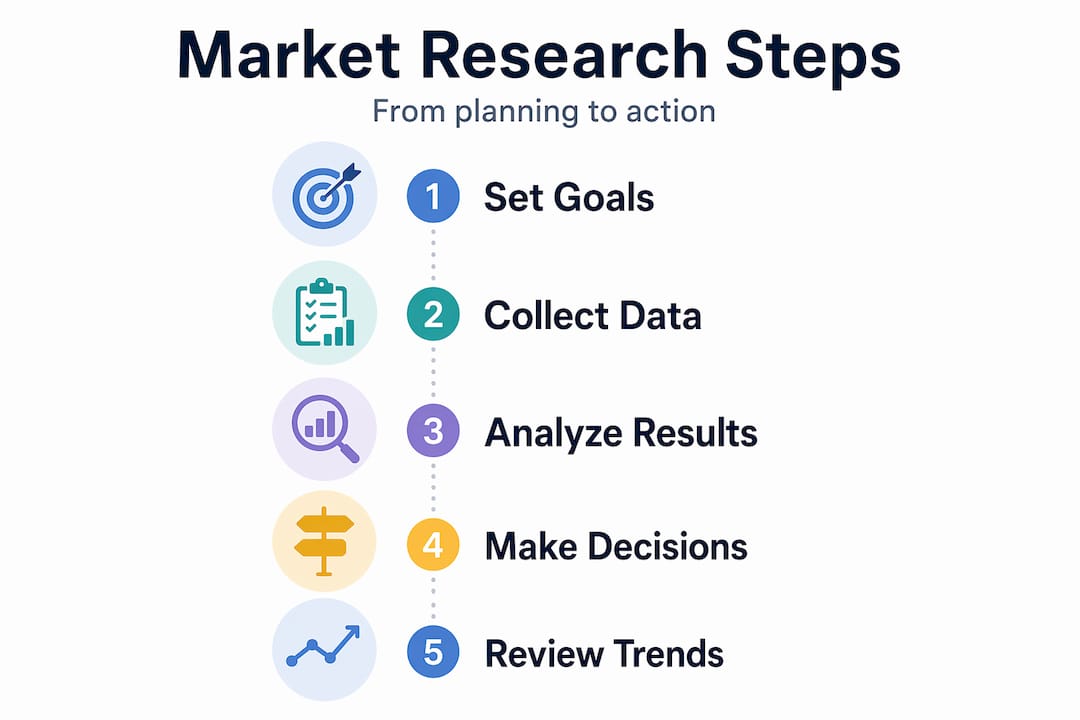
The biggest barrier most business owners face is a belief that market research is something large corporations do with big budgets and research firms. That belief has kept a lot of small businesses operating blind.
The reality: valuable research can be completed in an afternoon with simple surveys or direct customer conversations. You don't need a statistical sample of 1,000 people. You need enough real feedback to identify patterns, and patterns often emerge after just 8 to 12 conversations.
A few other misconceptions worth addressing directly:
- "Our team already knows our customers." Internal assumptions calcify over time. Customers change. What was true 18 months ago may not reflect what's driving decisions today.
- "Qualitative feedback isn't real data." A recurring theme across ten customer interviews is a signal worth acting on. Direct networking questions uncover qualitative insights that large quantitative surveys often miss.
- "We don't have the tools." Google Forms, Typeform, and your own email list are sufficient to run a meaningful survey. Your phone is sufficient to conduct interviews.
- "We'll do it after the launch." Post-launch research tells you what went wrong. Pre-launch research tells you how to get it right.
Pro Tip: Set a recurring calendar block every quarter to review three things: your top customer reviews, your competitor reviews, and one piece of free industry data. That 90-minute habit will tell you more than most annual research projects.
92% of market research professionals say their organizations rely heavily on data for strategic decisions. The shift toward evidence-based decision-making isn't a trend. It's the standard now.
A step-by-step framework to conduct market research
You don't need a formal methodology to get started. You need a clear sequence.
- Define your objective. What specific question are you trying to answer? "We want to understand why our conversion rate dropped last quarter" is a research objective. "We want to know our market" is not.
- Identify your audience. Who holds the answer? Current customers, lapsed customers, prospective buyers, or competitors' customers? Be specific.
- Select your methods. Based on your question and timeline, choose one or two methods. A quick secondary scan followed by five customer calls is often enough to get started.
- Collect your data. Execute your plan. Keep surveys under 10 questions. Keep interviews under 30 minutes. Record with permission so you can review later.
- Analyze your findings. Look for patterns, not outliers. Group responses by theme. What keeps coming up? What surprised you?
- Apply your insights. This is the step most businesses skip. Assign each major finding to a specific decision or change. Research with no output is just an exercise.
- Repeat on a schedule. Continuous, iterative research integrated into your planning process prevents costly errors from outdated assumptions. Quarterly check-ins work well for most businesses.
Free tools that support each stage include Google Forms for surveys, Google Trends for demand analysis, Statista for secondary data, and your own CRM data for customer behavior patterns. If you want to build this process into your broader marketing strategy, connecting research outputs to your goals from the start makes the whole system work better.
My take on market research after years in the field
I've worked with dozens of small and mid-size businesses over the years, and the pattern I see repeatedly is this: the ones that struggle most are the ones that skipped the research phase because they were confident they already knew their customer.
In my experience, that confidence is almost always partially wrong. Not because those owners aren't smart, but because proximity to your own product creates blind spots. You stop hearing what the market is actually saying and start hearing confirmation of what you already believe.
What I've learned is that the businesses with the sharpest instincts are the ones who combine their experience with direct, ongoing customer conversations. Not massive surveys. Not expensive focus groups. Just regular conversations that keep their assumptions honest.
I've also seen the opposite mistake: businesses that over-research and under-act. They collect more data, run more surveys, wait for certainty that never comes. The goal of market research isn't to eliminate risk. It's to reduce it enough to act with reasonable confidence.
Simple customer conversations can uncover insights that expensive quantitative surveys miss. That's not a consolation for small businesses without research budgets. That's a genuine competitive advantage. Large companies can't have a real conversation with their customers at scale. You can.
— Tran
How Sourcesnova helps you turn research into results
Understanding market research is the first step. Knowing how to act on it is where most businesses need support.
Sourcesnova works with local and small-to-mid-size businesses to build marketing strategies grounded in real market intelligence, not guesswork. From identifying the right audience to crafting messaging that converts, the team at Sourcesnova treats your business decisions with the same care you would. Whether you need help building a social media growth strategy informed by what your market actually responds to, or you want a full digital growth plan that puts your research to work, Sourcesnova provides clear strategy and hands-on execution. No vague reports. No inflated promises. Visit sourcesnova.com to learn how the team can help you grow.
FAQ
What is the simplest market research definition?
Market research is the process of gathering and analyzing information about customers, competitors, and market conditions to support better business decisions. It can be as simple as a short customer survey or as structured as a formal study.
What is primary research in market research?
Primary research means collecting original data directly from sources, such as through surveys, interviews, or focus groups. It gives you specific answers to your specific questions rather than relying on data someone else gathered.
How much does market research cost for a small business?
Valuable market research can often be completed in an afternoon using free tools like Google Forms and public data sources. The most effective small business research frequently costs nothing beyond your time.
How often should you conduct market research?
Market research is most effective when treated as an ongoing process rather than a one-time task. Most businesses benefit from conducting at least a basic review quarterly to stay current with customer needs and market shifts.
What are the main types of market research?
The two main types are primary research, which involves collecting new data directly from customers or prospects, and secondary research, which draws on existing sources like industry reports, government data, and competitor analysis. Most effective strategies use both.