
What online branding actually means
Online branding is the deliberate process of managing a brand's identity, reputation, and emotional character across digital platforms to cultivate long-term audience relationships. That definition, grounded in digital branding research, separates it from digital marketing in one critical way: online branding is not about driving immediate sales. It is about shaping how people perceive, remember, and trust a business before they ever click "buy."
Think of digital marketing as the engine that moves traffic. Online branding is the road that traffic travels on. Without a well-built road, the engine burns fuel and goes nowhere useful.
The foundational components of a strong online brand include:
- Visual identity: Logo, color palette, and typography that remain consistent across every platform, from your website to your Google Business Profile.
- Verbal identity: The tone of voice, messaging frameworks, and language style that define how the brand communicates, whether in an email, a social caption, or a product description.
- User experience consistency: How visitors navigate your website, interact with your content, and feel after each touchpoint. A disjointed experience undermines even the strongest visual identity.
- Presence management: Active, deliberate management of where and how the brand appears online, including search results, social media profiles, and third-party directories.
Brand consistency across all these touchpoints is what builds trust. Inconsistencies create fractured experiences that confuse buyers and erode confidence in the brand.
Why online branding matters for your business
A strong online brand does something that paid advertising cannot: it generates organic interest over time. Digital branding benefits include increased customer trust, loyalty, reduced marketing costs, and sharper competitive differentiation. When your brand is recognized and respected, people seek you out rather than stumbling across you through an ad.
The business case for investing in online branding is concrete:
- Trust and credibility: Buyers research businesses before purchasing. A polished, consistent digital presence signals professionalism and reduces purchase hesitation.
- Customer loyalty: Thoughtful brand communication fosters loyalty by setting clear expectations and delivering on them consistently across every interaction.
- Reduced marketing costs: A recognized brand converts paid traffic more efficiently. Without a cohesive identity, marketing spend leaks because visitors arrive and leave without connecting.
- Organic brand equity: Strong digital branding raises branded search volume and engagement metrics, building authority independent of paid advertising.
- Competitive differentiation: In crowded markets, the brand that is most clearly defined and consistently presented wins recognition, even against larger competitors with bigger budgets.
For small and mid-size businesses especially, online branding is the multiplier that makes every other marketing effort work harder. Sourcesnova works with clients across retail, beauty, e-commerce, and service industries who see this dynamic play out directly: the businesses with clear, consistent brands convert better and retain customers longer.
Pro Tip: Before spending on paid ads, audit your brand's consistency across your website, social profiles, and Google Business Profile. Gaps there will cost you conversions regardless of how much traffic you drive.
Key factors that make online branding work
Effective online branding does not happen by accident. It is built on a set of strategic factors that, when applied together, create a brand that is both memorable and credible.

The 5 C's of branding
The 5 C's of branding provide a practical framework: clarity, consistency, creativity, connection, and commitment. Brands that lack even one of these risk being forgettable or inconsistent in the market.
- Clarity: Know exactly what the brand stands for, who it serves, and what makes it different. Vague positioning produces vague results.
- Consistency: Every platform, every message, every visual element should feel like it comes from the same source.
- Creativity: Differentiation requires originality. Brands that look and sound like everyone else in their category disappear into the noise.
- Connection: The brand must resonate emotionally with its audience, not just describe what it sells.
- Commitment: Brand building is a long-term investment. Brands that rebrand every 18 months or abandon their voice under pressure never build lasting recognition.
Strategic factors to prioritize
Beyond the 5 C's, a practical online brand strategy rests on several operational pillars:
| Factor | What it involves | Why it matters |
|---|---|---|
| Brand identity foundation | Mission, values, tone, visual style | Anchors every decision and keeps the brand coherent |
| Platform selection | Choosing channels where the audience actually spends time | Prevents wasted effort on irrelevant platforms |
| Content aligned with brand voice | Blog posts, social content, video, email | Builds authority and reinforces brand personality |
| SEO integration | Keyword strategy tied to brand messaging | Increases organic visibility and branded search |
| Brand guidelines | Documented rules for visual and verbal usage | Maintains consistency as the team or agency grows |
| UX design | Website navigation, page speed, mobile experience | Shapes the brand impression at the most critical touchpoint |
| Brand health metrics | Branded search volume, engagement rate, sentiment | Reveals whether the brand is gaining or losing ground |
Visual identity elements such as logo, color palette, and typography are not decorative choices. They are recognition tools. When applied consistently, they unify the brand experience across platforms and make the business instantly identifiable. For businesses that extend their brand into physical touchpoints, uniform branding across merchandise and apparel reinforces the same recognition in the real world.
How to build your online brand: a step-by-step approach
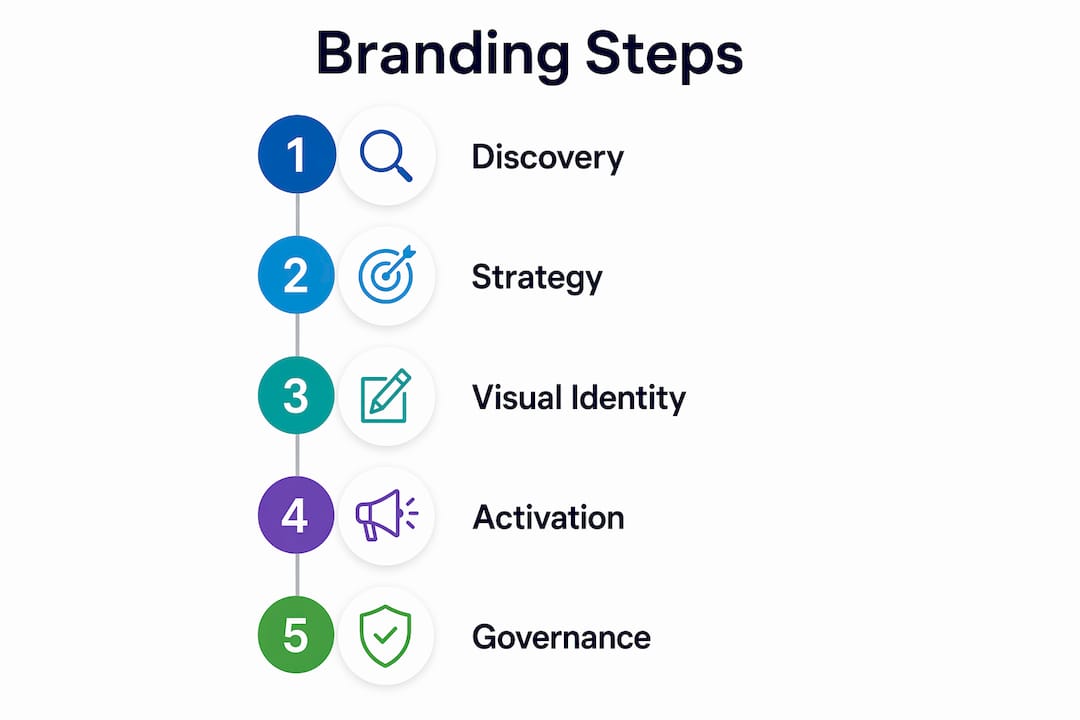
Most branding processes follow a defined lifecycle: discovery and research, strategy development, verbal and visual identity creation, activation, and ongoing governance. This process typically spans 8 to 27 weeks depending on the complexity of the business and the scope of work involved.
Phase 1: Discovery and research
Skipping this phase is the single biggest mistake in branding. A thorough discovery phase spans 2–4 weeks and grounds the brand in reality rather than assumptions. Activities include:
- Customer research: Who buys from you, why they chose you, and what language they use to describe the problem you solve.
- Competitive analysis: How competitors present themselves, where gaps exist, and what positioning is already claimed in the market.
- Stakeholder alignment: Getting internal agreement on the brand's purpose, values, and long-term direction before any creative work begins.
Without this foundation, the brand identity you build will reflect internal assumptions rather than market reality.
Phase 2: Strategy development
Strategy translates discovery findings into a clear brand platform. This includes a positioning statement (who you serve, what you offer, and why it matters), a value proposition, and defined brand pillars that guide all future messaging. The positioning statement is the most important document in the branding process. Every piece of content, every campaign, and every design decision should trace back to it.
Phase 3: Verbal and visual identity creation
Verbal identity covers tone of voice, messaging frameworks, and the specific language the brand uses consistently. Does the brand sound authoritative or approachable? Technical or plain-spoken? These choices must be documented so anyone writing for the brand produces content that sounds like it comes from the same voice.
Visual identity covers logo design, color palette, typography, and supporting graphic elements. These are not arbitrary aesthetic choices. Each element carries meaning and shapes perception. A cohesive visual identity supports recognition and unifies the brand experience across every platform where it appears. For businesses that want to extend brand identity into physical merchandise, resources like company shirt design guidance show how visual standards translate from screen to product.
Phase 4: Activation across digital touchpoints
Activation means deploying the brand across every relevant digital channel, consistently and completely. Brand activation involves ongoing monitoring to catch inconsistencies and adapt to market changes. Key activation steps include:
- Updating the website to reflect the new visual and verbal identity fully.
- Aligning all social media profiles, bios, cover images, and content tone.
- Applying brand standards to email templates, digital ads, and any third-party listings.
- Training any team members or agency partners who create content on behalf of the brand.
Focusing social media efforts on a few channels where the audience is actually active produces better results than spreading thin across every platform. Authentic connection on two or three channels outperforms a diluted presence on six.
Phase 5: Governance and ongoing monitoring
A brand is not a one-time project. It requires ongoing stewardship to stay relevant and consistent as the business grows. Governance includes maintaining brand guidelines, auditing digital touchpoints periodically, and tracking brand health metrics like branded search volume, social engagement, and customer sentiment. When the market shifts or the business evolves, the brand strategy should be revisited, not abandoned wholesale.

For businesses ready to build a strong digital brand presence, the process above provides a clear path from where you are now to where you need to be. Understanding your digital presence as a whole is the natural next step once the brand foundation is in place.
Key Takeaways
Online branding requires a consistent identity across every digital touchpoint, built through a structured process of discovery, strategy, creation, activation, and governance.
| Point | Details |
|---|---|
| Branding before marketing | A cohesive brand identity makes every marketing effort more efficient and improves conversion rates. |
| Consistency drives trust | Inconsistent visual or verbal identity across platforms erodes buyer confidence and weakens recognition. |
| Discovery phase is non-negotiable | Skipping customer research leads to brand identities that miss the mark; allow 2–4 weeks for this phase. |
| Full process takes time | A complete branding process typically spans 8–27 weeks depending on scope and business complexity. |
| Brand health requires monitoring | Track branded search volume, engagement, and sentiment to measure whether the brand is gaining ground. |
Ready to build a brand that actually works?
Sourcesnova helps local and small-to-mid-size businesses get found online, look professional, and turn visitors into customers. No jargon, no vanity reports. Just clear strategy and hands-on execution from a team that treats your business like their own.
Work with Sourcesnova to build a digital brand presence that drives real, measurable growth.