Paid advertising is the practice of paying a platform to display your ads to a specific audience, with most formats charging per user click. This model, formally called pay-per-click (PPC) advertising, puts your business in front of people who are actively searching or browsing. 55% of small businesses in the United States use some form of online advertising. That number tells you paid ads are no longer optional for businesses that want to compete online. Platforms like Google Ads and Facebook Ads are the two most common entry points for small business owners starting with paid advertising.
How do paid ads work?
Paid ads run through a real-time auction that happens every time a user performs a search or loads a page. The auction decides which ads appear and in what order, all within milliseconds. Understanding this process is the first step toward spending your budget wisely.
Google's ad ranking uses a modified second-price auction that factors in your bid, ad relevance, and Quality Score. You do not simply win by bidding the most. A competitor with a lower bid but a more relevant ad can outrank you.

What is Quality Score and why does it matter?
Quality Score is Google's rating of your ad's relevance and expected performance. It is scored on a scale of 1–10 and directly affects both your ad rank and the price you pay per click. A high Quality Score means you pay less for the same position compared to a lower-quality competitor.
Ad Rank is calculated using your bid, Quality Score, expected impact of ad extensions, and real-time auction signals. This means two advertisers with identical bids can end up in very different positions based on ad quality alone. That is why writing relevant, specific ad copy is not just a creative choice. It is a financial one.
Here is what the auction process evaluates for each ad:
- Bid amount: The maximum you are willing to pay per click
- Quality Score: Relevance of your ad, keywords, and landing page
- Ad extensions: Additional links, call buttons, or location info that improve click-through rates
- Auction-time signals: Device type, location, time of day, and search context
Pro Tip: Start with a tightly focused keyword list of 10–15 terms rather than hundreds. Fewer, more relevant keywords produce higher Quality Scores and lower costs per click.
What are the main types and platforms of paid advertising?
Paid ads fall into three main categories: search ads, display ads, and social media ads. Each targets users differently and suits different business goals. Choosing the right type depends on whether your customers are actively searching for you or need to be introduced to your brand.
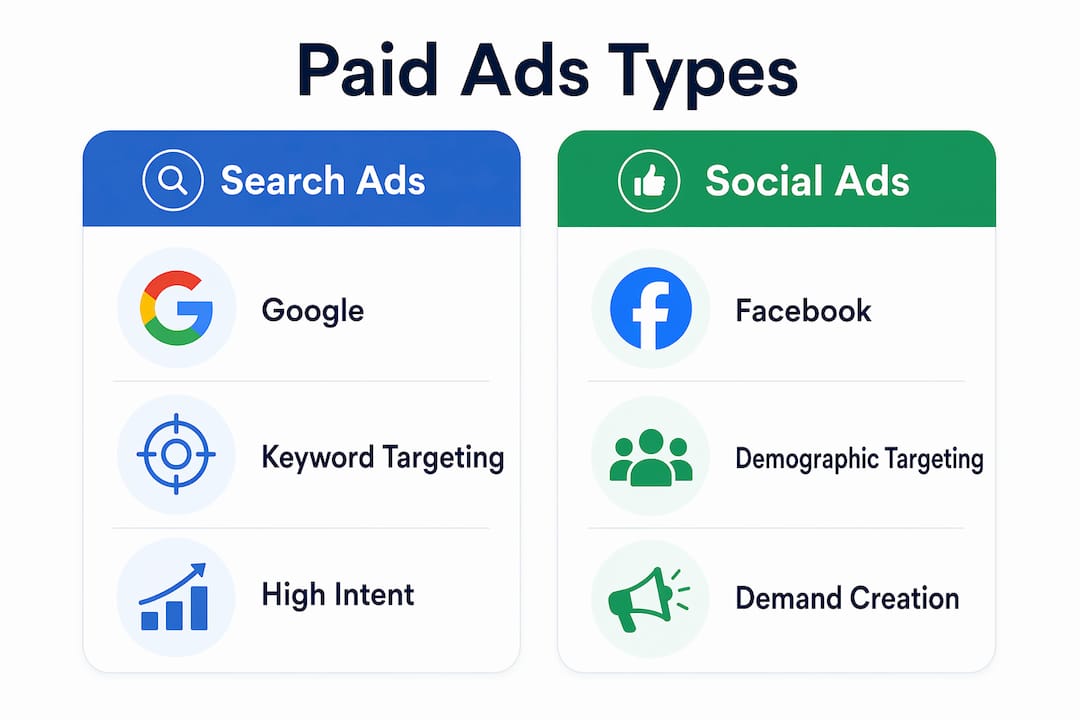
Search ads appear at the top of Google results when someone types a relevant query. Display ads are visual banners that appear across websites in Google's network. Social media ads run on platforms like Facebook and Instagram, targeting users by interests, demographics, and behavior rather than search intent.
| Ad type | Primary platform | Targeting method | Best for |
|---|---|---|---|
| Search ads | Google Ads | Keyword intent | High-intent buyers ready to act |
| Display ads | Google Display Network | Interests, browsing behavior | Brand awareness and retargeting |
| Social media ads | Facebook, Instagram | Demographics, interests, lookalike audiences | Audience building and engagement |
The key difference between search and social ads is intent. Search ads reach people who are already looking for what you sell. Social ads reach people who may not know they need you yet. A local plumber benefits more from search ads. A new clothing brand benefits more from social ads that build awareness first.
Pro Tip: Run search ads and social ads together when your budget allows. Search captures demand; social creates it. The two formats reinforce each other.
What are the benefits of paid ads for small businesses?
The biggest advantage of paid advertising for small businesses is control. PPC advertising lets you set daily budgets, adjust bids in real time, and pause campaigns instantly. No other marketing channel gives you that level of direct control over spending and results.
Here is what makes paid ads worth the investment for small businesses:
- Speed: Paid ads generate traffic the same day your campaign goes live. Organic search can take months to produce results.
- Precise targeting: You reach customers by location, age, income, search behavior, and device type. A nail salon in Austin can target women aged 25–45 within five miles.
- Measurable ROI: Every click, conversion, and dollar spent is tracked. You know exactly what your ad spend produces.
- Budget flexibility: You can start with $5 per day and scale up based on what works. There is no minimum spend requirement on most platforms.
- Competitive visibility: Paid ads place your business at the top of search results, even if your website is brand new.
PPC ads deliver cost-effectiveness, fast results, and precise targeting that organic methods cannot match in the short term. That combination is why small businesses with limited marketing budgets often see the fastest return from paid advertising compared to other channels.
Pro Tip: Track your cost per conversion, not just your cost per click. A $3 click that never converts is more expensive than a $10 click that closes a sale.
How can small businesses start a paid ad campaign?
Launching a paid ad campaign does not require a large budget or a marketing degree. Campaign setup follows a clear sequence that any business owner can work through step by step. The key is to start focused and expand based on data.
-
Define your goal. Decide what you want the campaign to achieve. Options include driving phone calls, website visits, form submissions, or in-store visits. A clear goal shapes every other decision.
-
Choose your platform. Match the platform to your goal. Google Ads works best for capturing people who are already searching. Facebook and Instagram work best for reaching people by profile and interest.
-
Research keywords or audiences. For search ads, use Google's Keyword Planner to find terms your customers actually type. For social ads, build an audience based on age, location, and interests that match your best existing customers.
-
Set a realistic budget. Start with a daily budget you can sustain for at least 30 days. This gives the platform enough data to learn and optimize. A common starting point for local businesses is $10–$30 per day.
-
Write your ad copy. Lead with the customer's problem, not your business name. "Same-day plumbing repair in Denver" outperforms "Welcome to Joe's Plumbing" every time. Include a clear call to action.
-
Build a matching landing page. Your ad and landing page must match in message and offer. If your ad promises a free quote, the landing page must deliver that promise immediately. Mismatched pages waste clicks.
-
Monitor and test. Check performance weekly for the first month. Run A/B tests on headlines and calls to action. Pause keywords or ad sets that spend without converting. Use marketing metrics tracking to measure what matters.
The most common mistake small businesses make is setting up a campaign and ignoring it. Paid ads require active management. A campaign left unattended for 60 days will almost always overspend on the wrong keywords or audiences.
Key Takeaways
Paid advertising gives small businesses direct, measurable control over who sees their ads, what they spend, and what results they get. No other marketing channel delivers that combination as quickly.
| Point | Details |
|---|---|
| Paid ads use real-time auctions | Bid amount, Quality Score, and ad relevance all determine your ad's position and cost. |
| Three core ad types exist | Search, display, and social ads each target users differently and suit different business goals. |
| Control is the top benefit | You set budgets, adjust bids, and pause campaigns instantly. No other channel matches this flexibility. |
| Start focused, then scale | Begin with a small daily budget and a tight keyword list, then expand based on conversion data. |
| Landing pages decide results | An ad that matches its landing page in message and offer converts far better than one that does not. |
What I've learned from watching small businesses run paid ads
Most small business owners I work with come in thinking paid ads are a slot machine. You put money in and hope something comes out. That belief leads to the most common and expensive mistake: running broad campaigns with no defined goal and no matching landing page.
The businesses that get real results treat paid ads like a sales process, not a lottery. They know their cost per lead, they test two versions of every ad, and they check their numbers weekly. The local business ad examples that consistently perform best share one trait: the ad and the landing page tell the exact same story.
My honest advice is to start smaller than you think you need to. A $15 per day budget on a focused campaign teaches you more in 30 days than a $500 per day budget spread across 200 keywords. Data is the product of those first weeks. Spend to learn, then spend to grow.
The businesses that fail at paid ads are not the ones with small budgets. They are the ones who stop paying attention after launch. Paid advertising rewards consistency and curiosity in equal measure.
— Tran
Paid advertising support from Sourcesnova
Sourcesnova works with small and mid-size businesses that want paid advertising to produce real, trackable results, not just impressions and clicks that go nowhere.
Sourcesnova builds and manages paid ad campaigns across Google Ads and social platforms, handling everything from keyword research and ad copy to landing page alignment and weekly performance reporting. The focus is always on cost per conversion, not vanity metrics. If you are ready to run campaigns that connect ad spend to actual business growth, the Sourcesnova digital advertising services page is the right place to start. No bloated retainers, no jargon. Just clear strategy and hands-on execution built around your goals.
FAQ
What does "paid ads" mean in digital marketing?
Paid ads are advertisements that businesses pay platforms to display to targeted users, with most formats charging per user click. The formal industry term is pay-per-click (PPC) advertising.
How much do paid ads cost for a small business?
There is no fixed minimum. Most small businesses start with $10–$30 per day and scale based on results. Your actual cost per click depends on your industry, keyword competition, and Quality Score.
What is the difference between paid ads and organic results?
Paid ads appear at the top of search results because you pay for placement. Organic results earn their position through SEO over time. Paid ads generate traffic immediately; organic results take months to build.
Which platform is best for small business paid advertising?
Google Ads works best when customers are actively searching for your product or service. Facebook and Instagram ads work best for building awareness among a defined demographic. Many small businesses benefit from running both.
How do I know if my paid ad campaign is working?
Track cost per conversion, not just clicks or impressions. A campaign is working when the revenue or leads it generates exceed what you spend. Use campaign performance data to identify which ads and keywords drive actual results.