
A sales funnel is a structured, measurable process that guides potential customers from first awareness through to purchase and beyond. Every business already has one, whether it's intentional or not. The difference between businesses that grow and those that stall is whether they've deliberately built and tracked each stage. This guide covers how to create a sales funnel that works for small to mid-sized businesses, from defining your offer to launching, measuring, and refining for sustained growth.
What are the key stages of a sales funnel?
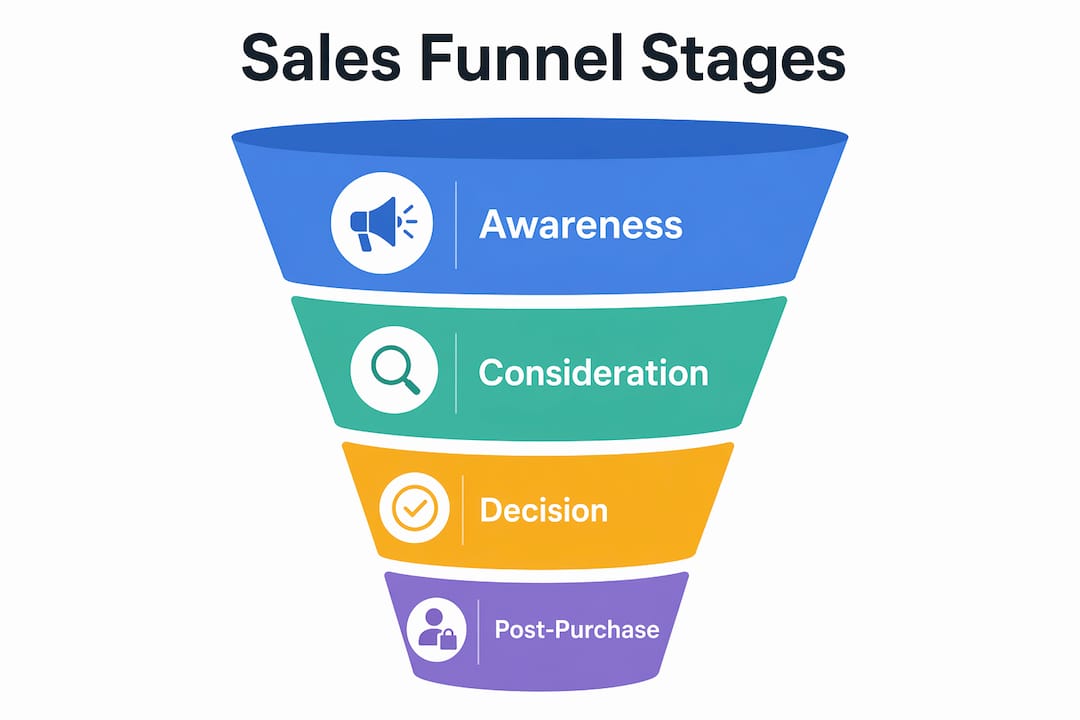
Sales funnels have three foundational stages: top (awareness), middle (research and consideration), and bottom (purchase decision). Each stage reflects a different buyer mindset, and each requires a different approach from you.
Top of funnel (awareness) is where strangers first encounter your business. Your goal here is to attract attention and educate, not sell. Blog posts, social media content, paid ads, and search engine visibility all serve this stage. The prospect does not know you yet, so your job is to show them you understand their problem.

Middle of funnel (consideration) is where prospects evaluate whether your solution fits their situation. This is the stage most small businesses neglect. Lead magnets, email sequences, webinars, and case studies belong here. Mapping the customer journey before designing your funnel reveals content gaps at this exact stage and aligns your messaging with how buyers actually think.
Bottom of funnel (decision and action) is where conversion happens. Sales pages, checkout flows, limited-time offers, and order bumps all push prospects to act. A clean checkout experience with minimal friction is the single biggest lever at this stage.
Post-purchase is the stage most guides skip entirely. Retention, upselling, and customer advocacy belong here. HubSpot's flywheel model treats existing customers as growth drivers, reducing acquisition costs by turning buyers into referral sources. That shift in thinking changes how you design the entire funnel.
| Funnel stage | Primary goal | Key actions |
|---|---|---|
| Awareness (top) | Attract and educate | Blog content, ads, SEO, social media |
| Consideration (middle) | Nurture and qualify | Email sequences, lead magnets, webinars |
| Decision (bottom) | Convert to customer | Sales page, checkout, order bumps |
| Post-purchase | Retain and grow | Upsells, loyalty offers, referral programs |
What tools and preparations do you need before building?
Offer clarity beats tool selection every time. A clean, focused offer with a clearly articulated transformation statement is the single biggest driver of conversion success, regardless of which platform you use. Before you open any software, write one sentence that describes who your customer is, what problem you solve, and what their life looks like after buying from you. If you cannot write that sentence, no funnel builder will save you.
Once your offer is clear, choose your funnel type based on price point and product complexity. A $27 digital product needs a simple squeeze page and sales page. A $2,000 service needs a longer nurture sequence, a discovery call, and a proposal stage. Matching funnel type to offer complexity prevents over-engineering low-ticket products and under-supporting high-ticket ones.
| Funnel type | Best for | Core pages needed |
|---|---|---|
| Squeeze funnel | Lead generation, free offers | Opt-in page, thank-you page |
| Tripwire funnel | Low-ticket products ($7–$97) | Sales page, order form, upsell |
| Webinar funnel | Mid-ticket ($200–$1,000) | Registration, webinar, sales page |
| High-ticket funnel | Premium services ($1,000+) | Application, call booking, proposal |
Your tool stack needs three components: a funnel builder for pages, an email platform for automation, and a payment processor for transactions. These do not need to be expensive. Many entry-level funnel builders include all three in one platform. Lead qualification criteria should be defined before you build, so your funnel filters for fit, interest, authority, budget, and timing from the start.
Pro Tip: Spend twice as long on your offer and headline as you do on page design. A mediocre page with a compelling offer outperforms a beautiful page with a weak one every time.
How to build your sales funnel step by step
Building a funnel is a linear process. Follow these six steps in order and you can launch a working funnel within 90 minutes using a matched template.
-
Pick your offer and funnel type. Confirm your transformation statement and select the funnel type that matches your price point. Write your headline before touching any software.
-
Sign up for a funnel builder and select a template. Choose a template built for your funnel type. Do not start from a blank page. Templates encode proven page structures that already convert.
-
Replace copy section by section. Work top to bottom: headline first, then subheadline, body copy, and call to action. Use a simple formula: state the problem, present your solution, prove it works, and tell the reader exactly what to do next.
-
Connect your payment processor and set pricing. Add your product, set the price, and configure any order bumps. An order bump is a small add-on offer shown at checkout. It adds revenue without requiring a separate sales page.
-
Write your follow-up email sequences. You need at minimum three sequences: an indoctrination sequence (who you are and why you matter), a cart-open sequence (for leads who did not buy), and a post-purchase sequence (onboarding and upsell). Automating lead nurturing workflows based on prospect behavior ensures relevant, timely follow-up without manual effort.
-
Test your purchase experience before going live. Complete a test purchase and verify that confirmation emails arrive, thank-you pages load correctly, and your CRM records the new contact. Skipping this step is the most common cause of lost sales on launch day.
| Step | Task | Estimated time |
|---|---|---|
| 1 | Define offer and funnel type | 30–60 minutes |
| 2 | Select template and set up builder | 15–30 minutes |
| 3 | Write and replace all page copy | 60–120 minutes |
| 4 | Connect payment and add order bump | 15–30 minutes |
| 5 | Write email sequences | 90–180 minutes |
| 6 | Test and launch | 30–60 minutes |
Pro Tip: Write your cart-abandonment email sequence before you launch. Most business owners skip it and leave a significant portion of recoverable revenue on the table from day one.
For a deeper look at building funnels for local businesses, the principles above apply directly, with the added layer of local trust signals like reviews and location-specific offers.
How do you optimize and nurture your funnel for growth?
Tracking the right metrics reveals exactly where your funnel loses money. Healthy funnel benchmarks include an opt-in rate of 20–40% for cold traffic and a refund rate under 5%. These numbers tell you whether your top-of-funnel messaging attracts the right people and whether your product delivers on its promise.
The four metrics every business owner should track are:
- Opt-in rate: the percentage of visitors who give you their email. Below 20% on cold traffic signals a weak headline or mismatched offer.
- Earnings per click (EPC): total revenue divided by total clicks. This tells you how much each visitor is worth and guides ad spend decisions.
- Average cart value: total revenue divided by number of orders. Order bumps and upsells raise this number without increasing traffic costs.
- Refund rate: refunds divided by total sales. A rate above 5% signals a product delivery or expectation mismatch.
Drop-off analysis is the most underused optimization tool available to small business owners. Funnel visibility through CRM tracking shows exactly which stage loses the most prospects. If 60% of visitors leave your sales page without scrolling past the fold, your headline is the problem. If 80% of people add to cart but do not complete checkout, your price or checkout friction is the problem.
Post-conversion email sequences generate 70–90% of total funnel revenue. That figure reframes where your time should go. Most business owners spend 90% of their effort on the sales page and 10% on follow-up, when the ratio should be closer to the reverse. Behavioral email workflows, triggered by actions like link clicks or page visits, keep your funnel working between purchases without manual intervention. Pair this with marketing automation to segment buyers from non-buyers and deliver relevant content to each group.
Pro Tip: Never send the same email sequence to buyers and non-buyers. Tag your contacts at the point of purchase and branch your automation. Sending a "buy now" email to someone who already bought destroys trust instantly.
Modern funnel strategy also benefits from supplementing the linear funnel with a flywheel approach. Leveraging existing customers for advocacy reduces acquisition costs and generates referrals that enter your funnel pre-qualified. A simple referral incentive or review request sequence added post-purchase can meaningfully reduce your cost per new customer over time.
Key Takeaways
A sales funnel converts prospects into customers only when each stage, from awareness through post-purchase, is deliberately designed, tracked, and refined.
| Point | Details |
|---|---|
| Offer clarity comes first | Define your customer transformation before selecting any tool or template. |
| Match funnel type to price point | Simple funnels suit low-ticket offers; high-ticket services need longer nurture sequences. |
| Test before launch | Complete a test purchase to verify emails, pages, and payment flows work correctly. |
| Track four core metrics | Monitor opt-in rate, EPC, average cart value, and refund rate to find and fix weak points. |
| Follow-up drives most revenue | Post-conversion email sequences account for 70–90% of total funnel revenue. |
Why most SMB funnels fail before they start
The businesses I see struggle most with funnels share one pattern: they obsess over the tool and ignore the offer. They spend weeks comparing funnel builders, debating page designs, and tweaking button colors. Then they launch with a vague headline and wonder why no one buys.
The funnel is not the strategy. The offer is the strategy. I have seen a plain text email sequence outperform a beautifully designed funnel page because the email spoke directly to a real problem the reader recognized in themselves. Design earns attention for about three seconds. Copy and offer earn the sale.
The second mistake I see constantly is treating the funnel as a one-time build. A funnel is a living system. Your first version will not be your best version. The business owners who win are the ones who launch fast, measure honestly, and make one change at a time based on data. They do not rebuild from scratch every time a metric dips. They identify the one constraint, fix it, and move forward.
Start with the simplest funnel that can prove your offer works. Add complexity only after you have proof. That discipline separates businesses that grow from ones that stay busy without results.
— Tran
Sourcesnova helps you build funnels that actually work
Building a sales funnel is straightforward when you have the right framework. Executing it well, especially the offer design, email sequences, and metric tracking, takes experience that most small business owners are still developing.
Sourcesnova works with local and small to mid-sized businesses to build practical funnel strategies grounded in clear offers, proven copy structures, and automation that runs without constant attention. The team also publishes practical guidance on lead generation and funnel building for business owners who want to understand the process before handing it off. If you want a funnel that converts rather than one that just looks good, Sourcesnova is the place to start.
FAQ
What is a sales funnel in simple terms?
A sales funnel is a step-by-step process that moves a potential customer from first hearing about your business to making a purchase. It typically includes awareness, consideration, decision, and post-purchase stages.
How long does it take to build a sales funnel?
A basic funnel with a sales page, checkout, and follow-up email sequence can be built and launched in under four hours using a matched template. More complex funnels with webinars or high-ticket applications take longer.
What is the most important part of a sales funnel?
Offer clarity is the most important element. A clearly articulated transformation statement drives conversion more than page design, traffic volume, or tool selection.
How do I know if my funnel is working?
Track your opt-in rate, earnings per click, average cart value, and refund rate. A healthy funnel shows an opt-in rate of 20–40% on cold traffic and a refund rate below 5%.
Do I need expensive software to build a sales funnel?
No. Entry-level funnel builders include page building, email automation, and payment processing in one platform at accessible price points. The offer and copy matter far more than the software you use.