
A marketing funnel is a structured framework that maps the customer journey from first contact with your brand through purchase and long-term loyalty. Known formally as a purchase funnel or conversion funnel, this model gives marketing professionals and business owners a clear system for aligning tactics to where prospects actually are in their decision process. Platforms like HubSpot, Salesforce, and Shopify have built entire product ecosystems around this framework because it works. This marketing funnel guide covers every stage, the strategies that perform at each one, and how to measure what matters so you stop guessing and start growing.
What is a marketing funnel and why does it matter?
A marketing funnel is distinct from a sales funnel. Marketing funnels focus on lead generation and nurturing, while sales funnels handle direct deal-closing activities. That distinction matters operationally because it defines who owns what, which prevents the finger-pointing that kills pipeline momentum at growing companies.
The funnel model exists because buyers do not convert on first contact. They move through predictable mental states: unaware, curious, evaluating, ready to buy, and then either loyal or gone. Mapping your marketing to those states is what separates businesses that grow predictably from those that rely on luck and referrals.

For small and mid-size businesses especially, this framework removes the guesswork from budget allocation. Instead of spreading spend evenly across channels, you invest where the bottleneck actually is.
What are the key stages of a marketing funnel?
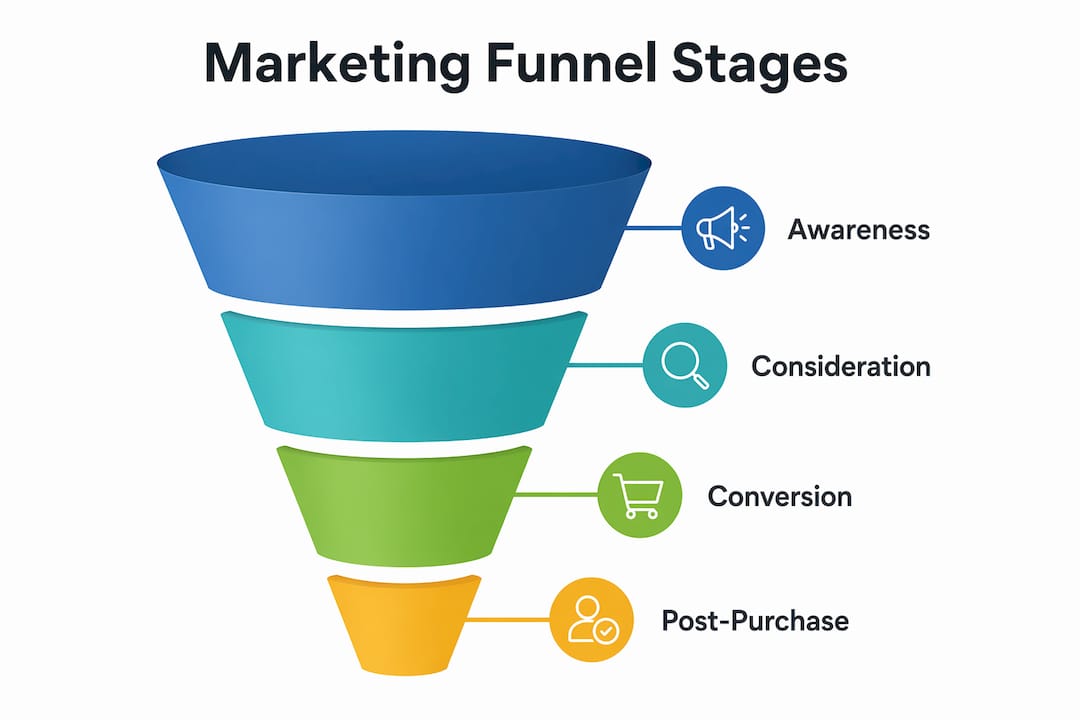
Funnel stages commonly include awareness, consideration, conversion, and post-purchase loyalty or advocacy. Practitioners typically group these into three operational zones: TOFU (top of funnel), MOFU (middle of funnel), and BOFU (bottom of funnel).
TOFU: Awareness
The top of the funnel is about reach and recognition. Your prospect does not know you yet, or knows you exist but has no reason to care. The objective here is traffic and brand recall, not conversion. Metrics like impressions, organic reach, and new website visitors tell you whether this stage is working.
MOFU: Consideration and nurturing
- Prospects are actively comparing options and looking for reasons to trust you
- Email sequences, webinars, downloadable guides, and comparison content all serve this stage
- Lead scoring becomes relevant here: not every contact is equally ready to buy
- B2B funnels spend the most time in this zone because multiple stakeholders and longer cycles require sustained, specialized content
BOFU: Conversion
The bottom of the funnel is where intent becomes action. Prospects here need confidence, not more information. Testimonials, case studies, free trials, demos, and a frictionless checkout process are the tools of this stage. Removing obstacles matters more than adding persuasion.
Post-purchase: Loyalty and advocacy
Post-purchase stages are critical for long-term growth and are increasingly built into modern funnel models. Retaining an existing customer costs far less than acquiring a new one. Loyalty programs, onboarding sequences, and referral campaigns turn buyers into advocates who feed the top of your funnel at zero acquisition cost.
How to build a marketing funnel step by step
Building a funnel that actually converts requires more than picking a few channels. Thinkific's 9-step process emphasizes audience understanding, journey mapping, SMART goals, and continuous optimization as the non-negotiable foundation.
Here is a practical sequence:
- Define your audience with buyer personas. Identify the specific problems, motivations, and objections of your ideal customer. A nail salon owner and a B2B SaaS buyer have completely different funnels even if both products cost the same.
- Map customer journey touchpoints. List every place a prospect interacts with your brand before buying: search results, social media, review sites, email, and direct outreach. Gaps in this map are where leads disappear.
- Set SMART objectives for each stage. Awareness goals sound like "reach 10,000 new visitors per month." Conversion goals sound like "achieve a 3% checkout conversion rate." Vague goals produce vague results.
- Select your marketing channels. Match channels to where your audience actually spends time. For small business marketing strategies, Google Search and local SEO often outperform paid social at the awareness stage.
- Create stage-specific content. Blog posts and short-form video for TOFU. Comparison guides and email sequences for MOFU. Testimonials and demos for BOFU. Content that works at one stage rarely works at another.
- Implement lead capture and nurturing. Landing pages, lead magnets, and opt-in forms capture contact information. Multi-channel automation using email, SMS, and retargeting ads keeps prospects engaged between touchpoints.
- Drive conversion. Reduce friction at checkout or sign-up. One extra form field or a slow page load can cut conversions significantly.
- Measure, analyze, and optimize. Review funnel performance weekly, not quarterly. Identify the stage with the highest drop-off and fix it before moving to the next problem.
Pro Tip: Build your funnel backward. Start with the conversion event you want, then work upstream to identify what content and touchpoints are needed to get a prospect there. This prevents the common mistake of creating lots of awareness content with no clear path to purchase.
The table below shows the relationship between funnel stage, primary goal, and the channel types that typically perform best.
| Funnel stage | Primary goal | High-performing channels |
|---|---|---|
| TOFU (Awareness) | Reach and brand recognition | SEO, social media, paid display |
| MOFU (Consideration) | Lead nurturing and trust building | Email, webinars, retargeting |
| BOFU (Conversion) | Purchase or sign-up | Landing pages, demos, reviews |
| Post-purchase | Retention and advocacy | Loyalty programs, referral campaigns |
What marketing funnel strategies work best at each stage?
Stage-specific tactics separate high-performing funnels from generic ones. The wrong content at the wrong stage actively damages conversion by confusing or overwhelming prospects.
TOFU strategies
At the awareness stage, the goal is volume and relevance. SEO-optimized blog content, YouTube videos, podcast appearances, and paid social ads all work here. The key is solving a problem your audience is already searching for, not promoting your product. A lighting retailer, for example, should publish content about "how to choose the right bulb for a home office" before ever mentioning their product catalog.
MOFU tactics
- Email nurture sequences that deliver value over 5 to 10 touchpoints before a direct offer
- Webinars and live Q&A sessions that demonstrate expertise and build personal connection
- Comparison guides that honestly address competitor alternatives (prospects are already comparing you)
- Case studies and detailed how-to guides for B2B lead generation where the buying cycle is longer
BOFU tactics
Customer testimonials, verified reviews on Google or Trustpilot, and live product demos address the final objections standing between a prospect and a purchase. Limited-time offers work here because urgency is legitimate at this stage. A streamlined checkout with minimal required fields and multiple payment options removes the last friction points.
Post-purchase retention
Loyalty programs, personalized follow-up emails, and referral incentives keep customers engaged after the sale. For B2C brands, tools like Klaviyo automate post-purchase sequences that increase repeat purchase rates. For B2B, structured onboarding and quarterly business reviews serve the same function.
Pro Tip: B2B funnels require a shared definition of what constitutes a qualified lead between your marketing and sales teams. Without that agreement, marketing sends leads that sales ignores, and both teams blame each other for missed targets.
How to measure and optimize funnel performance
Stage-appropriate KPIs are the only reliable way to identify where your funnel is leaking. A single conversion rate number tells you nothing about where the problem is. Traffic metrics and impressions belong to awareness. Email open and click rates belong to consideration. Conversion rates and average order value belong to the purchase stage. Customer lifetime value and churn rate belong to post-purchase.
The most common and costly leak in B2B funnels is the transition from Marketing Qualified Leads (MQLs) to Sales Qualified Leads (SQLs). The average MQL-to-SQL conversion rate sits at 13 to 15%, but organizations using behavioral scoring and aligned definitions between marketing and sales can push that rate close to 40%. That gap represents a significant revenue opportunity that requires no additional ad spend.
The table below compares weak and strong funnel measurement practices.
| Weak practice | Strong practice |
|---|---|
| Single conversion rate for entire funnel | Stage-specific KPIs for each funnel zone |
| Monthly or quarterly reviews | Weekly performance reviews with defined owners |
| Gut-feel channel decisions | A/B testing on landing pages, subject lines, and CTAs |
| MQL defined loosely | Shared MQL and SQL definitions agreed by marketing and sales |
Continuous A/B testing is the operational mechanism for optimization. Test one variable at a time: a landing page headline, a CTA button color, an email subject line. Tools like Google Optimize, VWO, and Hotjar provide the behavioral data needed to make those decisions with confidence rather than opinion.
Pro Tip: Set up a funnel health dashboard in Google Analytics 4 or HubSpot that shows stage-by-stage drop-off rates in one view. When one stage drops below its benchmark, you know exactly where to focus without auditing the entire funnel.
Key takeaways
A well-built marketing funnel is the single most reliable system for turning strangers into customers and customers into advocates, but only when each stage has distinct goals, matched content, and stage-specific KPIs.
| Point | Details |
|---|---|
| Funnel stages have distinct objectives | TOFU builds reach, MOFU builds trust, BOFU drives conversion, and post-purchase builds loyalty. |
| Build funnels backward from conversion | Start with the desired action, then map the content and touchpoints needed to get prospects there. |
| MQL-to-SQL is the critical B2B leak | Behavioral scoring and shared lead definitions can raise conversion rates from 13% to nearly 40%. |
| Stage-specific KPIs reveal real problems | Using one metric for the whole funnel hides where prospects are actually dropping off. |
| Post-purchase is not optional | Loyalty and advocacy programs reduce acquisition costs and feed the top of the funnel organically. |
Why most funnels fail before they start
After working with businesses across retail, e-commerce, and service industries, the pattern is consistent: most funnel failures are not tactical. They are structural. Teams build awareness campaigns without any MOFU content ready to receive the leads they generate. Or they invest heavily in BOFU offers before prospects have enough trust to act on them.
The second most common failure is treating the funnel as a one-time build. Markets shift, buyer behavior changes, and what worked in 2024 may underperform in 2026. The businesses that compound their growth year over year treat funnel optimization as an ongoing operational function, not a project with a completion date.
I have also seen teams become obsessed with a single metric, usually conversion rate or cost per acquisition, while ignoring the full picture. A low conversion rate at BOFU might actually be a MOFU problem: prospects are arriving at the offer without enough trust or information to act. Fixing the offer will not solve a nurturing gap.
The flywheel model is worth understanding here. It reframes the funnel as a continuous cycle where delighted customers generate momentum that feeds new awareness. That shift in thinking changes how you allocate resources. Post-purchase investment stops looking like a cost center and starts looking like a growth engine.
The practical takeaway: align your marketing and sales teams around shared definitions, review funnel performance weekly, and fix the biggest leak before adding more volume at the top.
— Tran
How Sourcesnova helps you build a funnel that converts
Sourcesnova works with local and small-to-mid-size businesses that want a marketing funnel built on clear strategy and real execution, not agency jargon. From SEO and content creation at the awareness stage to lead capture systems and conversion optimization at the bottom, Sourcesnova handles the full funnel so you can focus on running your business. Every engagement starts with understanding your audience and your goals, not a templated package. If your current marketing is generating traffic but not customers, or generating leads that never close, the problem is almost always a funnel gap. Visit Sourcesnova to see how the team diagnoses and fixes those gaps for businesses like yours.
FAQ
What is a marketing funnel in simple terms?
A marketing funnel is a framework that maps the steps a potential customer takes from first discovering your brand to making a purchase and becoming a repeat buyer. Each stage requires different content and tactics to move prospects forward.
How is a marketing funnel different from a sales funnel?
A marketing funnel covers lead generation and nurturing through awareness and consideration, while a sales funnel manages the direct deal-closing process. The two overlap at the MQL-to-SQL handoff point, which is where most B2B revenue leaks occur.
What are the most important KPIs for each funnel stage?
Awareness is measured by traffic and impressions, consideration by email engagement and lead conversion rates, and purchase by conversion rate and average order value. Stage-specific metrics are the only reliable way to identify where your funnel needs attention.
How long does it take to build an effective marketing funnel?
A basic funnel with defined stages, content, and lead capture can be operational within four to six weeks. Optimization is ongoing. The initial build is the starting point, not the finish line.
What is the biggest mistake businesses make with their marketing funnel?
The most common mistake is building TOFU content without MOFU infrastructure to receive and nurture the leads it generates. Prospects arrive, find nothing to engage with, and leave. Fixing this requires creating nurture sequences and lead capture mechanisms before scaling awareness spend.