
B2B sales growth rarely stalls because of a bad product. It stalls because the process is inconsistent, the pipeline is opaque, and teams rely on instinct rather than systems. For small to mid-sized companies especially, one strong quarter can mask deep structural problems that show up the moment the market tightens. This guide walks through the frameworks, tools, and execution habits that turn unpredictable revenue into a reliable growth engine, from building foundational infrastructure to coaching with leading indicators and running disciplined portfolio experiments.
Table of Contents
- Lay the groundwork: Essential tools and foundations
- Map your opportunities: Account-based selling and play systems
- Accelerate execution: Building a buyer-centric sales process
- Track, measure, and multiply: Coaching, metrics, and iterative growth
- Why most B2B sales growth efforts fail—and the portfolio mindset that works
- Ready to transform your B2B sales growth?
- Frequently asked questions
Key Takeaways
| Point | Details |
|---|---|
| Systematize your sales | A repeatable, documented process is the strongest foundation for consistent B2B growth. |
| Focus on the buying committee | Mapping and engaging all decision makers makes the difference in complex B2B deals. |
| Align with buyer timelines | Structure your process around the customer’s journey, not just your own targets. |
| Use leading indicators | Prioritize metrics that predict future outcomes for proactive coaching and growth. |
| Experiment and measure | Run several disciplined bets at once and track each for reliable, scalable results. |
Lay the groundwork: Essential tools and foundations
With growth challenges outlined, the first priority is making sure your foundation sets you up for success. Without the right infrastructure, even the most talented sales team will produce inconsistent results.
Research from Bain confirms that B2B sales growth improves with repeatable "sales play systems" rather than individual heroics. A play system is a documented, replicable sequence of actions your team follows for specific deal types or customer segments. It removes ambiguity, shortens ramp time for new hires, and creates a feedback loop you can actually measure.
Technology essentials for a working sales foundation:
- CRM platform: Tracks pipeline stages, deal value, activity history, and forecasted revenue. Every rep should log every meaningful interaction.
- Sales engagement tools: Automate follow-up sequences and log email and call activity directly to your CRM records.
- Analytics and reporting dashboards: Translate raw CRM data into visible patterns, conversion rates by stage, average deal cycle length, and win/loss ratios.
- Conversation intelligence tools: Record and analyze sales calls to identify what top performers do differently.
Defining your sales process stages is equally critical. Each stage should have a clear entry and exit criterion, not just a label like "Proposal Sent." For example, the "Qualified Opportunity" stage should only be entered when a specific set of criteria has been confirmed, such as budget, authority, need, and timeline.
Stakeholder complexity is another factor that trips up many teams. Gartner data shows that an average B2B buying group involves six to ten decision makers. That means your CRM needs to capture contact records for multiple stakeholders per account, not just one primary contact.
Overview: Tools, stakeholders, and requirements at a glance
| Category | Examples | What it enables |
|---|---|---|
| CRM | HubSpot, Salesforce | Pipeline visibility, deal tracking |
| Sales engagement | Outreach, Salesloft | Automated sequences, activity logging |
| Analytics | Tableau, Looker | Conversion rates, trend analysis |
| Conversation intelligence | Gong, Chorus | Call coaching, pattern recognition |
| Stakeholder mapping | LinkedIn Sales Navigator | Buying committee identification |
Understanding your B2B marketing growth engine is the natural complement to these sales tools. Marketing and sales data must flow in the same direction to build a coherent, accountable system.
Pro Tip: Document every process before you try to optimize it. Even a simple one-page flow chart showing your sales stages, exit criteria, and required CRM fields will cut onboarding time and create a common language across your team.
Map your opportunities: Account-based selling and play systems
With your foundations in place, the next step is mapping and engaging high-impact opportunities with precision. Random outreach produces random results. Targeted, coordinated account-based selling (ABS) produces predictable ones.

Account-based selling is a strategy where sales and marketing resources are focused on a defined set of target accounts rather than a broad pool of leads. The practical advantage is concentration. Your team spends more time on fewer accounts that are more likely to close and more likely to generate strong long-term revenue. The result is a higher average deal size and a shorter sales cycle for the accounts that matter most.
To operationalize account-based selling, the first task is mapping the buying committee. In a typical deal, that means identifying the economic buyer, the technical evaluator, the end user, and any procurement or legal stakeholders. Each role has different priorities, objections, and success metrics. Your messaging needs to reflect that.
Steps to implement account-based selling:
- Define your ideal customer profile (ICP). Use closed-won data to identify the firmographic and behavioral traits of your best customers.
- Build your target account list. Prioritize accounts that match your ICP and have high revenue potential.
- Map the buying committee for each account. Identify all six to ten decision makers and assign ownership to specific team members.
- Develop role-specific messaging. A CFO cares about ROI and risk. An operations manager cares about implementation and disruption. Write for both.
- Coordinate outreach across channels. Combine email, phone, social, and in-person touchpoints in a structured sequence.
- Track engagement signals per account. Monitor who is opening content, attending webinars, or visiting your pricing page.
Comparing outreach approaches:
| Approach | Focus | Scalability | Conversion rate | Personalization |
|---|---|---|---|---|
| Ad-hoc outreach | Individual reps | High | Low | Minimal |
| Play systems | Defined segments | Medium | Medium | Moderate |
| Account-based selling | Named accounts | Low | High | Deep |
Building B2B newsletters best practices into your nurture sequences is one practical way to maintain engagement between direct outreach touchpoints. Content keeps your brand visible during the longer decision cycles that characterize high-value B2B deals.
Connecting ABS with building brand visibility through content also creates a warmer environment for direct outreach. When a target account has already encountered your brand through thought leadership, introductory calls land with more context and credibility.
Accelerate execution: Building a buyer-centric sales process
Once your engagement playbooks are outlined, bring rigor to your execution with process and feedback. This is where most sales strategies fall apart. Teams design a process around internal convenience, then wonder why buyers disengage.
A buyer-centric sales process means your stages mirror what the buyer is experiencing, not just what your team needs to report. A sales methodology architected around the buyer's timeline closes the feedback loop so learnings compound across cycles. That distinction matters practically. If your "Proposal" stage happens before the buyer has internally aligned on a budget, your forecast is fiction. Align your stage gates to buyer decisions, not just seller actions.
Effective checkpoints serve a dual purpose. They give your team a clear picture of where each deal actually stands, and they give management accurate data for pipeline forecasting. Use conversion data to build a reliable forecast. For example, if 40 percent of "Qualified Opportunities" close and your average deal size is $25,000, then ten qualified opportunities represent $100,000 in expected revenue. That math only works if your stage definitions are disciplined.
Key sales process stages, activities, and objectives:
| Stage | Key activities | Primary objective |
|---|---|---|
| Prospecting | ICP research, outreach sequences | Identify and qualify potential accounts |
| Discovery | Needs assessment, stakeholder mapping | Understand business problems and buying criteria |
| Solution design | Demo, proposal, ROI modeling | Align your offer to their specific needs |
| Evaluation | Objection handling, champion building | Maintain momentum, neutralize risk concerns |
| Closing | Contract negotiation, procurement alignment | Secure commitment and set onboarding expectations |
| Post-sale | Handoff to customer success, feedback capture | Ensure adoption and generate referrals |
Embedded feedback loops are what separate a static process from a learning system. After each closed deal, win or loss, sales ops should capture structured data on what influenced the outcome. That data feeds back into messaging, qualification criteria, and targeting decisions.
Reviewing your SMB sourcing guide can surface additional context for building out process stages that reflect realistic buying timelines at smaller companies, where procurement is often less formal but stakeholder politics are just as complex.
Building a process with clear checkpoints and using pipeline sizing and forecasting turns gut-feel estimates into reliable planning data. Finance can budget more accurately, and sales leadership can intervene earlier when pipeline coverage drops below target.
Pro Tip: Every stage change in your CRM should require a concrete next action logged before the move is saved. This forces reps to confirm real buyer engagement rather than moving deals forward based on optimism.
Track, measure, and multiply: Coaching, metrics, and iterative growth
With execution underway, the focus shifts to measurement and agile iteration for continuous growth. Most sales teams measure results. Fewer measure the behaviors that predict results. That gap is where coaching opportunity lives.
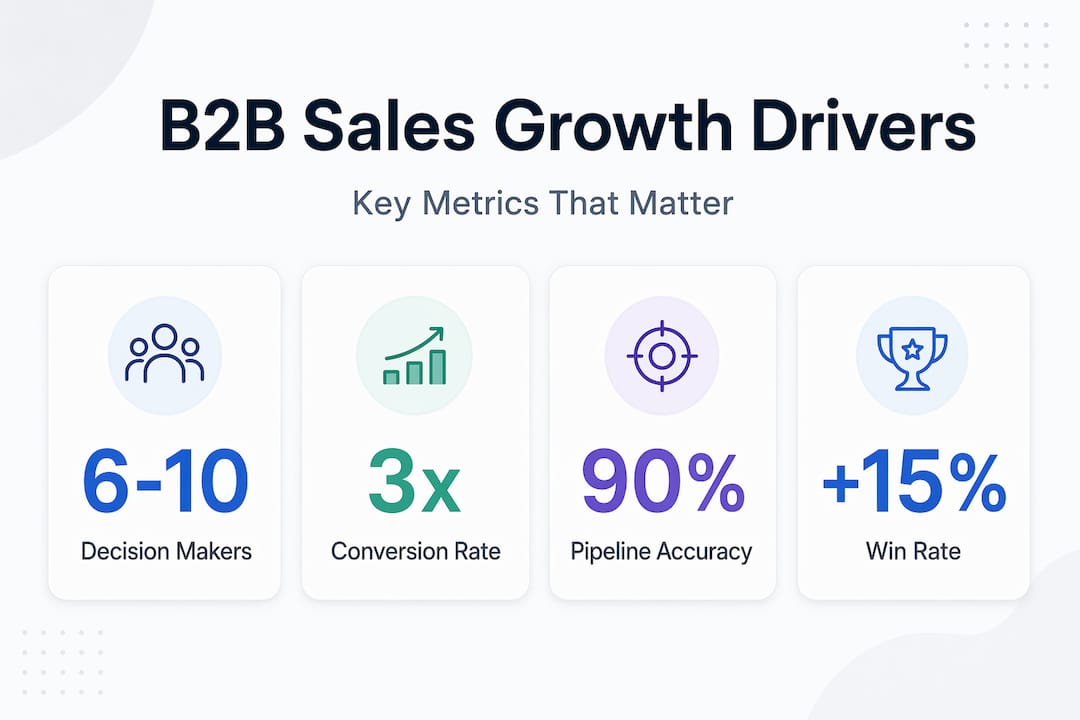
Sales productivity improves when coaching focuses on leading indicators and interaction-based metrics rather than quota attainment alone. Lagging indicators like closed revenue tell you what already happened. Leading indicators tell you where performance is heading in time to do something about it.
Key leading indicators to monitor:
- Lead response time: How quickly reps follow up on new inbound inquiries. Response within the first hour significantly increases conversion rates compared to a same-day response.
- Account engagement score: A composite measure of email opens, content downloads, meeting attendance, and website visits from target accounts.
- Multi-threading rate: The percentage of active deals where your team has relationships with three or more stakeholders. Single-threaded deals are high-risk.
- Discovery-to-demo conversion rate: Measures whether your qualification criteria are catching genuinely interested buyers.
- Pipeline coverage ratio: How much open pipeline exists relative to your revenue target for the period. A common benchmark is 3x to 4x coverage.
- Stage velocity: Average time deals spend in each pipeline stage. Sudden increases in velocity for a given stage often signal a process breakdown.
These metrics feed directly into coaching conversations. Instead of reviewing quota attainment in isolation, managers can ask targeted questions. Why did multi-threading drop this quarter? Which accounts have stalled in the evaluation stage and why? That specificity produces better behavioral change than general performance reviews.
Consistent pipeline movement requires more than activity volume. It requires every next step to be buyer-confirmed, calendar-committed, and tracked. Teams that enforce this standard at the deal level build the forecast confidence that enables faster decisions at the leadership level.
Revenue operations (RevOps) plays a critical role here. A dedicated RevOps function, or even a part-time RevOps practitioner at smaller companies, can design and maintain the analytics infrastructure that connects sales activity data to revenue outcomes. Without that infrastructure, testing improvements becomes guesswork.
Pairing sales measurement with your essential marketing strategies ensures that marketing-generated pipeline is evaluated with the same rigor as outbound sales activity. Both inputs matter and both need to be measured consistently.
Pro Tip: Build pipeline reviews into your weekly team cadence and use data to verify behaviors, not just outcomes. Ask reps to show the evidence for stage classifications, not just confirm deal status verbally. That habit catches problems before they become surprises.
Why most B2B sales growth efforts fail—and the portfolio mindset that works
Bringing it all together, here is what practical experience and the research reveal that is often ignored in theory. Most sales leaders chase the biggest possible deal because it makes intuitive sense. One large win can change the quarter. But that instinct, when it dominates strategy, produces a dangerous pattern. Teams over-invest in unlikely moonshots while neglecting the foundational work that compounds over time.
The more reliable path is a portfolio approach. Rather than betting the quarter on one or two large deals, high-performing teams run several disciplined growth experiments simultaneously. Some bets are incremental improvements to existing processes. Others are new market segments or new outreach sequences. Most will underperform. A few will significantly outperform. The portfolio as a whole builds consistent momentum.
McKinsey's research supports this directly. Practical growth comes from disciplined tracking and a portfolio approach to initiatives, not from sporadic large bets. The companies that win over multiple cycles are those that measure rigorously, cut what does not work early, and double down on what does.
The practical implication is clarity about prioritization. Every growth initiative your team pursues should have a defined hypothesis, a measurement plan, and a decision timeline. Without those three elements, experiments run indefinitely and consume resources without producing insight. That discipline is harder to maintain than most leaders expect, especially under quarterly pressure, but it is what separates compounding growth from cyclical peaks and troughs.
Connecting these findings to your service marketing strategies creates a unified picture. Sales and marketing experiments should be coordinated, measured together, and evaluated against the same growth targets. Siloed experiments produce siloed learning.
The uncomfortable truth is that most B2B sales growth problems are not talent problems. They are system and discipline problems. The talent is usually there. The documentation, the measurement, the coordinated experimentation, and the willingness to cut failing bets early are what most teams lack.
Ready to transform your B2B sales growth?
If you're ready to put these systems into practice, here's where to start. SourcesNova helps small to mid-sized B2B companies build the digital infrastructure that supports consistent, measurable growth. From clarifying your online presence to aligning marketing and sales execution, the work starts with getting the foundations right.
The SourcesNova platform connects strategy with execution, without the bloated retainers or vanity reporting that slow teams down. Whether you need help building a content system that supports your sales process, improving your visibility in target markets, or getting clear on what is and is not working in your current growth approach, SourcesNova brings the structure and hands-on execution that translates frameworks into real results. Explore the services or connect with the team to start building a growth system that holds up quarter after quarter.
Frequently asked questions
What is the most effective way to kickstart B2B sales growth?
Start by defining a repeatable sales play system and align your team around agreed checkpoint stages. B2B sales growth improves with these structured play systems rather than relying on individual rep performance.
How many decision makers do you need to consider in the typical B2B sale?
On average, expect six to ten decision makers in a B2B buying group. Gartner data confirms this range, which means single-contact strategies are likely to stall before reaching the final decision.
Which sales metrics should we prioritize for coaching?
Focus on leading indicators such as lead response time, multi-threading rate, and account engagement scores, as they predict future outcomes. Gartner identifies these interaction-based metrics as more actionable for coaching than lagging indicators like quota attainment.
What is closed-loop feedback in B2B sales?
Closed-loop feedback means insights captured during the sales process are shared systematically with marketing and product teams to refine targeting, messaging, and offers. A sales methodology with a closed feedback loop ensures that learnings compound across every sales cycle rather than staying isolated within individual deals.