
Marketing automation is software that automatically executes targeted marketing actions based on customer data and behavior. 96% of marketers now use some form of automation, achieving an average 5x ROI and saving approximately 27 hours per week. That kind of efficiency is not reserved for enterprise teams with large budgets. This guide to marketing automation breaks down the core components, phased implementation steps, AI-driven advances, and the pitfalls that trip up most small businesses before they see results.
What are the key components of a marketing automation workflow?
Marketing automation works through triggers, workflows, and segmentation working together. A trigger is any customer action or data point that starts an automated sequence. Behavior-based triggers include opening an email, visiting a pricing page, or abandoning a cart. Demographic triggers fire based on attributes like location, job title, or purchase history.
The most effective workflows follow predictable patterns:
- Welcome sequences: A new subscriber receives a 3–5 email series over 7–10 days introducing your brand and value.
- Abandoned cart recovery: A shopper who leaves without buying gets a timed reminder, often with a discount or social proof.
- Lead nurturing: Prospects receive educational content based on where they are in the buying process.
- Re-engagement: Contacts who go quiet for 60–90 days get a targeted campaign to pull them back.
| Workflow | Trigger | Primary goal |
|---|---|---|
| Welcome sequence | New subscriber opt-in | Build trust and set expectations |
| Abandoned cart | Cart left without purchase | Recover lost revenue |
| Lead nurturing | Content download or demo request | Move leads toward a decision |
| Re-engagement | 60+ days of inactivity | Reactivate dormant contacts |
| Post-purchase | Order confirmed | Upsell and collect reviews |
Customer journey mapping sits at the center of all of this. Without a clear map of how a prospect moves from awareness to purchase, your workflows fire in the wrong order or at the wrong time. The shift from isolated task automation to unifying marketing, sales, and customer success with a shared playbook is what separates high-performing automation from a collection of disconnected emails.

Pro Tip: Map your customer journey on paper before you build a single workflow. Identify the three moments where most leads drop off, then build your first automations around those gaps.
How to implement marketing automation in phases for fast ROI
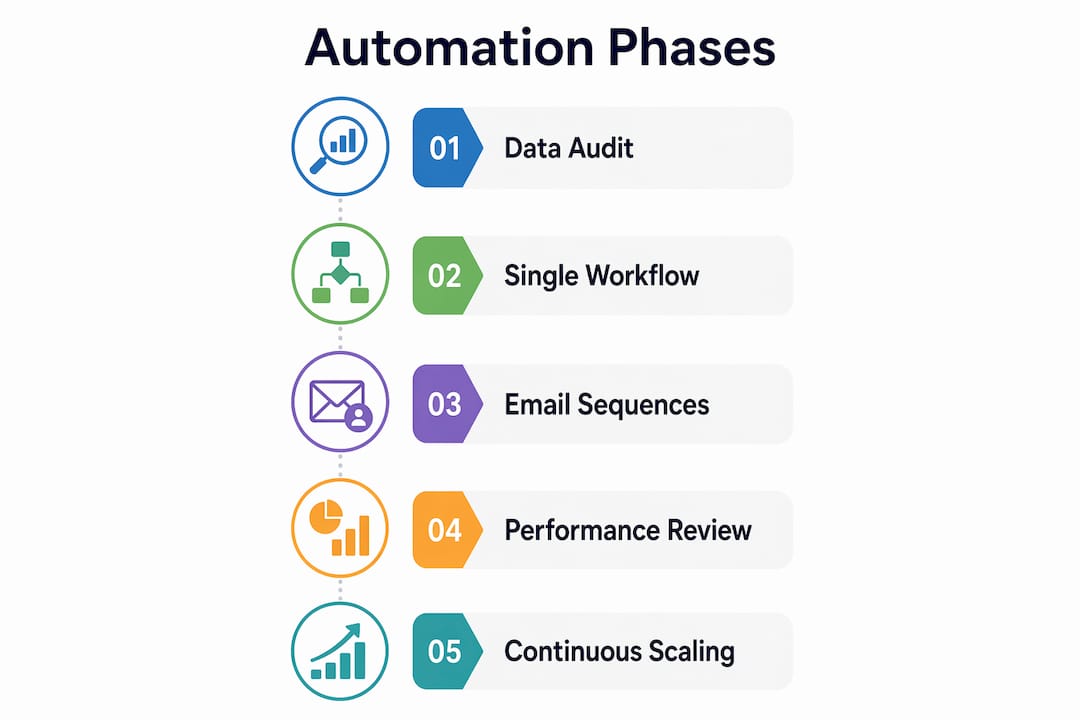
The fastest path to positive ROI is starting with the simplest workflows and adding complexity over time. Implementation follows a three-phase timeline across roughly six months, each phase building on the last.
-
Phase 1 (Weeks 1–4): Data unification and email automation. Connect your CRM, email platform, and website analytics into one data source. Set up your welcome sequence and one lead nurturing track. Focusing on email nurture sequences first yields measurable ROI within 30 days.
-
Phase 2 (Weeks 5–12): AI content and lead scoring. Introduce lead scoring to rank contacts by purchase readiness. Add behavioral triggers for high-intent pages like pricing or case studies. Begin testing AI-generated subject lines and send-time optimization.
-
Phase 3 (Months 3–6): Ad and social automation. Connect paid ad platforms to your CRM so audiences update automatically. Retarget contacts based on email behavior. Advanced content and ad optimization typically takes 60–90 days to compound its benefits.
Poor data quality is the main bottleneck at every phase. 67% of businesses report that messy, siloed data directly hinders their automation effectiveness. That number explains why so many businesses invest in automation tools and see weak results. Clean your contact list before Phase 1, not after.
Marketing strategies for small businesses in 2026 consistently show that businesses who start with one well-built workflow outperform those who try to automate everything at once. Pick the workflow with the clearest revenue connection and build from there.
Pro Tip: Run a data audit before you buy any automation software. Duplicate contacts, missing fields, and inconsistent tagging will break even the best-designed workflow.
What role does AI play in modern marketing automation?
Traditional marketing automation runs on "if-this-then-that" logic. A contact opens an email, so they receive the next email in the sequence. The rule is fixed. The outcome is predictable but static.
AI-native platforms work differently. AI-driven automation systems analyze behavior across large datasets and autonomously adjust campaigns in real time without constant human reconfiguration. That means a contact who reads three blog posts about pricing gets a different next step than one who only opened a welcome email.
Specific AI-driven capabilities that change results in practice:
- Predictive lead scoring: The system ranks leads by their probability of converting, based on behavioral patterns across your entire contact database.
- Adaptive nurturing: Content and messaging shift based on what a contact engages with, not just where they are in a fixed sequence.
- Send-time optimization: The platform identifies when each individual contact is most likely to open an email and sends at that moment.
AI-native marketing automation platforms are moving beyond static triggers, using billions of data points to continuously learn and optimize outcomes.
The catch is that AI performs only as well as the data feeding it. Clean, unified data is the prerequisite. Guardrails also matter. Set rules that prevent AI from sending more than a defined number of emails per week to any single contact. Without limits, AI-driven systems can over-communicate and spike unsubscribe rates. The role of automation in marketing has shifted from simple task execution to real-time decision-making, but human oversight remains the control layer that keeps it on track.
What are the most common marketing automation mistakes?
The most common mistake is trying to build one system that does everything. Integrating 3–5 specialized tools maintains flexibility and performance far better than a single monolithic platform. A dedicated email tool, a CRM, a landing page builder, and an analytics platform each do their job well. Forcing one tool to handle all four creates gaps.
| Common mistake | Best practice |
|---|---|
| Building an all-in-one system | Integrate 3–5 specialized tools |
| Skipping data cleanup | Audit and clean contacts before setup |
| Over-automating email frequency | Cap welcome sequences at 5 emails over 10 days |
| Ignoring team alignment | Align marketing, sales, and customer success on one playbook |
| Setting and forgetting workflows | Monitor performance weekly and adjust triggers |
Welcome sequences capped at 5 emails over 10 days consistently outperform longer sequences in engagement and unsubscribe rates. More emails do not mean more engagement. They mean more opt-outs. The same logic applies to re-engagement campaigns. Three well-timed emails beat ten generic ones every time.
Data-driven marketing requires ongoing monitoring, not a one-time setup. Review your open rates, click rates, and unsubscribe rates every week during the first 90 days. Adjust triggers, subject lines, and timing based on what the data shows.
Pro Tip: Set a calendar reminder to review your top three workflows every 30 days. Automation that worked in january may need adjustment by march as your audience and offers change.
Key takeaways
Effective marketing automation requires clean data, phased implementation, and continuous monitoring to deliver consistent ROI.
| Point | Details |
|---|---|
| Start with email workflows | Welcome and nurture sequences deliver ROI within 30 days and require minimal setup. |
| Clean data first | 67% of businesses cite messy data as the top barrier to automation success. |
| Use specialized tools | Integrating 3–5 focused platforms outperforms any single all-in-one solution. |
| Apply AI with guardrails | AI-driven automation adapts in real time but requires frequency limits to prevent unsubscribes. |
| Align all teams | Marketing, sales, and customer success sharing one playbook separates high performers from the rest. |
What I have learned from building automation systems that actually work
Working with small businesses on marketing automation reveals a consistent pattern. The businesses that see the fastest results are not the ones with the most sophisticated tools. They are the ones who started with one clear goal, built one workflow around it, and measured the outcome before adding anything else.
The biggest mistake I see is treating automation as a technology project instead of a strategy project. Teams spend weeks evaluating platforms and almost no time mapping what they actually want a customer to do. The platform does not matter much if the underlying logic is broken.
AI tools have genuinely changed what is possible for small marketing teams. Predictive lead scoring and send-time optimization used to require a data science team. Now they are features in mid-range platforms. But the businesses getting the most from these tools are the ones who invested in clean data and clear team alignment first. AI amplifies what is already working. It does not fix what is broken.
The advice I give every client is the same: pick the one workflow that, if it worked perfectly, would have the biggest impact on revenue. Build that. Measure it for 30 days. Then build the next one. That approach consistently outperforms the "automate everything" strategy that leads to bloated systems nobody maintains.
— Tran
How Sourcesnova helps you put automation into practice
Sourcesnova works with small and mid-size businesses that want real marketing results without the complexity of managing it alone. If you have read this far and are thinking about where to start, that is exactly the conversation Sourcesnova is built for.
Sourcesnova's team handles the strategy, setup, and ongoing management of digital marketing campaigns so you can focus on running your business. From building your first email nurture sequence to connecting your CRM with paid ad platforms, Sourcesnova brings hands-on execution to every stage. No bloated retainers, no jargon. Just clear work that moves the numbers. Visit Sourcesnova to see how the team approaches lead generation and automation for businesses like yours.
FAQ
What is marketing automation?
Marketing automation is software that executes targeted marketing actions automatically based on customer data and behavior. Common functions include email sequences, lead scoring, and behavioral triggers tied to customer actions.
How much does marketing automation cost for small businesses?
Monthly costs for automation tools range from $99 to $500 depending on the number of integrations and the complexity of workflows. Most small businesses start at the lower end and scale as their needs grow.
What is the fastest way to see ROI from marketing automation?
Starting with email nurture sequences and automated reporting delivers ROI within 30 days. Advanced ad and social automations take 60–90 days to show compounding results.
How is AI-powered automation different from traditional automation?
Traditional automation follows fixed rules. AI-driven systems adapt in real time by analyzing behavioral data across your entire contact base, adjusting messaging and timing without manual reconfiguration.
How many emails should a welcome sequence include?
A welcome sequence should include 3–5 emails sent over 7–10 days. Longer sequences increase unsubscribe rates without improving engagement or conversion.