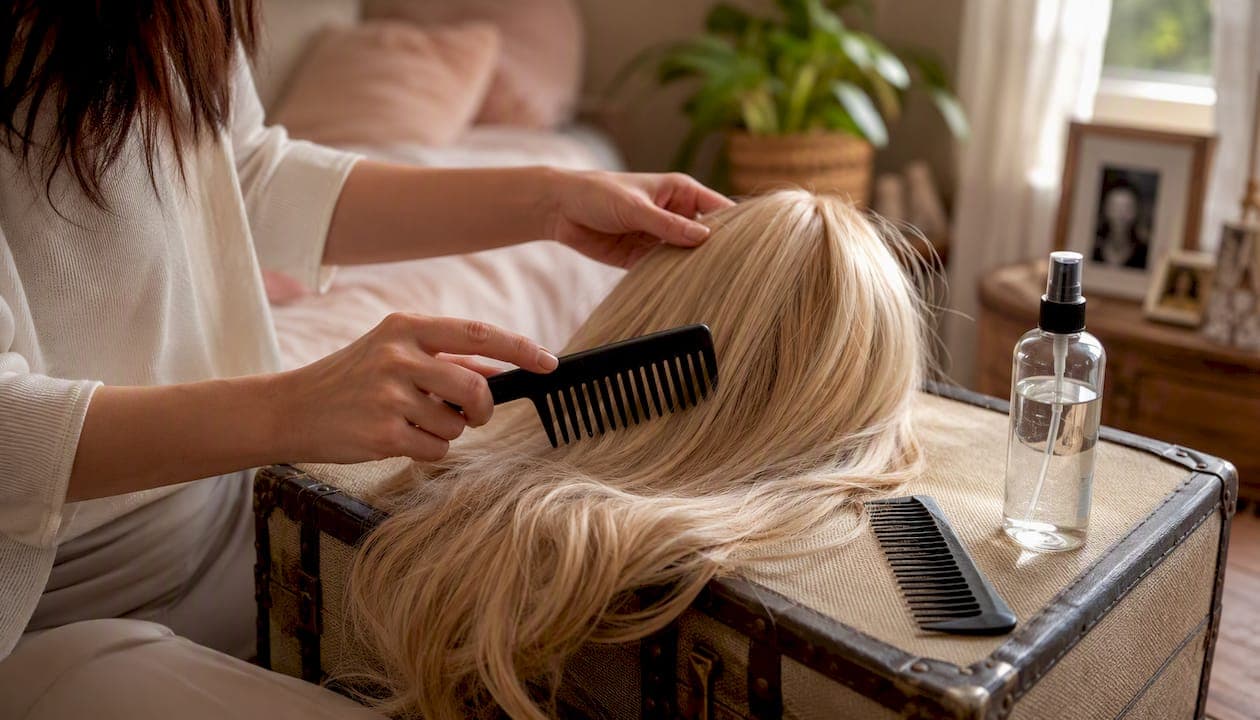
To keep a wig from tangling, use the right brush, apply a light slip product at the ends and nape, detangle from the ends upward, protect friction hotspots, and store on a stand after every wear.
- Before you leave: Brush from ends to roots with a wide-tooth comb or loop brush, then mist ends lightly with a wig-safe detangler.
- While wearing: Pull long hair forward over your shoulder when sitting; check the nape every few hours if you're wearing a high collar or backpack.
- After you take it off: Brush again before storing, place on a wig stand, and loosely braid long wigs to prevent overnight friction.
Key Takeaways
Keeping a wig tangle-free comes down to five consistent habits: the right tools, light slip at friction points, ends-up detangling, proper washing, and stand storage after every wear.
| Point | Details |
|---|---|
| Brush ends to roots daily | Use a loop brush or wide-tooth comb before and after every wear to prevent knot buildup. |
| Protect the nape | Check the nape every few hours and apply a light mist of detangler to the underlayer to counter collar friction. |
| Store on a stand | A wig stand keeps fibers aligned between wears; a satin bag adds protection during travel. |
| Match products to fiber type | Use antistatic and silicone-based slip for synthetics; use lightweight leave-in conditioner for human hair wigs only. |
| Know when to seek help | Widespread matting or brittle fibers signal it's time for professional reconditioning or replacement. |
Table of Contents
- 1. Why wigs tangle: the real causes behind knots and matting
- 2. Daily and pre-use routine to keep your wig tangle-free
- 3. Which tools and products actually reduce tangling?
- 4. How to detangle a wig safely, step by step
- 5. How to wash and dry a wig without creating new tangles
- 6. Best storage and travel practices to prevent tangles
- 7. When tangles become permanent: reconditioning, repair, and replacement
- 8. Why routine care matters more than reactive fixes
- Sources
1. Why wigs tangle: the real causes behind knots and matting
Wigs tangle for a specific set of reasons, and once you understand each one, the prevention steps become obvious.
Fiber type. Synthetic fibers carry a slight electrical charge and lack the natural oils that keep human hair aligned. Human hair wigs lose those oils through washing, which is why conditioning is non-negotiable for them.
Friction. Collars, scarves, coat necks, backpack straps, and even seat belts repeatedly catch the underlayer of a wig. Nape tangling is almost always caused by this friction, not by poor wig quality. Fix: check the nape periodically and apply a very light mist of detangler to that underlayer.

Dryness and product buildup. Human hair wigs dry out between washes; synthetic wigs accumulate product residue that makes fibers sticky and prone to clumping. Washing every 8–12 wears for human hair and every 12–15 wears for synthetic wigs keeps buildup in check without over-stripping fibers.
Environment. Dry air creates static that pulls fibers together; humidity and sweat mat the underlayer from the inside out. Both conditions need different product responses.
Improper storage. Leaving a wig loose in a drawer or bag lets fibers rub against each other for hours. A stand or a soft coil inside a satin bag eliminates that entirely.
2. Daily and pre-use routine to keep your wig tangle-free
A consistent daily routine is the single most reliable wig maintenance technique. Each step takes under two minutes.
Before wear:
- Place the wig on a stand or hold it at the cap.
- Starting at the ends, work upward with a wide-tooth comb or loop brush in small sections.
- Mist ends and the nape area lightly with a wig-safe detangling spray.
- Check the nape underlayer for any small knots and finger-separate them before they tighten.
During wear:
- For long wigs, bring the hair forward over one shoulder when sitting or wearing a backpack.
- Check the nape every two to three hours if you're wearing a high collar, scarf, or coat.
- Carry a mini wide-tooth comb for quick mid-day touch-ups.
After wear:
- Brush from ends to roots before the wig goes on the stand.
- For long wigs, put them in a loose braid or soft twist before storage to prevent overnight tangling.
- Daily brushing before and after wear, storing on a stand, and avoiding rough fabrics at the back of the neck significantly reduce tangling for long and synthetic wigs.
Pro Tip: Cosplayers wearing long wigs at conventions should check the nape every 60–90 minutes. Crowd contact and costume collars create friction faster than everyday wear. A small travel detangler in your bag fixes most mid-event knots in under a minute.
3. Which tools and products actually reduce tangling?
Choosing the right tool for your fiber type prevents the micro-damage that turns a small tangle into a permanent mat.
Tools by fiber type:
- Wide-tooth comb: Safe for both synthetic and human hair; use for initial detangling and mid-day touch-ups.
- Loop/looped-bristle wig brush: Designed specifically for synthetic wigs; the looped bristles flex around knots instead of pulling through them. Use for brushing synthetic wigs safely.
- Paddle brush: Appropriate for straight human hair wigs after initial detangling with a wide-tooth comb.
- Fingers: Always the first tool for curly or wavy wigs, regardless of fiber type.
Products by fiber type:
- Antistatic spray: Use on synthetic wigs in dry climates to reduce electrical charge and flyaways. Apply sparingly before wear.
- Silicone-based detangler: Creates slip at the ends and nape of synthetic wigs, reducing friction. Antistatic spray reduces static cling while silicone-based detanglers create slip; both address different tangling causes and should be used sparingly to avoid buildup.
- Lightweight leave-in conditioner: For human hair wigs only; apply mid-lengths to ends, never at the roots or cap.
- Heavy oils: Avoid on synthetic fibers entirely. On human hair wigs, use only at the ends and only when the wig is noticeably dry.
Pro Tip: Test any new product on a small, hidden section of the wig first. Silicone sprays and oils can leave a tacky residue that attracts more debris and worsens tangling if overused. A light mist from 10–12 inches away is usually enough.
4. How to detangle a wig safely, step by step
When knots form, the goal is to remove them without pulling fibers from the cap or snapping the hair shaft. Patience here protects your investment.
- Secure the wig. Place it on a wig stand or mannequin head. Working on a stable surface gives you both hands free and prevents cap distortion.
- Divide into sections. Clip or separate the wig into four to six manageable sections. Never attack the whole wig at once.
- Finger-detangle first. Starting at the ends of one section, use your fingers to gently separate fibers. Work upward in small increments. This removes the bulk of the knot without tool friction.
- Mist lightly. Apply a small amount of wig-safe detangling spray or plain water to the section. Let it sit for 30 seconds before continuing.
- Wide-tooth comb, ends to roots. The safest detangling method is to work from the ends upward, use fingers first, then a wide-tooth comb, and finish with a wig brush to minimize pulling and shedding. Take your time on resistant knots; hold the hair above the knot to protect the cap.
- Finish with a wig brush. Once the wide-tooth comb passes through cleanly, a loop brush or paddle brush (for human hair) smooths the section.
- Nape matting sub-steps. For the nape underlayer specifically: lift the cap slightly away from the stand to reduce tension, work in very thin layers, mist generously, and use only your fingers and a wide-tooth comb. If a nape mat does not yield after 10–15 minutes of patient work, stop and move to the reconditioning options in the next section.
Pro Tip: If a knot resists the wide-tooth comb after misting, apply a small drop of silicone-based slip product directly to the knot, wait 60 seconds, then try again with your fingers. Forcing the comb through a dry, resistant knot causes fiber breakage that cannot be repaired.
5. How to wash and dry a wig without creating new tangles
Washing is one of the most common moments when tangles form, usually because of rubbing, wrong rinse direction, or skipping conditioner.
Wash sequence:
- Fill a basin with cool or lukewarm water and add a small amount of sulfate-free or wig-safe shampoo.
- Submerge the wig and gently swish it in one direction. Never rub, scrunch, or wring.
- Rinse from the top of the cap downward, keeping water flowing in one direction to preserve fiber alignment.
Conditioning:
- Apply conditioner to mid-lengths and ends only. Avoid the cap and roots; conditioner at the base loosens the knots holding wefts and can cause shedding.
- Leave conditioner on for two to three minutes, then rinse thoroughly in the same top-to-ends direction.
Drying:
- Blot gently with a microfiber towel. Never twist or wring.
- Place on a wig stand to air-dry. Gravity keeps fibers aligned as they dry.
- Avoid heat unless the wig is labeled heat-friendly and you have tested a small section first. For safe heat options on synthetic wigs, the guide on styling synthetic wigs safely covers which tools and temperatures apply.
Wash frequency by fiber type:
| Fiber type | Recommended wash frequency | Key reason |
|---|---|---|
| Human hair wig | Every 8–12 wears | Prevents oil and product buildup; restores moisture |
| Synthetic wig | Every 12–15 wears | Removes residue without over-stripping fiber coating |
6. Best storage and travel practices to prevent tangles
How you store a wig between wears determines how much detangling you need to do before the next one.
Home storage:
- Store on a wig stand or mannequin head to maintain shape and keep fibers aligned.
- Use a breathable fabric cover or a satin bag over the stand to block dust without trapping moisture.
- For long wigs, put them in a loose, low-tension braid or soft twist before placing on the stand. Avoid tight braids that crease fibers.
- Never store in a plastic bag for regular use; trapped moisture promotes matting and odor.
Travel checklist:
- Detangle the wig completely before packing.
- Put it in a loose braid or soft twist.
- Place inside a satin bag or a soft net that does not compress the fibers.
- Pack the wig on top of other items, never underneath heavy clothing.
- Carry a mini wide-tooth comb and a travel-size detangling spray in your bag. Travel habits like bringing hair forward, using a loose braid while commuting, and detangling before packing are key to preventing transit-related matting.
Climate adjustments:
- Dry climates: Add an antistatic spray to your pre-wear routine; static is the primary tangling driver in low-humidity environments.
- Humid climates: Focus on nape moisture management. A light mist of detangler at the nape underlayer before wearing reduces the friction that humidity and sweat amplify.
7. When tangles become permanent: reconditioning, repair, and replacement
Not every tangle responds to a wide-tooth comb and patience. Knowing when to stop home treatment saves time and prevents further damage.
Decision flow:
- Small, localized mats (one or two spots, fibers still intact): continue with home reconditioning steps below.
- Widespread matting across multiple sections or fiber that feels gummy, brittle, or breaks on contact: stop home treatment and consult a professional wig repair service or plan for replacement.
Home reconditioning options:
- Human hair wigs: Apply a deep conditioning mask from mid-lengths to ends, cover with a plastic cap, and leave for 20–30 minutes before rinsing. This restores moisture and loosens tight mats.
- Heat-friendly synthetic wigs: Low-heat steaming (a handheld garment steamer held several inches away) can relax fiber kinks. Test a hidden section first.
- Stubborn localized mats: Careful trimming of the matted section is sometimes the cleanest solution. A small trim is less visible than a permanent bald patch from forced detangling.
Professional wig reconditioning at a salon typically runs $30–$80 depending on wig length and mat severity, while a quality replacement wig for everyday wear ranges from $80 to several hundred dollars. If the cost of repair approaches or exceeds replacement cost, replacement is the practical choice.
Pro Tip: When contacting a professional repair service, describe the fiber type (human hair or synthetic), the location of the matting (nape, ends, crown), and how long the mat has been there. That information lets the technician quote accurately and choose the right treatment without guessing.
8. Why routine care matters more than reactive fixes
The most overlooked aspect of wig care is how little time consistent prevention actually takes. A two-minute brush before and after wear, a quick nape check mid-day, and a proper stand for storage add up to roughly five minutes a day. That five minutes prevents the 45-minute detangling session that most wearers dread.
Long wigs and cosplay pieces are particularly unforgiving. The length multiplies every friction point: a single commute with a backpack can create nape matting that takes three times as long to undo as it took to form. Reactive care is always more expensive in time, product, and wig lifespan than the small habits that prevent the problem.
Sourcesnova's practical content library covers related care topics in detail, from brushing technique to styling safety, for wearers who want to build a complete routine rather than solve one problem at a time.
Sources
The sources below cover the specific topics referenced throughout this guide.
- How to Prevent Wigs from Tangling and Matting – Wig Making Supplies, Tools and Techniques & Information Blog
- How to Stop Your Wig from Tangling: Expert Tips
- How to keep synthetic hair from tangling? - ATMWigs
- How to Detangle a Wig Without Damaging It: Easy Fixes That Actually Work - SkyWigs
- How to Stop a Synthetic Wig from Tangling | Joseph's Wigs