
A MAP pricing policy is a unilateral brand rule setting the lowest price a retailer may advertise for a product, not the price they must charge at checkout. If you sell through third-party retailers or marketplaces, your first three moves are the same regardless of industry: put the policy in writing, have counsel review it before you publish it, and turn on monitoring before your first violation ever happens.
- Draft a written, unilateral MAP document, not a verbal understanding with resellers.
- Consult legal counsel on distribution language before distributing it.
- Enable monitoring across marketplaces and retailer sites from day one.
The FTC's antitrust guidance draws a clear line between manufacturers setting policy alone and manufacturers negotiating price terms with retailers. Sourcesnova works with manufacturers on exactly this handoff from legal draft to operational enforcement, which is where most MAP programs actually break down.
Key Takeaways
A lawful, enforceable MAP pricing policy requires unilateral drafting, documented consistent enforcement, and monitoring tools that turn policy language into detectable violations.
| Point | Details |
|---|---|
| Draft unilaterally | Write and publish MAP terms without negotiating them individually with retailers. |
| MAP controls advertising, not sales | Retailers can still sell below MAP privately as long as they don't advertise it publicly. |
| Use a predictable escalation model | Apply warning, suspension, and termination steps the same way for every retailer. |
| Document every enforcement action | Timestamped evidence protects your legal position and supports fair treatment. |
| Localize policies for other markets | Adapt enforceability and exceptions before applying MAP outside the U.S. |
Table of Contents
- What Is MAP Pricing and How Does It Differ From MSRP?
- Do the Benefits of a MAP Policy Outweigh the Costs?
- Is a MAP Pricing Policy Legal Under U.S. Antitrust Law?
- How Do You Create a MAP Policy Retailers Will Actually Follow?
- What Tools and Workflow Does MAP Enforcement Require?
- How Do Retailers Get Around MAP Pricing Rules?
- What Does a Sample MAP Policy Excerpt Look Like?
- How Can Sourcesnova Help You Operationalize MAP?
- How Does MAP Pricing Work Outside the United States?
- What's the One Thing Most Brands Get Wrong About MAP?
- Sources
What Is MAP Pricing and How Does It Differ From MSRP?
MAP, or minimum advertised price, sets a floor on what a retailer can publicly display or advertise for your product. IMAP (Internet MAP) is the same rule applied specifically to online listings, though most brands today write one policy that covers both. Neither term controls the final transaction price.
That distinction trips up more brand owners than any other part of MAP pricing strategy. A retailer can sell your product below the advertised floor at checkout, in an email quote, or through a private discount code, as long as they never display that lower number publicly. Shopify's guide to MAP pricing confirms this: MAP governs advertised prices, and retailers may still sell at lower final prices provided they don't advertise the lower figure.
MSRP (manufacturer's suggested retail price) is a different animal entirely. MSRP is a suggestion with zero enforcement teeth. MAP is a contractual or policy-based rule with real consequences attached. Compare the two side by side:
- MSRP: Suggested only, no enforcement mechanism, sets a target price point.
- MAP: Enforceable floor on advertising, tied to consequences like suspension or termination, doesn't touch final sale price.
- IMAP: MAP applied specifically to online storefronts, marketplace listings, and digital ads.
The most common workaround you'll encounter is "see price in cart." A retailer lists your product with no visible price, or a price that says "add to cart to see price," and reveals the real number only at checkout. That's not automatically a violation, but it often signals a retailer testing how far they can push before you notice.
Do the Benefits of a MAP Policy Outweigh the Costs?
For most branded manufacturers selling through multiple retail channels, yes. MAP protects brand value by preventing a race to the bottom where retailers undercut each other on advertised price until margins collapse for everyone, including you.
The upside runs in a few directions at once. Retailers who invest in merchandising, product photography, and customer service get protected from being undercut by a reseller doing none of that work. Your product looks more premium when the price is consistent across every storefront a shopper visits. And healthier retailer margins mean partners are more willing to feature your products, run co-op promotions, and stock deeper inventory.
The tradeoffs are real too:
- Some retailers will drop your line rather than comply, shrinking short-term distribution.
- Enforcement takes staff time or a monitoring subscription, an ongoing cost.
- Aggressive discounters may treat your brand as less useful for driving foot traffic or site visits.
Pro Tip: MAP tends to make sense once you have three or more retail partners competing for the same customer online. With one or two channels, the discipline of an enforced policy usually costs more in staff time than it saves in margin protection.
Is a MAP Pricing Policy Legal Under U.S. Antitrust Law?
Yes, when it's structured correctly. The legal foundation goes back to Leegin Creative Leather Products v. PSKS (2007), where the Supreme Court ruled that resale price maintenance agreements aren't automatically illegal under the rule of reason. That ruling opened the door for manufacturers to set advertised-price floors, but it did not open the door to price fixing.
The distinction that matters: a unilateral MAP policy that you write, publish, and enforce on your own is treated differently from an agreement you negotiate with individual retailers. The moment you and a retailer negotiate terms together, you risk crossing into resale price maintenance territory, which draws far more antitrust scrutiny.
Manufacturers should set MAP policies unilaterally and document each enforcement step. Negotiating price terms directly with individual retailers, rather than announcing and applying a policy independently, is what invites antitrust exposure.
That guidance comes straight from the FTC's page on manufacturer-imposed requirements, and it should shape how you write and communicate your policy from the first draft.
A practical compliance checklist:
- Never discuss or negotiate MAP terms one-on-one with a retailer.
- Apply the same consequences to every violator, regardless of account size.
- Keep dated records of every warning, suspension, and termination.
- Watch for FTC rules on unfair or deceptive fees, which can require mandatory fees to appear in the advertised price.
- Loop in legal counsel before publishing the policy and before any termination decision.
How Do You Create a MAP Policy Retailers Will Actually Follow?
A workable MAP policy template needs six core sections. Skip one and you'll find yourself improvising during your first dispute, usually with a retailer who reads contracts closely.
- Effective date and revision process. State when the policy takes effect and how you'll notify retailers of updates, typically with 30 days' written notice.
- Covered products (Appendix A). List every SKU the policy applies to. New product lines get added by amendment, not by assumption.
- MAP price list (Appendix B). Set the actual floor for each SKU, usually a percentage of MSRP, though the specific proportion varies by category and margin structure.
- Prohibited advertising practices. Define what counts as "advertising," including third-party marketplace listings, paid search ads, and social media posts.
- Permitted exceptions and promotional waivers. Specify blackout-free windows (Black Friday, product launches) where temporary suspension is allowed with advance written notice.
- Contact, appeals, and communication process. Give retailers one point of contact for questions and a clear path to dispute a violation notice.
Priceva's MAP policy template guide lays out this same structure and pairs it with a predictable escalation model, which is the piece most first-draft policies skip entirely.
| Clause | What it prevents |
|---|---|
| Covered products list | Disputes over which SKUs the policy applies to |
| MAP price list | Ambiguity about the actual floor per product |
| Prohibited practices | Loopholes like in-cart pricing tricks or vague strikethroughs |
| Promotional waivers | Conflict during Black Friday and launch windows |
| Appeals process | Retailers feeling blindsided by enforcement |
Keep the whole document to a few pages. Retailers ignore policies that read like a legal brief, and a shorter document is easier for your own team to enforce consistently.
What Tools and Workflow Does MAP Enforcement Require?
Manual enforcement works for a handful of SKUs and a small retailer list. Past that, you need automated monitoring, or you'll miss violations for weeks at a time.
The tools worth prioritizing parse your actual policy document into monitoring rules rather than relying on generic price-tracking alone. MAP Policy Partners describes this approach: uploading the policy PDF itself so the platform can flag violations against your specific clauses, not a one-size-fits-all threshold. That cuts down on false positives, which matters when you're deciding whether to send a formal warning.
Evidence matters as much as detection. For every flagged violation, capture:
- A timestamped screenshot of the advertised price.
- The URL and marketplace or retailer name.
- The date and time of detection, stored in a searchable log.
A reasonable monitoring cadence checks major retailers daily and smaller or marketplace sellers weekly, tightening around major sales events when violations spike.
| Enforcement step | Typical timing | Action taken |
|---|---|---|
| First violation | Detected, warning sent | Written notice with evidence attached |
| Second violation | Within 30 days | Formal warning, allocation limits may apply |
| Repeat violation | Beyond 30 days | Suspension of account or order holds |
| Continued noncompliance | After suspension | Termination of retailer relationship |
Pro Tip: Log every warning and response in the same system, even when a retailer fixes the price within hours. A thin enforcement history is the first thing a lawyer or a retailer's counsel will ask about if a dispute ever escalates.
Documenting each action consistently, according to Priceva's enforcement guidance, is what supports both fairness across your retailer base and your legal position if a terminated retailer pushes back.
How Do Retailers Get Around MAP Pricing Rules?
Retailers get creative fast, and most of the workarounds fall into a handful of repeat patterns.
- See-price-in-cart: the listed price is hidden until checkout, technically compliant but often used to mask violations.
- Hidden coupon codes: a public "add to cart" price sits above MAP, but a widely shared code drops it below.
- Misleading strikethrough pricing: a fake "was" price inflates the discount, making the sale price look compliant when the math doesn't hold up.
- Marketplace fee bundling: a seller advertises at MAP but bundles in a mandatory "processing fee" that effectively lowers the advertised total.
Your policy needs explicit language closing each of these gaps: ban strikethrough claims that can't be substantiated, define "advertised price" to include any coupon visible without an account login, and specify that mandatory fees count toward the advertised total. Monitoring tools should flag price drops tied to detectable coupon codes and fee structures, not just the sticker price.
What Does a Sample MAP Policy Excerpt Look Like?
Here's a condensed, adaptable excerpt covering the clauses that matter most:
- Effective Date: This policy is effective January 1, 2026, and supersedes all prior versions.
- Covered Products: Applies to all SKUs listed in Appendix A, updated quarterly.
- MAP Definition: The minimum price at which covered products may be advertised, displayed, or promoted in any public medium.
- Prohibited Practices: Advertising below MAP through strikethrough pricing, publicly visible coupon codes, or bundled fee structures that reduce the effective advertised price.
- Permitted Exceptions: Written waiver requests submitted 14 days in advance for approved promotional windows.
- Enforcement: Violations result in the escalation sequence below, applied uniformly to all retailers.
| Stage | Timing | Consequence |
|---|---|---|
| First warning | Immediate on detection | Written notice, 5 days to correct |
| Suspension | If uncorrected after 30 days | Order holds, no new allocation |
| Termination | Second violation within one year | End of retailer relationship |
The waiver clause matters more than it looks. Mailchimp's MAP pricing guidance recommends advance written notice with fixed start and end dates for promotional windows, which prevents the single most common dispute: a retailer claiming they thought a sale event was fair game.
How Can Sourcesnova Help You Operationalize MAP?
Writing a MAP policy is the easy part. Getting a distributed retailer network to actually follow it, especially across marketplaces you don't control directly, is where most manufacturers entering the U.S. market get stuck.
Sourcesnova supports Asian manufacturers and consumer brands building North American distribution with the pieces that connect a MAP policy to real enforcement:
- Distributor and retailer matching that builds a channel worth protecting in the first place.
- Compliance consulting to align pricing policy with U.S. market entry strategy.
- Website and e-commerce builds that make advertised pricing consistent across your own storefront.
A sensible pilot sequence looks like this: legal review of your draft policy, a small SKU test group with your top three or four retailers, then scale enforcement once monitoring rules are tuned. If you're entering the U.S. market and need pricing strategy folded into your broader channel plan, Sourcesnova's market entry services are built for exactly that handoff.
How Does MAP Pricing Work Outside the United States?
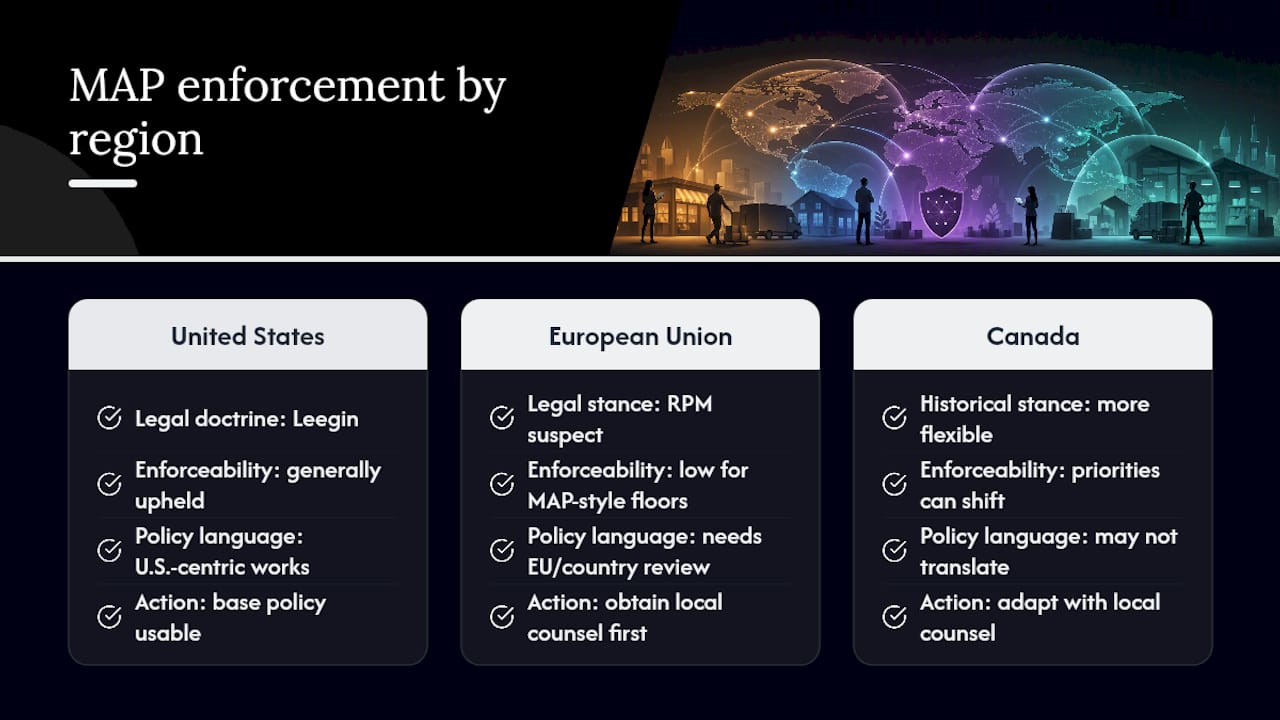
MAP policy enforcement doesn't travel the same way everywhere. The Leegin framework that protects unilateral MAP policies in the U.S. is an American antitrust doctrine, and it doesn't automatically apply once your distribution crosses into other markets.
The European Union treats resale price maintenance with more suspicion than U.S. law does. EU competition rules generally classify RPM, including MAP-style advertised-price floors, as a "hardcore restriction" under vertical agreement block exemptions, meaning the unilateral defense that works in the U.S. carries far less weight there. Manufacturers selling into EU markets need country-specific or EU-wide legal review before applying the same policy language.
Canada's Competition Act has historically treated price maintenance more flexibly than older versions of EU law, but enforcement priorities shift, and a policy written for U.S. retailers won't automatically translate into compliant language for Canadian distributors.
The practical takeaway for manufacturers building multi-region distribution: never assume one MAP document covers every market. Build a base policy structure, then have local counsel adapt the enforceability language, permitted exceptions, and escalation consequences market by market. A policy that's rock solid in the U.S. can create real legal exposure if applied verbatim to a European or Canadian retailer network without that review.
What's the One Thing Most Brands Get Wrong About MAP?
Most brand owners treat MAP as a legal document problem. It's actually an operations problem wearing a legal costume.
The research bears this out again and again: the policies that hold up aren't the ones with the most airtight clauses, they're the ones backed by consistent monitoring and an escalation cadence nobody skips for a big account. I'd argue the conventional advice, spend months perfecting policy language before you touch enforcement, has the sequence backward. A shorter, looser policy enforced consistently beats a bulletproof policy enforced sporadically, every time.
Where I'd push back hardest: treating every violation the same way regardless of retailer size. Brands that quietly let a major retailer slide while terminating a small one over the identical violation aren't just risking retailer relationships, they're undermining the "unilateral and consistent" standard that keeps MAP policies on the right side of antitrust law in the first place.
If you're starting from zero, don't start with the document. Start with the monitoring question: how will you actually know when someone breaks the rule? Everything else follows from that answer.
— Tran
Sources
- Antitrust laws | Federal Trade Commission (FTC)
- MAP Policy Template: Free Sample & Enforcement Guide | Priceva