
Market positioning is defined as the strategic process of shaping how a target customer perceives your brand or product relative to competitors. It is not what you do to a product. Positioning frames the product within a customer's mind to win comparison battles against competitors or the status quo. Every pricing decision, marketing message, and product feature flows from this single strategic choice. Frameworks like S-T-P (Segmentation, Targeting, Positioning), developed and popularized by marketing scholars including Al Ries and Jack Trout, give businesses a structured way to claim and defend that mental space.
What is market positioning and why does it matter?
Market positioning is the deliberate act of defining where your brand stands in the minds of your target customers. Most marketing professionals) use the S-T-P framework to structure this process: segment the market, identify the right target, then define a position that resonates with that segment. Without this foundation, pricing, messaging, and product decisions lack direction. The result is wasted budget and confused customers.
The importance of market positioning extends beyond marketing. It shapes how you hire, how you price, and which product features you build. A company that positions itself as the most reliable option for small retailers will make different operational decisions than one positioned as the lowest-cost supplier. Positioning is the internal compass that keeps every department aligned.

Trying to be everything to everyone dilutes market ownership of any specific benefit or category. Brands that avoid a clear position end up competing on price by default. That is the fastest path to commoditization and shrinking margins.
What are the key frameworks and components of market positioning?
The S-T-P framework is the most widely used structure for building a market position. Segmentation divides the total market into groups with shared needs. Targeting selects the segment where your offer has the strongest fit. Positioning defines the specific place you want to occupy in that segment's mind.
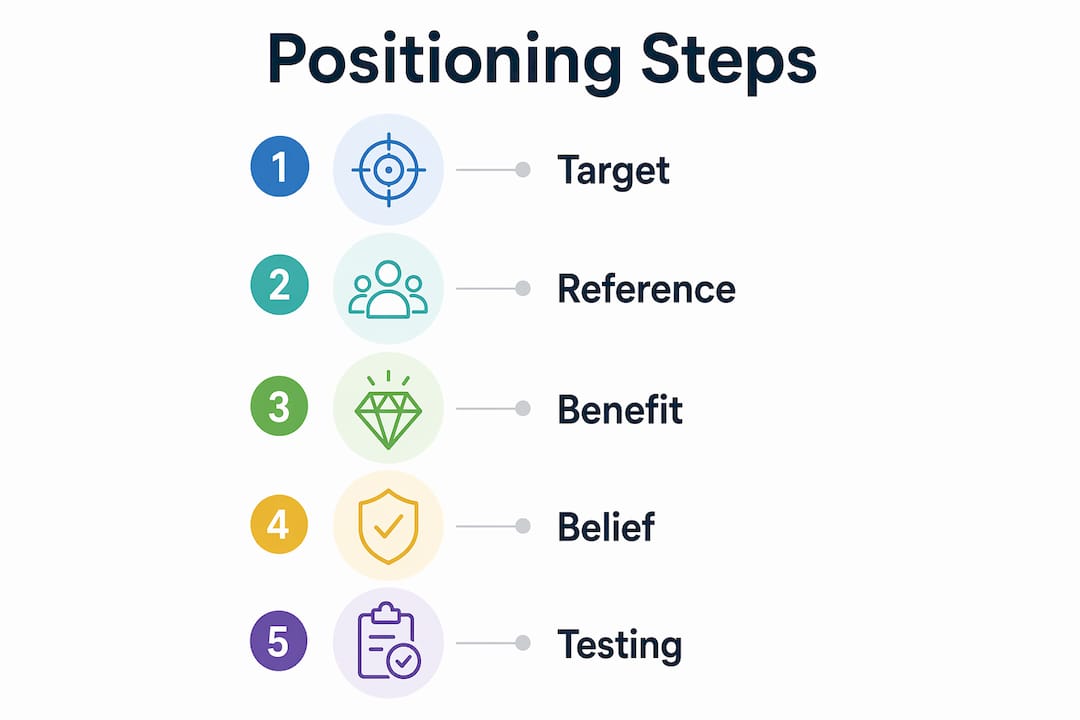
Within positioning itself, four components define the structure:
- Target customer: Who specifically you are serving, defined by behavior, need, or context, not just demographics.
- Frame of reference: The product category you compete in. Defining the frame of reference prevents customers from defaulting to the cheapest alternative when they cannot categorize your offer.
- Primary benefit: The single most compelling reason your target customer should choose you over alternatives.
- Reason to believe: The proof point that makes your primary benefit credible, such as a patent, a process, or a track record.
A common pitfall is writing a positioning statement that is too broad. "We help businesses grow" is not a position. It is a category. A strong position names a specific customer, a specific benefit, and a specific reason that benefit is real.
Pro Tip: Write your positioning statement in one sentence and test it by reading it aloud to someone outside your company. If they cannot immediately understand who you serve and why you are different, rewrite it.
| Element | What it defines |
|---|---|
| Target customer | The specific segment you serve |
| Frame of reference | The category you compete in |
| Primary benefit | Your single strongest differentiator |
| Reason to believe | The proof that makes your claim credible |
What are common types of market positioning strategies?
Businesses use several distinct positioning strategies depending on their strengths and market conditions. Each type targets a different driver of customer preference.
- Value-based positioning: Competes on price or quality. Budget airlines like Spirit position on low cost. Luxury brands like Apple position on premium quality and design. Both are value-based, but they occupy opposite ends of the spectrum.
- Benefit-driven positioning: Centers on a specific functional or emotional outcome. Volvo has owned "safety" as a benefit for decades. FedEx built its brand on "overnight delivery guaranteed."
- Competitive positioning: Defines your brand directly against a named competitor or category leader. Pepsi's long-running campaigns against Coca-Cola are a textbook example of this approach.
- Niche positioning: Targets a narrow, underserved segment. A software company that serves only dental practices is niche-positioned. It trades total addressable market size for deep relevance and lower competition.
- Usage-based positioning: Ties the product to a specific occasion or context. Gatorade does not just sell hydration. It sells hydration for athletic performance.
| Strategy type | Best used when | Risk |
|---|---|---|
| Value-based | Price or quality is your clearest edge | Price wars if cost-focused |
| Benefit-driven | One benefit is clearly superior | Competitors can copy the benefit |
| Competitive | You have a direct, weaker rival | Elevates the competitor's visibility |
| Niche | Segment is underserved and loyal | Limited growth ceiling |
| Usage-based | Occasion drives purchase decisions | Narrow relevance outside the occasion |
Choosing the right strategy depends on where your business has a defensible advantage. A small retailer competing against national chains will rarely win on price. Niche or benefit-driven positioning gives smaller businesses a more durable edge.
How do you develop an effective positioning statement?
A positioning statement is an internal document, not a tagline. An effective statement guides internal alignment, not marketing copy. It answers four questions: Who is the target? What category do you compete in? What is the primary benefit? Why should the customer believe it?
Follow these steps to build one:
- Define your target customer precisely. Go beyond age and income. Describe the specific problem they face and the context in which they face it.
- Name your frame of reference. State the category clearly. Customers use categories to make comparisons. If you skip this step, they will place you in the wrong one.
- Identify your single strongest benefit. Resist the urge to list three or four benefits. One clear benefit is more memorable and more defensible than a list.
- Provide a reason to believe. Back the benefit with evidence. This could be a proprietary ingredient, a certification, a customer success rate, or years of specialized experience.
- Write the statement in one sentence. Use this structure: "For [target customer] who [need or problem], [brand] is the [frame of reference] that [primary benefit] because [reason to believe]."
- Test it internally. Share it with your sales, product, and customer service teams. If they cannot use it to make decisions, it is too vague.
Pro Tip: Revisit your positioning statement every 12 months. Markets shift, competitors move, and customer needs evolve. A position that was accurate two years ago may no longer reflect your strongest advantage.
A weak positioning statement looks like this: "We provide high-quality solutions for businesses of all sizes." A strong one looks like this: "For independent hardware retailers with fewer than 10 employees, BrandX is the inventory software that prevents stockouts because it integrates directly with the top 5 wholesale distributors."
Why is market positioning crucial for pricing and competitive advantage?
Effective positioning builds pricing power. Consumers pay a premium for perceived unique value, which reduces reliance on price competition. Price competition consumes a disproportionate share of marketing budgets in crowded sectors. A business with a clear, owned position avoids that trap entirely.
The connection between positioning and profitability is direct. Positioning is foundational for competitive pricing and allows businesses to avoid commoditization. When customers see your product as the only one that delivers a specific benefit, price becomes a secondary factor in their decision.
Consistent brand positioning over time compounds commercial performance more than any single campaign or slogan. Stable positioning builds price, loyalty, and repeat purchase advantages that accumulate year over year. A business that repositions every 18 months never builds that equity.
"Positioning is not a campaign. It is a compounding asset. Every consistent message you send adds to the mental real estate you own in your customer's mind."
The benefits of a well-held position include:
- Higher average transaction values because customers are not comparing you on price alone.
- Lower customer acquisition costs because your message attracts the right buyers from the start.
- Stronger retention because customers who chose you for a specific reason stay loyal to that reason.
- Clearer marketing briefs that reduce wasted creative and media spend.
How can businesses apply positioning to marketing and product strategy?
Positioning becomes useful only when it drives real decisions. Brand positioning influences every commercial touchpoint with a defined stance on who you serve, what you offer, and why it matters. That means it must show up in your ad copy, your website headlines, your sales scripts, and your product roadmap.
Practical application starts with messaging. Every piece of content you publish should reinforce the same core benefit. A brand positioned on reliability should not run a campaign about being the cheapest option. Inconsistency erodes the position faster than any competitor can.
Product decisions follow the same logic. If your position is built on ease of use, every new feature should pass a simplicity test before it ships. Defining your unique value before launching marketing prevents wasted budgets and missed customer preferences. Market research validates whether your claimed position matches what customers actually value.
For digital brand presence, consistency across channels is the execution standard. Your Google Business Profile, your social media bio, and your homepage headline should all reflect the same position. Customers encounter your brand across multiple touchpoints. Each one either reinforces or undermines the position you are trying to own.
Key Takeaways
Effective market positioning is the single most important strategic decision a business makes, because it determines pricing power, marketing efficiency, and long-term competitive advantage.
| Point | Details |
|---|---|
| Define your position clearly | Use the S-T-P framework to segment, target, and claim a specific mental space. |
| Build a precise positioning statement | Include target customer, frame of reference, primary benefit, and reason to believe. |
| Choose the right strategy type | Match your positioning type to your strongest defensible advantage, not your aspirations. |
| Use positioning to set prices | A clear position reduces price competition and supports premium pricing. |
| Apply it consistently across channels | Every touchpoint must reinforce the same core benefit to build lasting equity. |
The trap most businesses fall into with positioning
Most businesses treat positioning as a marketing exercise. They write a tagline, update the website, and move on. That is the wrong approach, and I have seen it fail repeatedly across industries from retail to B2B services.
The real work of positioning happens internally. A clear, internal positioning statement is critical for marketing consistency and business alignment. When your sales team, your product team, and your marketing team all operate from the same positioning statement, your customer experience becomes coherent. When they do not, every department pulls in a different direction and the customer feels the confusion.
The second trap is trying to own too much. A brand that claims to be affordable, premium, fast, and reliable all at once owns nothing. Pick the one benefit your business can defend better than anyone else in your specific market. Then repeat it until it sticks.
Positioning also needs to be revisited, not just written once. Markets shift. Competitors copy your differentiators. Customer priorities change. The businesses that maintain strong positions are the ones that treat positioning as a living document, not a one-time deliverable. Review it annually. Test it with real customers. Adjust when the evidence demands it.
— Tran
How Sourcesnova helps you build a position that holds
Positioning without execution is just a document. Sourcesnova works with small and mid-size businesses to translate positioning strategy into marketing that drives growth, from messaging frameworks to digital campaigns that consistently reinforce your brand's core benefit.
Sourcesnova's team handles the full process: market research to validate your position, messaging development to express it clearly, and channel execution to deliver it consistently. Whether you are entering a new market or repositioning an existing brand, Sourcesnova provides the strategy and hands-on execution that small businesses need without the bloated retainers. Visit sourcesnova.com to connect with the team and get started.
FAQ
What is the definition of market positioning?
Market positioning is the strategic process of shaping how a target customer perceives your brand or product relative to competitors. It determines where your brand sits in the customer's mind within a specific product category.
What is the difference between market positioning and brand positioning?
Market positioning defines where a product or company stands relative to competitors in a given category. Brand positioning focuses specifically on the emotional and functional associations a brand builds with its audience over time. The two concepts overlap significantly and are often used interchangeably in practice.
What are the four elements of a positioning statement?
The four elements are target customer, frame of reference (product category), primary benefit, and reason to believe. An effective positioning statement guides internal alignment rather than serving as external marketing copy.
Why does consistent positioning matter for pricing?
Consistent brand positioning builds price, loyalty, and repeat purchase advantages that compound over time. Customers who associate a brand with a specific, credible benefit are less likely to compare it on price alone.
How often should a business revisit its market positioning?
A business should review its positioning at least once a year. Markets shift, competitors evolve, and customer priorities change. A position that was accurate two years ago may no longer reflect your strongest competitive advantage.