
Video marketing steps are the structured stages marketers and business owners follow to plan, produce, distribute, and measure video content that drives real business results. Skipping steps or starting with creative before strategy is the most common reason campaigns underperform. This guide covers the full video marketing process, from setting objectives to reading analytics, with 2026-specific guidance on AI tools, platform optimization, and content architecture. Tools like Adobe, Wistia, and AI-driven platforms have reshaped how teams execute each stage. Follow these steps and your video content will work harder for your brand.
What are the core video marketing steps for an effective strategy?
A goal-first approach is the most effective framework for video marketing. Your objectives must dictate your video format and funnel placement before a single frame is shot.
Step 1: Define your objectives and KPIs

Start by naming the business outcome you want. Awareness campaigns call for reach and view metrics. Conversion campaigns need click-through rates and sign-up counts. Without a defined goal, you cannot choose the right format, platform, or length. Align every KPI to a funnel stage before production begins.
Step 2: Research your audience
Know who you are making the video for before you decide what to say. Identify the platforms your audience uses, the questions they ask, and the content formats they prefer. A B2B buyer on LinkedIn responds to case studies and thought leadership. A consumer on TikTok responds to fast, entertaining clips. These are different videos entirely.
Step 3: Set your budget and workflow
Establish a realistic production budget and decide who owns each task. Many teams now blend in-house production with AI tools to reduce costs. Assign roles for scripting, filming, editing, and distribution before you start. A clear workflow prevents bottlenecks and keeps output consistent.
Step 4: Choose your content pillars
Content pillars organize your video themes into repeatable categories. Common pillars include educational content, product demonstrations, customer testimonials, and behind-the-scenes footage. Pillars give your channel a consistent identity and make planning future videos faster.
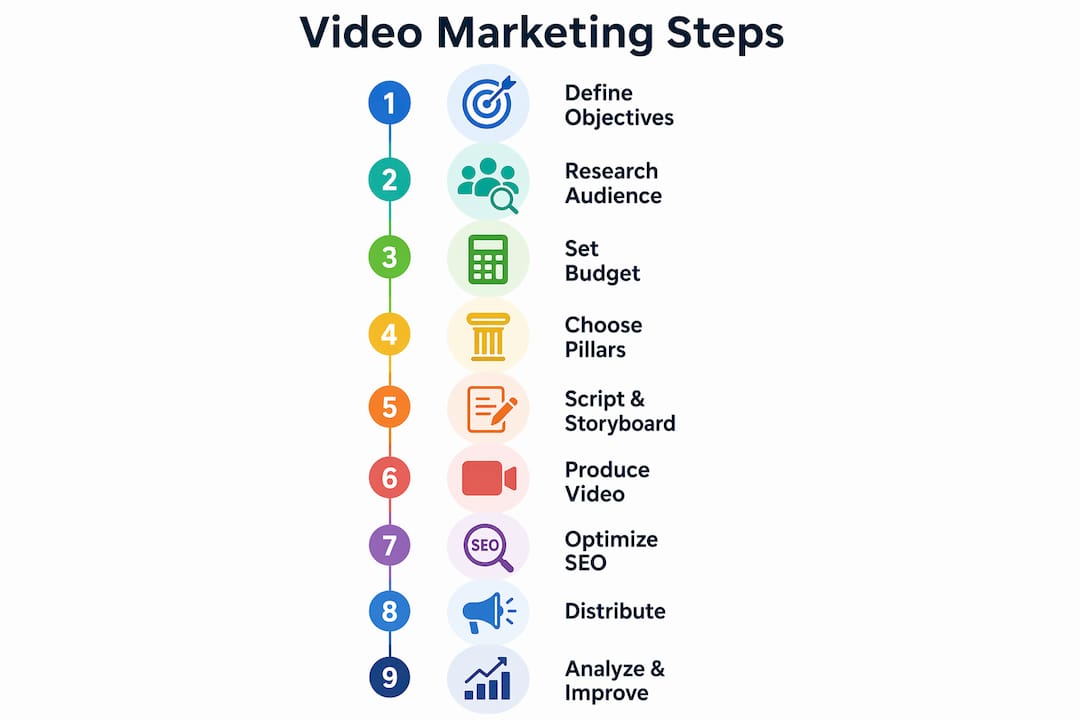
Step 5: Write your script and storyboard
Every effective video starts with a written plan. Your script should open with a hook in the first three seconds, deliver the core message in the middle, and close with a clear call to action. Storyboarding maps out the visual sequence so your production team knows exactly what to shoot.
Step 6: Produce your video
Shoot with your distribution platform in mind. Mobile-first platforms like Instagram Reels and TikTok require vertical framing. YouTube favors horizontal. Up to 50% of mobile users watch videos with sound off, which means captions are not optional. Add them during editing, not as an afterthought.
Pro Tip: Record a 16:9 and a 9:16 version of your key content in the same session. You get two platform-ready formats without doubling your production time.
Step 7: Optimize for each platform and SEO
Each platform has its own algorithm and audience behavior. Optimize your video title, description, and tags with keywords your audience searches. Transcripts, extended descriptions, and timestamps act as essential metadata for search engine indexing. A well-optimized video on YouTube can generate organic traffic for years.
Step 8: Distribute and promote
Publishing is not promoting. Share your video across owned channels, embed it in email campaigns, and run paid distribution where your budget allows. Repurposing is a force multiplier. One core video can yield 3–5 social clips, extending your reach without starting from scratch each time.
Step 9: Track, analyze, and improve
Pull your performance data weekly. Identify where viewers drop off, which thumbnails drive clicks, and which calls to action convert. Use that data to adjust your next video. Video marketing is not a set-and-forget channel. It rewards teams that iterate.
How does AI transform video marketing workflows in 2026?
In-house video creative teams have grown 52% year-over-year, and AI is the primary reason smaller teams can now match the output of larger ones. The shift is not about replacing human creativity. It is about removing the slow, repetitive parts of production.
AI tools now assist with:
- Scriptwriting. Tools generate first drafts from a brief, cutting scripting time significantly.
- Editing and clipping. AI identifies the strongest moments in long recordings and assembles short clips automatically.
- Captions and transcription. Automated captioning tools produce accurate transcripts in minutes, not hours.
- Dubbing and localization. AI dubbing tools translate and lip-sync video for new markets without reshooting.
- Accessibility. Auto-generated captions and audio descriptions make content compliant and reach broader audiences.
62% of marketers report using AI in video production processes in 2026. That number reflects a real shift in how marketing teams are structured, with individual contributors now expected to hold multimedia production skills alongside traditional marketing competencies.
The risk with AI is over-reliance. AI-generated scripts often lack the specific customer insight that makes a video resonate. Use AI to handle the mechanical work. Keep a human in charge of strategy, tone, and audience understanding. For a broader look at how automation fits into your marketing stack, the role of automation in marketing is worth understanding before you build your workflow.
Pro Tip: Run your AI-generated script through a real customer conversation before production. If a customer would not say it that way, rewrite it.
What are the best practices for video optimization and platform fit?
The first three seconds of your video determine whether anyone watches the rest. Avoid brand intros and logos upfront. Open with visual tension, a surprising statement, or a direct payoff. Give viewers a reason to stay before you ask them to care about your brand.
Platform format comparison
| Platform | Aspect ratio | Ideal length | Key priority |
|---|---|---|---|
| YouTube | 16:9 | 7–15 minutes | SEO, retention, depth |
| TikTok | 9:16 | 15–60 seconds | Hook speed, entertainment |
| Instagram Reels | 9:16 | 15–90 seconds | Visual quality, captions |
| 16:9 or 1:1 | 1–3 minutes | Authority, professional tone | |
| 16:9 or 1:1 | 1–5 minutes | Captions, community focus |
Pacing also varies by platform. TikTok rewards fast cuts and high energy. LinkedIn rewards a slower, more deliberate delivery. Posting the same video across all channels without adapting it is one of the most common mistakes in video content marketing.
Captions are now a baseline requirement, not a nice-to-have. Designing videos first for silent viewing is the standard for modern engagement. Every key message must be readable on screen, not just audible. This also improves SEO, since caption text is indexed by search engines.
For video SEO specifically:
- Write descriptions of 200 words or more with natural keyword inclusion.
- Add timestamps for videos longer than three minutes to aid navigation and indexing.
- Use your primary keyword in the video file name before uploading.
- Include a transcript in the description or as a pinned comment on YouTube.
Captions improve reach and SEO significantly because they give search engines text to index and give viewers a reason to stay when audio is unavailable. Both outcomes directly support your distribution goals.
How do you measure video marketing success and improve over time?
Metrics like completion rate, click-throughs, conversion rates, and retention are the key indicators aligned to marketing funnel stages. Tracking the wrong metric for your goal is as damaging as not tracking at all.
| Funnel stage | Primary metric | What it tells you |
|---|---|---|
| Awareness | View count, reach | How many people discovered the content |
| Consideration | Watch time, completion rate | How engaged viewers are with your message |
| Conversion | Click-through rate, sign-ups | Whether the video drives the desired action |
| Retention | Return views, subscriber growth | Whether your audience is building loyalty |
Drop-off rate is the most underused metric in video analytics. If 70% of viewers leave at the 30-second mark, your hook worked but your core message failed. That is a scripting problem, not a distribution problem. Fix the content before you spend more on promotion.
Review your analytics on a set schedule, weekly for active campaigns and monthly for evergreen content. Compare videos within the same content pillar to identify patterns. A video that outperforms its peers on completion rate tells you something about format, length, or topic that you should repeat.
Pro Tip: Build a simple tracking spreadsheet with one row per video. Log the publish date, platform, goal, and key metric. After 10 videos, patterns become visible that no single video would reveal.
Content-based strategies chasing viral trends produce vanity metrics, while strategy-based approaches aligned with customer pain points drive revenue and leads. High view counts mean nothing if they do not move people toward a business outcome. Keep your KPIs tied to the goals you set in step one.
Key Takeaways
Effective video marketing requires a goal-first framework where objectives, audience research, and platform strategy drive every production and distribution decision.
| Point | Details |
|---|---|
| Start with business goals | Define KPIs before scripting or shooting any video content. |
| Hook in three seconds | Open with tension or payoff, not brand logos or lengthy intros. |
| Captions are mandatory | Half of mobile viewers watch without sound; caption every video. |
| Repurpose core content | One pillar video can generate 3–5 platform-ready clips. |
| Match metrics to funnel stage | Use completion rate for awareness and conversion rate for sales goals. |
What I have learned from building video strategies that actually work
The biggest mistake I see marketers make is treating video as a creative exercise rather than a business tool. Teams spend weeks on production quality and almost no time on distribution or measurement. A beautifully produced video with no clear goal is an expensive way to get views that go nowhere.
The shift that changes everything is moving from content creation to content architecture. When you produce one strong pillar video and plan its repurposing from the start, you get more output from less effort. A 10-minute YouTube video becomes five LinkedIn clips, three Instagram Reels, and a podcast-style audio file. That is not cutting corners. That is working with intention.
AI tools have made this easier, but they have also created a new trap. Marketers who let AI write their scripts without grounding them in real customer language end up with polished content that nobody connects with. The best use of AI is to handle the mechanical work so your team has more time to think about the audience.
Building internal video skills is worth the investment. Teams that can produce, edit, and publish without waiting on an agency move faster, test more, and learn more. Speed of iteration is a real competitive advantage in video marketing. The teams winning in 2026 are not the ones with the biggest budgets. They are the ones who publish consistently, read their data honestly, and adjust quickly.
— Tran
How Sourcesnova helps you execute your video marketing strategy
Sourcesnova works with local and small-to-mid-size businesses that want real marketing results, not vanity reports. If you are ready to put these video marketing steps into practice but need a team behind you, Sourcesnova provides clear strategy and hands-on execution across content, distribution, and analytics.

From building your content pillars to setting up tracking that actually connects to revenue, Sourcesnova treats your business like its own. Whether you are starting your first video campaign or scaling an existing one, explore small business marketing strategies that complement your video efforts, or visit Sourcesnova to talk through your specific goals with a team that delivers.
FAQ
What are the first steps in a video marketing strategy?
Define your business objective and identify your audience before any production begins. A goal-first approach ensures your video format, platform, and message align with the outcome you want.
How long should a marketing video be?
Length depends on the platform and goal. YouTube performs well at 7–15 minutes for depth, while TikTok and Instagram Reels work best at 15–90 seconds. Match length to where your audience is and what action you want them to take.
Why are captions required for video marketing in 2026?
Up to 50% of mobile users watch videos with sound off. Captions keep your message accessible and also improve SEO by giving search engines text to index.
How do I measure whether my video marketing is working?
Track metrics by funnel stage. Use completion rate for awareness videos, click-through rate for consideration, and conversion rate for sales-focused content. Completion rate, click-throughs, and retention are the core indicators that reveal whether your content is doing its job.
How does AI fit into the video production process?
AI handles scriptwriting drafts, automated captioning, clip editing, and dubbing. 62% of marketers use AI in video production in 2026. Use it for mechanical tasks and keep human judgment in charge of strategy and audience insight.