
SEO, or Search Engine Optimization, is the practice of improving your website's visibility in organic search results to attract more targeted customers. Understanding why SEO matters is the first step toward building a business that gets found online without paying for every click. Organic search drives approximately 47% of web traffic and converts at 2.4% compared to 1.3% for paid search. That gap is not trivial. It means SEO traffic is both larger in volume and more likely to turn into paying customers.
Why SEO matters: visibility, traffic, and business growth
SEO improves your position in Google and other search engines so that buyers find you when they are actively looking. That intent is what separates organic traffic from almost every other marketing channel. A person searching "best nail salon near me" or "lighting supplier in Chicago" is ready to act. SEO puts your business in front of them at exactly that moment.
The compounding effect of SEO is one of its most underrated advantages. Paid advertising stops the moment your budget runs out. SEO builds authority over time, and a well-ranked page continues to attract visitors for months or years without additional spend. This long-term return is why many business owners who understand the importance of SEO treat it as a core investment rather than an optional line item.
The benefits of SEO extend beyond traffic volume:
- Higher conversion rates. Organic search converts at 2.4% versus 1.3% for paid search, meaning SEO visitors are nearly twice as likely to take action.
- Lower cost per acquisition over time. Once a page ranks, the cost to maintain that ranking is far lower than running continuous paid campaigns.
- Brand credibility. Appearing at the top of search results signals authority to buyers. Most people trust organic results more than ads.
- Qualified traffic. SEO targets buyers by keyword intent, so the visitors you attract are already interested in what you sell.
Pro Tip: Pair your SEO investment with a clear conversion strategy. Ranking well means nothing if your landing page does not give visitors a clear reason to contact you or buy.
Why local SEO matters for small and multi-location businesses
Local SEO is the practice of optimizing your online presence to attract customers from a specific geographic area. For small businesses and service providers, the advantages of local SEO are substantial and measurable.

46% of all Google searches have local intent, and that share continues to grow as mobile search expands. Businesses that rank in the local Map Pack, the three-result block that appears above organic listings, see 126% more traffic and 93% more calls and clicks than those that do not. That is not a marginal improvement. It is the difference between being the first call a customer makes and being invisible.
Cost is another compelling reason to invest in local SEO. Local SEO generates leads at 61% lower cost than traditional outbound marketing, with an average lead cost of $32 compared to $75–$150 for Google Ads. For a small business watching every dollar, that difference compounds quickly across a full year of marketing spend.
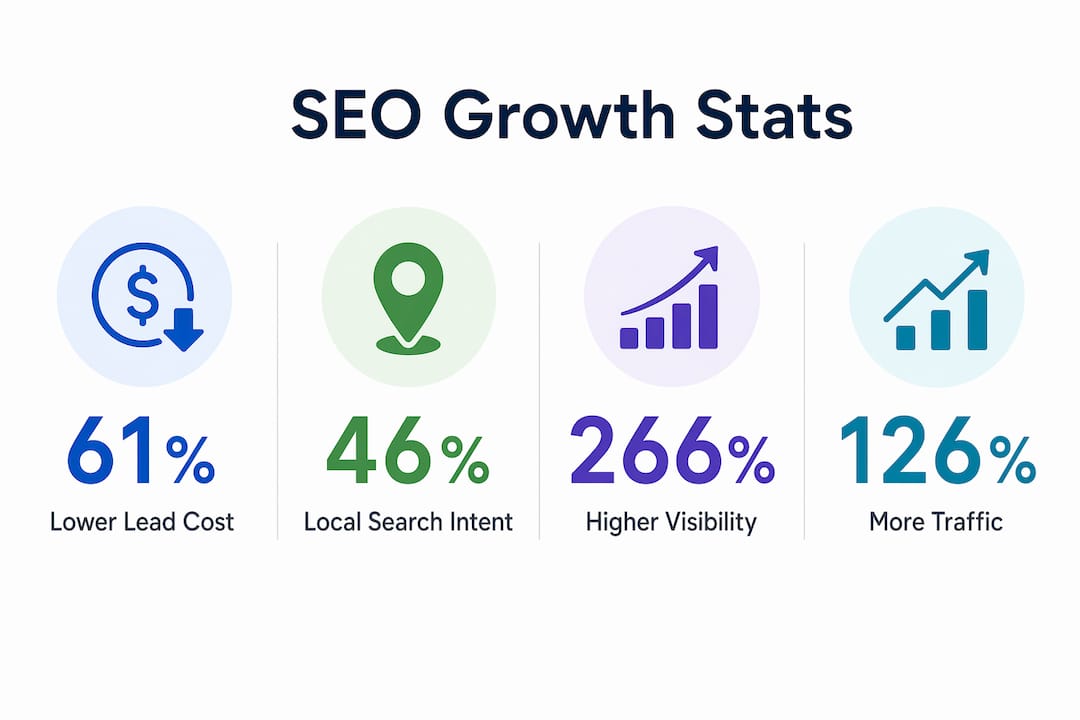
Reviews are a critical piece of the local SEO equation. Businesses with 50 or more Google reviews are 266% more likely to appear in the Local Pack. Every 10 new reviews boost conversion rates by 2.8%. Review velocity and volume create a compounding effect that lifts both your ranking and your credibility with potential customers simultaneously.
| Local SEO factor | Impact |
|---|---|
| Ranking in Local Map Pack | 126% more traffic, 93% more calls and clicks |
| 50+ Google reviews | 266% more likely to appear in Local Pack |
| Every 10 new reviews | 2.8% increase in conversion rate |
| Local SEO vs. outbound marketing | 61% lower cost per lead |
| Local SEO campaign ROI | 500%+ return possible for small businesses |
Pro Tip: Ask every satisfied customer for a Google review within 24 hours of service. Timing matters. Customers are most likely to leave a review when the experience is still fresh.
How has SEO changed with AI search in 2026?
AI is reshaping how search results are delivered, and business owners need to understand what that means for their visibility. Google's AI Overviews now appear on more than 13% of US queries and reduce organic click-through rates by 61% for non-cited sources. That is a significant shift. But the same data shows that sources cited inside AI Overviews gain a 35% increase in click-through rate.
The implication is clear. SEO in 2026 is not just about ranking in the blue links. SEO now feeds three distinct surfaces: traditional organic results, AI Overview citations, and responses from large language models like ChatGPT and Perplexity. Businesses that appear across all three surfaces have a significant visibility advantage over those that only chase keyword rankings.
"Ranking in AI Overviews and LLM citations requires producing higher quality, structured, and authoritative content tailored to survive AI filters. SEO in 2026 demands expertise, deep content, and original data to maintain and grow visibility."
What does this mean practically? The bar for content quality has risen sharply. Thin pages, duplicate templates, and generic blog posts no longer rank well in traditional search. They certainly do not get cited in AI answers. Technical SEO, topical authority, and digital PR together form the foundation for both traditional ranking and AI citation success.
Business owners also need to set realistic expectations on timing. Meaningful SEO ROI requires three conditions: sufficient search demand in your market, a waiting period for rankings to build, and content quality that meets current standards. Businesses that treat SEO as a quick fix consistently underperform those that commit to a 6–12 month build. Understanding SEO reporting benchmarks helps you track progress and communicate results to stakeholders during that build period.
How to apply SEO and local SEO effectively right now
Knowing why SEO matters is only useful if you act on it. The following steps reflect what actually moves the needle for small and mid-size businesses in 2026.
-
Complete your Google Business Profile. Google Business Profile signals account for about 32% of local SEO ranking weight. Fill in every field: hours, services, photos, and your service area. Update it regularly with posts and new photos.
-
Build your review base systematically. Do not wait for reviews to arrive organically. Create a simple process to ask every customer after a completed job or purchase. Aim for 50+ reviews as a baseline, then keep adding.
-
Create locally relevant content. Write pages and posts that speak to your specific city, neighborhood, or service area. Avoid copying the same template across multiple location pages. Unique local content with genuinely new information per page ranks better and engages readers more effectively.
-
Integrate SEO with paid advertising. SEO and paid search work well together. Use paid ads for immediate visibility while your organic rankings build. Once SEO gains traction, you can reduce paid spend on high-performing keywords.
-
Track AI visibility alongside traditional rankings. Monitor whether your content appears in AI Overviews and LLM responses. Tools that track AI citations are now part of a complete digital marketing strategy for any business serious about 2026 search visibility.
Pro Tip: Use Google Search Console to identify pages already ranking on page two. A focused update to those pages, adding depth, examples, and structured data, often produces faster ranking gains than starting new content from scratch.
Key Takeaways
SEO drives business growth by delivering high-intent organic traffic that converts at nearly twice the rate of paid search, while local SEO compounds that advantage with lower acquisition costs and measurable foot traffic gains.
| Point | Details |
|---|---|
| Organic traffic quality | Organic search converts at 2.4% vs. 1.3% for paid, making SEO traffic more valuable per visitor. |
| Local SEO cost advantage | Local SEO generates leads at 61% lower cost than outbound marketing, averaging $32 per lead. |
| Reviews drive local rankings | Businesses with 50+ Google reviews are 266% more likely to appear in the Local Map Pack. |
| AI search changes the game | Cited sources in AI Overviews gain a 35% CTR increase, making content quality non-negotiable. |
| Google Business Profile weight | GBP signals account for 32% of local ranking weight, making it your most important local asset. |
SEO is still the best long-term bet, and here is why I say that
I have watched business owners chase every new marketing trend, from social media ads to influencer campaigns, looking for the channel that finally delivers consistent results. Most of them eventually come back to SEO. Not because it is easy or fast, but because it is the only channel that builds an asset you actually own.
Paid ads rent you visibility. SEO earns it. When you rank for a high-intent keyword in your city, that position generates leads every single day without a recurring cost attached to each click. For a local service business, that math is hard to argue with.
The AI disruption is real, but it does not make SEO obsolete. It raises the standard. Businesses that invest in genuine expertise, real customer reviews, and content that actually answers questions will benefit from AI search, not suffer from it. The businesses that relied on thin content and keyword stuffing are the ones losing ground.
My honest advice: stop treating SEO as a cost and start treating it as infrastructure. A well-built SEO foundation supports every other marketing effort you run, from email campaigns to paid ads to referral programs. Businesses that get this right early build a compounding advantage that is very difficult for competitors to close. For a clear picture of where to start, the SMB marketing strategies Sourcesnova outlines are a practical entry point.
— Tran
Sourcesnova helps your business get found and grow
Getting SEO right takes more than reading about it. It takes consistent execution across your website, your Google Business Profile, your content, and your review strategy.
Sourcesnova works with local and small-to-mid-size businesses to build exactly that kind of presence. No jargon, no bloated retainers, and no vanity reports that look impressive but do not explain what is actually happening. The team at Sourcesnova handles the strategy and the execution so you can focus on running your business. If you are ready to turn your website into a real lead generation asset, visit sourcesnova.com to learn how Sourcesnova approaches measurable digital growth for businesses like yours.
FAQ
Why does SEO matter more than paid advertising?
SEO builds long-term visibility that does not stop when your budget runs out. Organic traffic also converts at 2.4% versus 1.3% for paid search, giving you better returns per visitor over time.
What is local SEO and who needs it?
Local SEO is the practice of optimizing your online presence to attract customers in a specific geographic area. Any business that serves customers in a physical location or defined region benefits directly from it.
How many Google reviews does a business need for local SEO?
Businesses with 50 or more Google reviews are 266% more likely to appear in the Local Map Pack. Every 10 new reviews also boost conversion rates by 2.8%, so review growth compounds over time.
Does AI search make SEO less valuable in 2026?
AI Overviews reduce click-through rates for non-cited sources by 61%, but sources cited inside AI answers gain a 35% CTR increase. High-quality, authoritative content now earns visibility across both traditional search and AI-generated results.
How long does SEO take to show results?
Meaningful SEO results typically require 6–12 months of consistent effort. The timeline depends on search demand in your market, the quality of your content, and the technical health of your website.