
Most small business owners assume digital consulting is reserved for enterprises with large IT budgets and dedicated tech teams. That assumption is costing them money. The real benefits of digital consulting are especially accessible to small and mid-sized companies, precisely because the gap between where they operate and where they could operate is widest. This article breaks down what digital consulting actually delivers, what it costs in time and money to do right, and how to position your business to capture the growth it promises.
Table of Contents
- Key takeaways
- What digital consulting actually means for your business
- The measurable benefits of digital consulting
- Pitfalls that erase your digital consulting ROI
- How to engage digital consulting for maximum return
- My honest take on what makes consulting work
- How Sourcesnova approaches digital consulting for SMBs
- FAQ
Key takeaways
| Point | Details |
|---|---|
| Digital consulting drives real ROI | SMBs implementing digital transformation stacks can achieve 3 to 8x ROI within 24 months. |
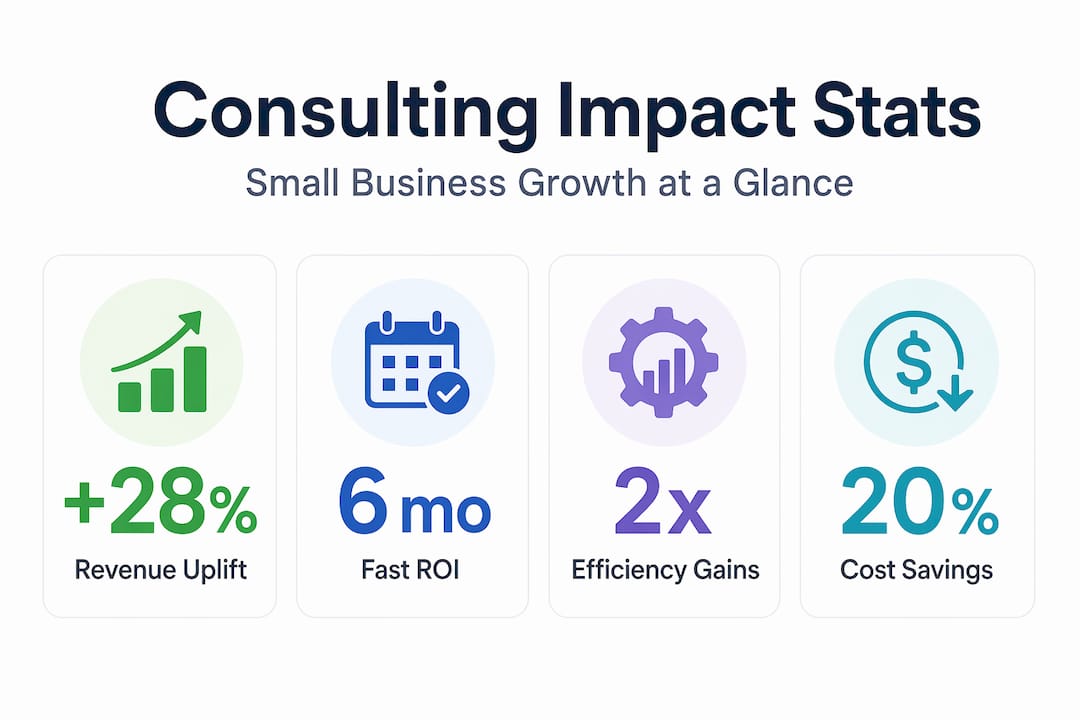
| Automation pays back fast | Process automation targeting manual tasks recovers up to 24 staff hours per week, often paying back in under 6 months. |
| Knowledge transfer is non-negotiable | ROI evaporates if your team cannot maintain the systems a consultant builds after the engagement ends. |
| Budget beyond consulting fees | A realistic budget must include a 20% contingency for licensing, training, and staff time diverted during implementation. |
| Governance determines success | Scope creep and weak executive support are the primary reasons digital consulting engagements fail. |
What digital consulting actually means for your business
Digital consulting is not the same as digital transformation, though the two terms get used interchangeably. Digital transformation describes the destination: a business that uses technology to operate, compete, and grow differently. Digital consulting is the guided process that helps you get there without wasting budget on tools that do not fit your operations.
A digital consultant fills three roles simultaneously. First, they bring strategy, identifying which processes, channels, and systems are creating friction or missed revenue. Second, they bring technology expertise, evaluating and recommending tools that match your scale and budget. Third, they manage change, helping your team adopt new workflows without the resistance that kills most technology rollouts. Understanding what digital marketing means for your specific business is often the first conversation a consultant will have with you.
The deliverables from a well-structured engagement typically include:
- A process and technology audit identifying gaps and quick wins
- A phased roadmap with clear milestones and success metrics
- Tool selection and implementation support
- Staff training and documentation
- Ongoing performance reviews to course-correct early
One critical framing to carry into any consulting engagement: as research shows, digital transformation is fundamentally a business improvement project that uses technology as a tool, not a tech upgrade that happens to improve business. That distinction matters when you are deciding where to invest and how to measure success.
The measurable benefits of digital consulting
The clearest argument for digital consulting is the financial one. Companies that operate with real-time data and empowered employees achieve over 50% higher revenue growth and net margins than bottom-quartile competitors. For an SMB, that kind of gap against competitors who are still running on spreadsheets and gut instinct is a direct revenue opportunity.

Efficiency gains are where most businesses feel the impact first. Automating manual data entry and administrative tasks can recover 18 to 24 staff hours per week, per employee. At standard labor costs, that is a meaningful reduction in operational drag, and it compounds over time. For a five-person office team, recovering even 10 hours per week per person translates directly to capacity you can redirect toward revenue-generating work.
Beyond efficiency, the advantages of digital consulting show up in four additional areas that business owners often underestimate:
- Better decision-making: When your data is centralized and accessible in real time, you stop making decisions based on last month's reports. You catch problems faster and act on opportunities before competitors do.
- Competitive positioning: A well-executed digital growth strategy places your business in front of customers who are actively searching for what you offer, before competitors with less digital visibility get there first.
- Improved customer experience: Faster response times, cleaner booking or purchasing flows, and consistent communication across channels reduce friction for customers and increase repeat business.
- Employee confidence: Teams that are trained on modern tools and have documented processes make fewer errors and need less supervision. That is a direct impact on your management capacity.
There is also a multiplier effect when AI is introduced thoughtfully. Companies that measure feedback loops rather than just tool adoption are six times more likely to see major financial benefits from AI integration. A good digital consultant builds that measurement discipline into the engagement from day one, not as an afterthought.
Pro Tip: Before any tool is selected, ask your consultant to quantify the problem it solves in dollars or hours. If they cannot, the tool is being chosen for the wrong reasons.
Pitfalls that erase your digital consulting ROI
The most expensive mistake SMBs make with digital consulting is treating it as a one-time project. An audit gets done, a platform gets launched, and then the consultant leaves. Six months later, the platform is underused, the original problems have returned in new forms, and the budget spent feels wasted. ROI depends heavily on execution and adoption, not just the consulting recommendations themselves.
The second most common problem is inadequate knowledge transfer. When a consultant builds a new system or workflow and does not train your team to maintain it, that knowledge leaves with them. Good consulting builds internal capability as a core deliverable, not a bonus. Ask any firm you evaluate how they plan to transfer knowledge before you sign the agreement.
Budgeting is where unrealistic expectations create the most friction. A realistic consulting budget must include a 20% contingency for costs that rarely appear in the initial proposal: software licensing, training time, staff hours diverted during rollout, and data migration. If your quote only covers consulting fees, you are not looking at the full cost.
Other pitfalls to plan for before an engagement starts:
- Scope creep: Projects that start as a website redesign become a full CRM migration because no one defined the boundaries clearly. A signed scope document with change-order protocols prevents this.
- Weak executive sponsorship: When leadership is not visibly committed to the initiative, teams at every level find reasons not to adopt the new approach. Sustained executive support is not a nice-to-have. It determines whether the engagement succeeds.
- Skipping the audit: Many SMBs wait until problems worsen before engaging a consultant, which means they enter the engagement reactive rather than strategic. A process audit before any technology investment saves you from solving the wrong problem expensively.
How to engage digital consulting for maximum return
The first step is not hiring a consultant. It is running an internal process audit to document where your team spends time, where errors happen most often, and where customer friction points exist. That documentation becomes the brief you bring to any consultant, and it immediately separates good candidates from those who would start from scratch at your expense.
Once you have clarity on the problems to solve, set measurable objectives before the engagement begins. Not "improve our marketing" but "increase qualified website leads by 30% within six months" or "reduce order processing time from 4 hours to 45 minutes." Metrics give both parties accountability and make ROI calculation straightforward.
Choosing the right engagement model matters as much as choosing the right consultant. The three most common models for SMBs are:
- Short-term project engagement: A defined scope, fixed timeline, and clear deliverable. Best for one-time needs like a new website, a CRM setup, or a paid advertising audit.
- Extended partnership: Ongoing monthly engagement where the consultant acts as a part-time digital operations lead. Best for businesses in active growth phases where strategy needs to evolve week by week.
- Hybrid model: A project engagement followed by a reduced monthly retainer for performance monitoring and course correction. This captures the speed of a project with the staying power of a partnership.
| Model | Best for | Key advantage |
|---|---|---|
| Short-term project | One-time fix or launch | Predictable cost and timeline |
| Extended partnership | Active growth phase | Flexible, evolving strategy |
| Hybrid model | Post-launch optimization | Speed plus sustainability |
Revenue outperformers show a clear pattern: companies exceeding revenue targets are 28% more likely to increase operating expenses strategically to invest in growth rather than simply cut costs. The implication for SMB decision-makers is that digital consulting is not a cost to minimize. It is an investment to structure well, with a clear digital marketing strategy guiding each phase.
My honest take on what makes consulting work
I have seen enough digital consulting engagements play out to know that the technology is almost never the hard part. What determines whether a business actually captures the digital consulting value it paid for comes down to two things: culture and continuity.
Culture means whether the leadership team genuinely believes the business needs to change, not just add a few tools. When an owner signs a consulting contract but privately thinks the old way worked fine, the team reads that signal and the adoption rate flatlines. I have watched solid systems get built and then quietly abandoned because nobody at the top was asking about them three months later.
Continuity means treating the engagement as the start of an operational discipline, not a one-time fix. The businesses I have seen capture sustained ROI are the ones that built internal ownership of the new systems. One person on the team owned the CRM data quality. Another managed the content calendar. The consultant became an advisor rather than a crutch, and the improvements compounded instead of decaying.
The uncomfortable truth is that most SMBs underinvest in the change management side of digital consulting. They budget for the technology and the strategy, but not for the hours their own team will need to learn, adjust, and take ownership. That oversight is where ROI goes to disappear. Investing in building a strong digital brand is a long-term discipline, and the same applies to every other system a consultant helps you build.
— Tran
How Sourcesnova approaches digital consulting for SMBs
Sourcesnova works with small and mid-sized businesses that want real growth, not a prettier website or a longer report. The team brings a practical, ROI-focused approach to every engagement, starting with an honest audit of where your business stands and building a plan grounded in what will actually move the needle.
Whether you need a clearer digital strategy, better online visibility, or help turning website traffic into paying customers, Sourcesnova treats your business with the same attention it would give its own. No bloated retainers. No jargon. Just clear execution with measurable outcomes. If you are ready to put the impact of digital consulting to work for your business, explore Sourcesnova's services and take the first step toward sustainable digital growth.
FAQ
What are the main benefits of digital consulting for small businesses?
The core benefits include faster revenue growth, reduced operational costs through automation, better customer experience, and sharper competitive positioning. SMBs implementing digital consulting solutions can achieve 3 to 8x ROI within 24 months when engagements are executed with clear objectives and strong team adoption.
How long does it take to see ROI from digital consulting?
Process automation, which is typically the fastest-return component, can pay back in under 6 months. Broader digital transformation initiatives generally show compounding returns over a 12 to 24-month period, depending on scope and adoption.
What is the difference between digital consulting and digital transformation?
Digital transformation is the outcome: a business that operates and competes differently through technology. Digital consulting is the structured process that guides you to that outcome, covering strategy, tool selection, implementation, and change management.
Why do digital consulting engagements fail?
The primary causes are weak executive sponsorship, inadequate knowledge transfer to internal teams, and scope creep from poorly defined project boundaries. ROI depends on execution and adoption, not just the quality of the consulting recommendations.
How much should an SMB budget for digital consulting?
Budget for the full cost, not just consulting fees. A realistic budget includes a 20% contingency to cover software licensing, staff training, data migration, and internal time diverted during rollout.