
Content marketing is defined as the strategic creation and distribution of valuable, relevant content to attract, engage, and retain a specific audience, with the goal of driving profitable customer actions. Unlike paid ads, it builds trust over time rather than buying attention for a moment. Content marketing campaigns cost approximately 62% less than traditional advertising, making it one of the most budget-efficient growth channels available to small and mid-sized businesses. Explaining content marketing clearly matters because too many business owners either skip it entirely or confuse it with social media posting. This article breaks down what it actually is, why it works, and how to do it right.
What are the main benefits of content marketing for SMBs?
Content marketing builds four core business assets at once: brand awareness, audience trust, lead generation, and customer loyalty. Each one compounds over time in a way that paid advertising simply cannot replicate.
Brand awareness and trust are the most immediate gains. When you publish a helpful blog post, an explainer video, or a detailed product guide, you show potential customers that you understand their problems. High-quality content builds trust and increases brand awareness before a prospect ever contacts you. That trust shortens the sales cycle significantly.

Lead generation and SEO work together through content. Search engines reward websites that consistently publish relevant, well-structured content with higher rankings. Higher rankings bring in organic traffic, which costs nothing per click. Business owners who invest in marketing strategies for small businesses through content see compounding returns that paid ads cannot deliver once the budget runs out.
The budget efficiency advantage is real and measurable:
- Content marketing costs far less per lead than outbound methods like cold calling or display advertising
- Blog posts and videos continue generating traffic for months or years after publication
- Social media content builds community and repeat engagement without per-post ad spend
- Email newsletters built on content keep existing customers engaged at minimal cost
- Educational content reduces customer support volume by answering common questions proactively
Companies with a documented content strategy achieve 33% more ROI than those operating without one. That gap exists because undocumented efforts tend to be inconsistent, unfocused, and impossible to measure or improve.
How to develop an effective content marketing strategy
A content marketing strategy is a documented plan that connects your content to specific business goals, audience needs, and distribution channels. It is not a content calendar. Confusing the two is the most common mistake small business owners make.
A content calendar tells you when to post. A strategy tells you why you are posting, who you are reaching, and what you want them to do next. The biggest misconception is confusing a content calendar with a real content strategy. Real strategy aligns every piece of content to pipeline goals and builds a structured narrative for the buyer.
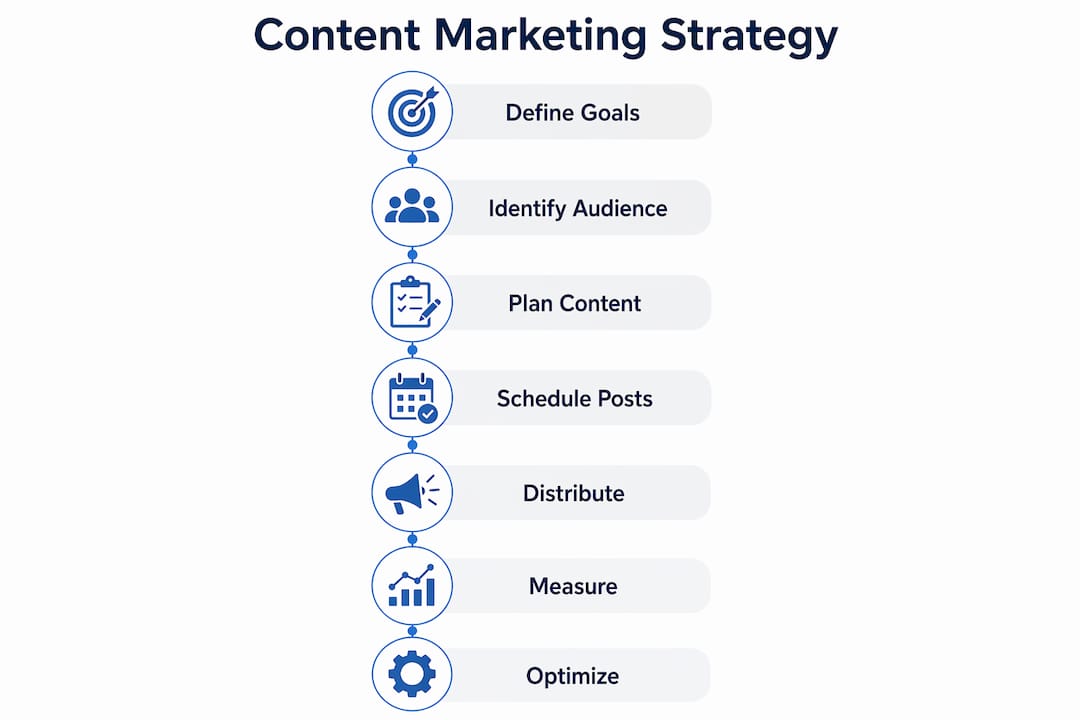
Align content with the buyer journey
Every prospect moves through three stages before buying: awareness, consideration, and decision. Your content must serve all three.
- Awareness stage: The prospect knows they have a problem but does not know your business exists. Blog posts, short videos, and social media content that address common pain points work best here.
- Consideration stage: The prospect is actively comparing options. Detailed guides, case studies, comparison articles, and webinars help them evaluate you against alternatives.
- Decision stage: The prospect is ready to buy. Testimonials, product demos, free consultations, and clear calls to action convert consideration into purchase.
Build distribution into your content plan from day one
Most business owners create content first and think about distribution second. This is backward. Plan where each piece of content will live, who will share it, and how it will reach the right audience before you write a single word. Treating content marketing as an ongoing system rather than a one-off campaign means planning distribution at the point of content conception.
Pro Tip: Write a one-paragraph "distribution brief" for every piece of content before you create it. List the three channels where it will be published, the audience segment it targets, and the one action you want readers to take. This single habit prevents wasted content.
The role of content strategy in business growth is not just about publishing more. It is about publishing the right content, to the right audience, through the right channels, at the right stage of the buyer journey.
What types of content and distribution channels work best?
The best content type depends on your audience, your product, and the stage of the buyer journey you are targeting. No single format works for every business or every goal.
Each content page must tell a complete story from problem to solution to product, for both Google and AI search engines. This means long-form articles need clear structure, explainer videos need strong calls to action, and social posts need to link back to deeper resources on your website.
| Content type | Best audience goal | Primary channel |
|---|---|---|
| Long-form blog articles | SEO traffic and education | Website, Google Search |
| Explainer videos | Trust-building and product demos | YouTube, website, social |
| Social media posts | Awareness and community engagement | Instagram, LinkedIn, Facebook |
| Email newsletters | Retention and repeat purchase | Email list |
| Case studies | Decision-stage conversion | Website, sales outreach |
| How-to guides | Awareness and SEO | Website, AI search surfaces |
Distribution channel selection matters as much as content format. Reaching in-moment audiences in communities and search surfaces where they actively seek answers outperforms broad targeting every time. A nail salon owner gets more value from a local SEO blog post than from a generic Facebook ad shown to a wide demographic.
Practical channel guidance for SMBs:
- Google Search and AI search: Long-form articles and how-to guides optimized for specific questions
- YouTube: Short explainer videos (2–5 minutes) that answer one question per video
- LinkedIn: Thought leadership posts for B2B service businesses
- Instagram and Facebook: Visual content, behind-the-scenes posts, and customer stories for retail and service businesses
- Email: Weekly or biweekly newsletters that deliver value and drive traffic back to your website
Pro Tip: Explore top B2B content types that build brand visibility before committing to a format. Matching content type to your specific audience saves months of trial and error.
Video deserves special attention for SMBs. A video marketing strategy does not require a production budget. A smartphone, good lighting, and a clear script produce content that outperforms polished corporate videos in authenticity and engagement.
How to measure content marketing success and optimize ROI
Measuring content marketing requires a different mindset than measuring paid ads. Paid ads deliver results within days. Content marketing builds results over months.
Last-click attribution underestimates content marketing's value. A prospect might read your blog post in january, follow you on social media in march, and then buy in june. Last-click attribution credits only the final touchpoint, making the blog post look worthless. Tracking influence and assisted conversions over a 6–12 month window gives a far more accurate picture of what your content actually drives.
Key performance indicators every SMB should track:
- Organic traffic growth: Month-over-month increase in visitors from search engines
- Time on page: Longer sessions signal that content is genuinely useful and engaging
- Lead form completions: Direct conversions from content pages
- Email list growth: New subscribers acquired through content offers
- Assisted conversions: Sales where content appeared somewhere in the buyer's path
- Return visitor rate: Measures whether content builds an audience that comes back
Visibility is becoming easier through AI search optimization, but conversion is becoming harder without clear conversion architecture. Getting found is only half the job. Your content pages need obvious next steps: contact forms, consultation booking links, product pages, and clear calls to action. Without these, traffic stays traffic and never becomes revenue.
The measurement cycle for content marketing follows four steps: publish, measure, refresh, and adapt. Content that performs well gets updated and expanded. Content that underperforms gets revised or repurposed. This iterative approach compounds results over time and prevents the common mistake of publishing content and forgetting it.
Key Takeaways
Content marketing is the most cost-efficient growth channel for small and mid-sized businesses, but only when it runs as a documented system aligned to buyer journey stages and supported by clear conversion architecture.
| Point | Details |
|---|---|
| Define before you publish | Content marketing requires a documented strategy, not just a posting schedule. |
| Cost advantage is real | Content campaigns cost approximately 62% less than traditional advertising and deliver compounding returns. |
| Match content to buyer stage | Awareness, consideration, and decision content serve different purposes and require different formats. |
| Plan distribution first | Decide where content will live and who will see it before creating it. |
| Measure influence, not just clicks | Track assisted conversions over 6–12 months to see the true ROI of content. |
What I have learned from watching SMBs get content marketing wrong
Most small business owners I work with start content marketing the same way. They post three times a week for a month, see no immediate results, and conclude that content marketing does not work for their industry. That conclusion is wrong, but the frustration is completely understandable.
The real problem is almost never the content itself. It is the absence of a system. Content without a distribution plan is like printing flyers and leaving them in your own office. The work gets done, but nobody sees it. I have seen businesses with genuinely excellent blog content generate almost no traffic because they never built the SEO foundation or distribution channels to get it in front of the right people.
The second mistake I see constantly is treating visibility as the finish line. Getting ranked on Google or appearing in an AI search result is a starting point, not a result. If your content page has no clear next step, no contact form, no offer, and no reason for the reader to stay, you have paid for an audience that immediately leaves. Conversion architecture is not optional. It is the difference between content that costs money and content that makes money.
Patience is genuinely required here. Content marketing ROI compounds over time, and the businesses that stick with it for 12 months consistently outperform those that run it for 90 days and quit. The search landscape is also shifting fast. AI engines now surface content alongside traditional search results, which means your content needs to satisfy both link authority and topical depth simultaneously. That is a higher bar than it was two years ago, but it also means well-structured, genuinely useful content has more places to get found than ever before.
— Tran
How Sourcesnova helps SMBs build content that actually converts
Sourcesnova works with small and mid-sized businesses that are tired of paying for marketing that produces reports instead of results. Content marketing is one of the core services Sourcesnova delivers, from strategy documentation and content creation to distribution planning and conversion optimization.
The team at Sourcesnova builds content systems aligned to your specific business goals, buyer journey, and industry. No generic templates, no vanity metrics. If you want content that gets found, builds trust, and turns readers into customers, visit Sourcesnova to see how the process works and what it looks like for businesses in your industry.
FAQ
What is content marketing in simple terms?
Content marketing is the practice of creating and sharing useful, relevant content to attract potential customers and keep existing ones engaged. The goal is to build trust and drive sales without relying solely on paid advertising.
How much does content marketing cost compared to traditional ads?
Content marketing campaigns cost approximately 62% less than traditional advertising. The cost advantage grows over time because content continues generating traffic and leads long after it is published.
How long does it take to see results from content marketing?
Most businesses see meaningful organic traffic growth within 3–6 months of consistent publishing. Full ROI, including assisted conversions and compounding search rankings, typically becomes clear over a 6–12 month window.
What is the difference between a content strategy and a content calendar?
A content calendar schedules when to publish. A content strategy defines why you are publishing, who you are targeting, and what business goal each piece of content serves. Businesses with a documented strategy achieve 33% more ROI than those without one.
What types of content work best for small businesses?
Long-form blog articles, explainer videos, and email newsletters deliver the strongest results for most small businesses. The best format depends on your audience and buyer journey stage, but content that answers specific questions consistently outperforms broad, promotional messaging.