
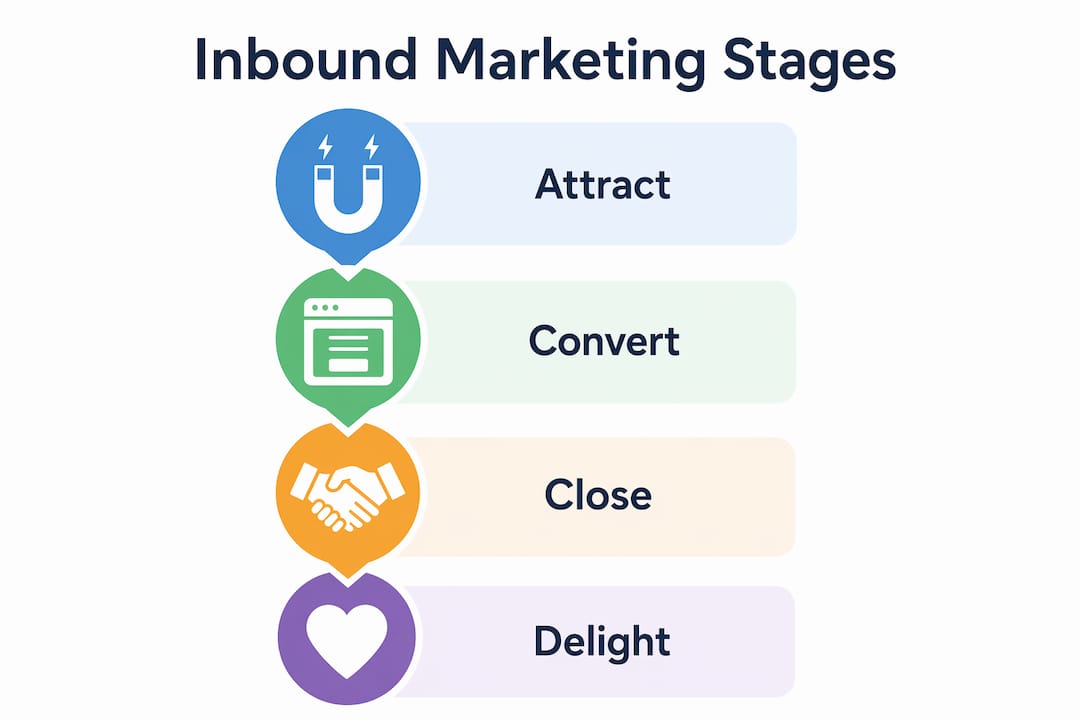
Inbound marketing is defined as a strategy that attracts potential customers by delivering relevant, helpful content and experiences at each stage of the buying process. Unlike outbound tactics that push messages at uninterested audiences, inbound pulls prospects in by solving their problems first. The four-stage inbound model — Attract, Convert, Close, and Delight — guides a prospect from first discovery to loyal promoter. Understanding how does inbound marketing work today means accounting for AI-powered search disruption and GTM engineering, which are reshaping execution at every stage.
How does inbound marketing work? The four core stages explained
The inbound marketing process runs through four connected stages, each with a distinct goal and set of tactics. No stage works in isolation. Skipping or rushing any one of them breaks the chain.
Attract: drawing in the right prospects
The Attract stage focuses on getting found by people who are already looking for what you offer. SEO, blog content, social media, and video are the primary tools. The goal is not raw traffic volume. High-intent, high-quality leads engage and convert at far higher rates than broad audiences reached through paid interruption. A local salon ranking for "best nail salon near me" or a B2B software company publishing a detailed comparison guide both use the same Attract principle: be useful before asking for anything.

Convert: turning visitors into known contacts
Once a visitor lands on your site, the Convert stage captures their contact information. Forms, calls to action, landing pages, and lead magnets are the core tools here. A free checklist, a webinar registration, or a product demo request all serve the same function. They give the visitor a reason to share their email in exchange for something genuinely useful.
Close: nurturing leads into customers
The Close stage moves qualified contacts toward a purchase decision. Email automation, lead scoring, and CRM integration do the heavy lifting. Inbound marketing uses SEO, social media, email automation, and content marketing as a connected system, not isolated tactics. A lead who downloaded a pricing guide gets a different email sequence than one who only read a blog post. That distinction is what separates a real inbound system from a basic newsletter.
Delight: building loyalty and creating promoters
The Delight stage is where most businesses underinvest. Surveys, smart content, onboarding sequences, and community engagement keep existing customers engaged and turn them into referral sources. A delighted customer costs far less to retain than a new one costs to acquire. This stage also feeds the Attract stage by generating reviews, testimonials, and word-of-mouth that bring in new prospects organically.
Pro Tip: Map every piece of content you create to one specific stage. If you cannot name the stage it serves, the content has no strategic purpose.
| Stage | Goal | Core tactics | Key metric |
|---|---|---|---|
| Attract | Drive qualified traffic | SEO, blog, social media, video | Organic sessions, search rankings |
| Convert | Capture contact info | Landing pages, forms, lead magnets | Conversion rate, leads generated |
| Close | Move leads to purchase | Email automation, lead scoring, CRM | SQL rate, deals closed |
| Delight | Retain and grow customers | Surveys, smart content, community | NPS, retention rate, referrals |
How AI and GTM engineering are reshaping inbound marketing
61% of marketing professionals report that the marketing landscape is undergoing its most significant disruption in two decades. AI-powered search and automated GTM engineering are the two primary drivers. That disruption changes how inbound strategies attract customers and how leads move through the pipeline.
AI-powered search tools like generative answer engines now answer many queries directly, without sending users to a website. This reduces organic click-through rates on informational content. Businesses that built their entire inbound strategy on blog traffic are feeling this most acutely. The response is not to abandon content. It is to shift toward content that earns citations in AI answers, builds brand authority, and supports direct search intent rather than generic informational queries.
GTM engineering addresses the pipeline side of this shift. GTM engineering automates lead enrichment, scoring, routing, and outreach, with inbound cadences converting at 50% to 90% meeting-booked rates. That is a structural advantage over manual follow-up processes. A lead who fills out a form at 11 p.m. on a Friday no longer waits until Monday morning for a response. Automated routing sends the lead to the right rep, triggers a personalized email sequence, and scores the contact based on behavior, all within minutes.
For marketing automation in 2026, the practical implications are clear:
- AI tools can personalize email sequences at scale based on behavioral signals.
- Lead scoring models now incorporate intent data from third-party sources, not just on-site behavior.
- CRM integrations trigger sales outreach automatically when a lead hits a defined score threshold.
- Content performance tracking connects specific assets to pipeline revenue, not just page views.
Pro Tip: Do not automate for automation's sake. Map each automated touchpoint to a specific buyer action. If a trigger does not reflect real buyer intent, remove it.
Teams that integrate AI and GTM engineering skills gain structural advantages in pipeline efficiency and measurement. This is not a future consideration. It is a present competitive reality.
What are the most common inbound marketing mistakes?
The single most damaging mistake is treating inbound marketing as a content production schedule rather than a revenue engine. Publishing three blog posts a week without connecting them to lead generation goals produces traffic reports, not business results. Framing inbound as a demand generation system unlocks the budget and management support needed to execute it properly.
The second major mistake is skipping content-to-intent mapping. Content must be categorized into TOFU (top of funnel), MOFU (middle of funnel), and BOFU (bottom of funnel) to avoid pushing prospects toward a purchase before they are ready. A first-time visitor reading a general explainer article is not ready for a sales call. Sending them a demo invitation immediately is the fastest way to lose them.
Here are the four most common inbound mistakes and how to correct them:
- Treating inbound as a short-term play. Inbound marketing requires a 90-day pilot with defined KPIs before expecting significant lead volume. Set that expectation with stakeholders from day one.
- Publishing content without intent mapping. Assign every content asset a funnel stage before publishing. TOFU content educates, MOFU content evaluates, and BOFU content converts.
- Relying solely on organic traffic. AI-powered search changes mean organic traffic alone is no longer a reliable growth engine. Pair inbound content with email, paid amplification, and social distribution.
- Measuring vanity metrics. Page views and social shares do not pay invoices. Measurement frameworks must link every content asset to qualified lead conversion and pipeline outcomes.
Pro Tip: Build a simple content audit spreadsheet. List every published asset, assign it a funnel stage, and track which ones generate leads. Delete or update anything that has not contributed to pipeline in 12 months.
How to apply inbound marketing effectively as a small business owner or marketing professional
Effective inbound marketing for small businesses starts with a focused content plan, not a massive one. Trying to cover every topic and every channel at launch spreads resources too thin. Pick two or three topics where you have genuine expertise and your audience has clear search intent. Build depth there before expanding.
Lead generation strategies that fill your pipeline combine content with deliberate conversion architecture. Every page on your site should have a clear next step. A blog post about nail salon pricing should link to a booking page or a free consultation offer. A product comparison guide should end with a demo request form. Content without a conversion path is a dead end.
For small business marketing in 2026, the most effective inbound tactics break into two categories:
Quick wins (0–90 days):
- Publish three to five high-intent, long-tail SEO articles targeting specific buyer questions.
- Create one lead magnet tied directly to your core service or product.
- Set up a basic email welcome sequence for new subscribers.
- Claim and optimize your Google Business Profile for local search visibility.
Long-term plays (90 days and beyond):
- Build a content library organized by funnel stage, with TOFU, MOFU, and BOFU assets for each core topic.
- Implement lead scoring in your CRM to prioritize follow-up on the highest-intent contacts.
- Use SMB marketing strategies to integrate inbound with outbound for faster visibility while authority builds.
- Establish a monthly content performance review that tracks leads and pipeline, not just traffic.
Inbound and outbound marketing are complementary. Inbound builds long-term authority while outbound supports immediate visibility. Running both in parallel is the most practical approach for businesses that need results now and sustainable growth later.
Key takeaways
Inbound marketing works because it aligns content, SEO, automation, and measurement into a single demand generation system that attracts, converts, closes, and delights customers at every stage of the buying process.
| Point | Details |
|---|---|
| Four-stage framework | Attract, Convert, Close, and Delight each require distinct tactics and metrics to function. |
| AI and GTM engineering | Automation now handles lead scoring, routing, and outreach, compressing response time and improving conversion rates. |
| Content-to-intent mapping | Assign every asset a funnel stage (TOFU, MOFU, BOFU) before publishing to avoid premature conversion attempts. |
| 90-day baseline requirement | Inbound marketing needs a defined pilot period with KPIs before meaningful lead volume appears. |
| Measurement over vanity metrics | Link every content asset to qualified lead conversion and pipeline outcomes, not page views. |
Why I think most businesses misread inbound marketing entirely
Most businesses I have worked with come to inbound marketing expecting a content calendar to solve their growth problem. They hire a writer, publish a few articles, and wait for leads. When nothing happens in 60 days, they declare inbound "doesn't work" and move on.
The problem is not the tactic. It is the framing. Effective 2026 inbound strategies rely on help-first interactions that build trust before any sales intervention. That is a fundamentally different operating model than most small businesses are used to. It requires patience, measurement discipline, and a willingness to create content that serves the reader before it serves the business.
The businesses I have seen succeed with inbound are the ones that treat it as a system, not a campaign. They connect content to conversion paths, conversion paths to CRM workflows, and CRM workflows to sales activity. They also do not abandon outbound while inbound builds. The two approaches reinforce each other when run in parallel.
My honest caution: do not overinvest in any single channel. Search algorithms change. Social platforms shift reach. Email deliverability fluctuates. The businesses with the most durable inbound results are the ones that diversify across content, email, and community, and measure everything against pipeline, not traffic.
— Tran
How Sourcesnova helps you build an inbound marketing system that generates real leads
Sourcesnova works with local and small-to-mid-size businesses that are tired of paying for marketing that produces reports instead of revenue. The team builds inbound marketing systems that connect content strategy, SEO, lead capture, and automation into a single pipeline.
Whether you need a full inbound strategy built from scratch or help fixing a system that is not converting, Sourcesnova delivers clear execution without the bloated retainers. Every engagement starts with a defined measurement framework so you know exactly what success looks like before work begins. Visit Sourcesnova to talk through your current situation and get a direct assessment of where your inbound marketing can improve.
FAQ
What is the inbound marketing definition?
Inbound marketing is a strategy that attracts customers by delivering relevant, helpful content and experiences tailored to their needs at each stage of the buying process, rather than interrupting them with unsolicited messages.
How does inbound marketing attract customers?
Inbound marketing attracts customers through SEO, blog content, social media, and video that answer specific questions buyers are already searching for, drawing high-intent prospects to your site organically.
How long does inbound marketing take to show results?
Inbound marketing requires a 90-day pilot period with defined KPIs before significant lead volume appears, reflecting its nature as a demand generation system rather than a quick-win advertising tactic.
What is the difference between TOFU, MOFU, and BOFU content?
TOFU (top of funnel) content educates new prospects, MOFU (middle of funnel) content helps them evaluate options, and BOFU (bottom of funnel) content converts ready buyers. Mapping content to the right stage prevents premature sales pressure.
How does AI affect inbound marketing in 2026?
AI-powered search tools now answer many queries directly without sending users to websites, reducing organic click-through rates. Effective inbound strategies respond by creating content that earns AI citations and pairs organic content with email and paid distribution channels.