
The most effective SEO strategy in 2026 combines technical hygiene, intent-focused content, and genuine authority signals. It is not about gaming algorithms. Search engines have grown sophisticated enough that the practices rewarding real users and the practices rewarding rankings are now largely the same thing. Whether you are a small business owner trying to get found locally or an individual building a site from scratch, the fundamentals below will give you a clear, current roadmap.
SEO best practices fall into four core pillars:
- Technical SEO: Site speed, crawlability, mobile-first indexing, Core Web Vitals, and structured data
- Content optimization: Keyword research aligned with user intent, E-E-A-T signals, and topical depth
- Authority and link building: Earning backlinks, internal linking, and brand presence
- Performance monitoring: Tracking rankings, traffic, and engagement metrics with tools like Google Search Console
Recognized authorities including Google Search Central, Backlinko, and Semrush consistently reinforce these same pillars. The difference in 2026 is the weight given to AI-driven search surfaces, user experience signals, and topical authority over isolated keyword tactics. Businesses that treat SEO as a long-term brand-building exercise, rather than a short-term traffic hack, are the ones seeing durable results.
Table of Contents
- 1. How search engines actually work, and why it matters for your site
- 2. Keyword research and optimization aligned with user intent
- 3. Site architecture, URL structures, and handling duplicate content
- 4. Crafting content that users actually want to read
- 5. Technical SEO essentials and Core Web Vitals benchmarks
- 6. How to build backlinks and grow your site's authority
- 7. Monitoring SEO performance and using the right tools
- 8. Why mobile SEO and responsive design are non-negotiable
- 9. How user behavior signals shape your rankings
- 10. SEO for images, videos, and other content types
- Sourcesnova helps small businesses get found online without the agency runaround
- Key Takeaways
1. How search engines actually work, and why it matters for your site
Search engines operate through three sequential processes: crawling, indexing, and ranking. Crawlers, sometimes called spiders or bots, follow links across the web to discover pages. Those pages get stored in a massive index. When someone searches, the engine pulls from that index and ranks results based on relevance, authority, and quality signals.

Relevance is determined by how well your content matches the searcher's intent, not just the literal words they typed. Authority comes from the quantity and quality of other sites linking to yours, along with brand signals like direct searches for your name. Quality is assessed through user experience factors: does the page load fast, is it easy to read on a phone, does the visitor stay or immediately leave?
In 2026, AI plays a growing role in how search results are assembled. Google's AI Overviews, for example, synthesize answers from multiple sources and display them before traditional blue links. Understanding how AI crawlers and large language models process content gives you a real edge. Pages that are clearly structured, answer questions directly, and demonstrate genuine expertise are the ones getting pulled into these AI-generated summaries.
User experience has become a ranking factor in its own right. A page that loads slowly, shifts around while loading, or buries the answer three scrolls down will lose ground to a cleaner competitor, even if the content itself is technically superior.
2. Keyword research and optimization aligned with user intent
Keywords are signals, not targets. The goal is not to repeat a phrase as many times as possible but to use language that tells search engines what your page is about and who it serves. SEO has shifted from optimizing isolated keywords to designing content experiences that satisfy full user intent across search surfaces.
Practical keyword usage for small businesses:
- Place the primary keyword in the title tag, H1, and first paragraph. Well-crafted title tags remain the highest-leverage on-page factor, needing the keyword early, a length of roughly 50–60 characters, and compelling phrasing to earn clicks.
- Use semantic variations and related terms throughout the body. Search engines understand synonyms and related concepts, so writing naturally about a topic will naturally include the right language.
- Target long-tail keywords for specific, high-intent searches. A nail salon in Austin ranks far more easily for "gel nail fill near downtown Austin" than for "nail salon."
- Match keyword choice to search intent. Informational queries ("how to fix a leaky faucet") need educational content. Transactional queries ("plumber Austin TX") need a service page with clear contact details.
- Use free tools like Google Search Console and Google's autocomplete to find what your actual audience is already searching for.
For small business owners, the most practical approach is to start with a handful of specific, intent-matched phrases rather than chasing high-volume head terms. A local retailer ranking on page one for five precise phrases will outperform a site that ranks on page four for a broad term.
Pro Tip: Map each page on your site to one primary keyword and one clear intent. If two pages target the same phrase, you are competing against yourself, a problem called keyword cannibalization that dilutes your rankings.
3. Site architecture, URL structures, and handling duplicate content
A well-organized site helps both search engines and visitors find what they need. Search engines allocate a crawl budget to each site, meaning they will not crawl every page on every visit. A logical structure ensures your most important pages get crawled and indexed consistently.
URL best practices:
- Keep URLs short, descriptive, and lowercase
- Use hyphens between words, not underscores
- Include the target keyword where it fits naturally
- Avoid parameters, session IDs, or random strings in URLs
The three-click rule is a useful benchmark: any important page on your site should be reachable within three clicks from the homepage. Pages buried deeper than that get crawled less often and tend to rank lower. Effective internal linking connects related pages and keeps crawlers moving through your site efficiently.
Topical clusters are the architecture model that works best in 2026. One pillar page covers a broad topic in depth, and multiple supporting pages cover specific subtopics, each linking back to the pillar. This structure signals expertise to search engines far more clearly than a collection of unrelated standalone articles.

Duplicate content is a common problem that hurts crawl efficiency and can dilute ranking signals. The fix is usually a canonical tag, a line of HTML that tells search engines which version of a page is the "official" one. Common sources of duplication include:
| Duplicate content source | Recommended fix |
|---|---|
| HTTP vs. HTTPS versions | Redirect all HTTP to HTTPS; set canonical to HTTPS |
| www vs. non-www | Pick one, redirect the other, set canonical |
| Trailing slash vs. no slash | Standardize and redirect |
| Printer-friendly page versions | Add canonical pointing to the main page |
| Paginated content | Use canonical or rel=next/prev markup |
An HTML sitemap submitted to Google Search Console also helps crawlers discover and prioritize your most important pages.
4. Crafting content that users actually want to read
Content quality is the single biggest lever most small businesses have not fully pulled. Writing for searchers, not algorithms, is the most durable SEO practice in the age of AI. Specificity, complete question answering, and authentic expertise are what search systems now prioritize.
Google's E-E-A-T framework (Experience, Expertise, Authoritativeness, Trustworthiness) sets the standard for what "quality" means. The first "E," Experience, is the newest addition and the hardest to fake. It requires proof of real-world expertise: personal anecdotes, original data, documented activities, or firsthand accounts. A beauty salon writing about nail care from direct client experience will outrank a generic article assembled from other articles.
Content best practices for small business owners:
- Answer the question directly in the first paragraph. Do not make readers scroll to find the answer.
- Use structured headings (H2, H3) to organize content logically. This helps both readers and search engines understand the page's structure.
- Include FAQs at the bottom of service pages. They capture long-tail question queries and can appear in Google's "People Also Ask" boxes.
- Prioritize depth over length. A 600-word page that fully answers a specific question beats a 2,000-word page that wanders.
- Update content regularly. Quarterly refreshes improve rankings for informational content, particularly on topics that change over time.
Pro Tip: Build a content cluster around your core service. If you run a lighting retail store, publish a pillar page on "choosing the right lighting for your home," then link to supporting pages on recessed lighting, pendant lights, and outdoor fixtures. Each page reinforces the others.
5. Technical SEO essentials and Core Web Vitals benchmarks
Technical SEO is the foundation everything else sits on. Before investing heavily in content or link building, your site needs to be crawlable, indexable, and fast. Successful SEO for small teams begins with technical hygiene before high-volume content production.
Core Web Vitals in 2026
Google's Core Web Vitals measure real user experience across three dimensions. The 2026 benchmarks require these thresholds to be met on a majority of real-user visits:
| Metric | What it measures | Good threshold | Poor threshold |
|---|---|---|---|
| LCP (Largest Contentful Paint) | How fast the main content loads | Under 2.5 seconds | — |
| INP (Interaction to Next Paint) | How quickly the page responds to input | Under 200 milliseconds | — |
| CLS (Cumulative Layout Shift) | How much the page shifts while loading | Under 0.1 (CLS threshold) | — |
INP replaced FID (First Input Delay) as the interactivity metric in 2024 and remains the standard in 2026. A page that loads fast but jumps around as images load will still fail on CLS. Google's PageSpeed Insights and Search Console's Core Web Vitals report both show your real-user data.
Other technical essentials
- HTTPS: Every page must be served over HTTPS. Browsers flag HTTP pages as "not secure," and Google treats HTTPS as a ranking signal.
- Mobile-first indexing: Google indexes the mobile version of your site first. If your mobile experience is degraded, your rankings reflect that.
- Structured data with JSON-LD: Adding schema markup helps search engines understand your content's context. JSON-LD improves entity disambiguation and makes your content more accessible to AI retrieval systems. Schema types useful for small businesses include LocalBusiness, Product, FAQ, and Review.
- LLMs.txt: An emerging standard, similar to robots.txt, that tells AI crawlers which parts of your site they can use for training and retrieval. Adopting it early signals technical awareness to AI-driven search systems.
6. How to build backlinks and grow your site's authority
Authority is earned, not bought. A single backlink from a respected local news site or an industry publication carries more weight than dozens of links from low-quality directories. The goal is to become the kind of resource that other sites naturally want to reference.
Off-page SEO, the work you do outside your own site, is primarily about building that reputation. On-page SEO gets your content ready to rank; off-page SEO gives search engines a reason to trust it.
Sustainable link-building tactics for small businesses:
- Publish original research or data. A local retailer that surveys its customers and publishes the results creates a citable asset.
- Write guest posts for local or industry publications. A nail salon owner contributing to a beauty trade blog earns a relevant, authoritative link.
- Get listed in legitimate directories. Google Business Profile, Yelp, and industry-specific directories all contribute to local authority.
- Earn brand mentions. Even unlinked mentions of your business name on reputable sites contribute to brand authority signals.
- Build relationships with complementary businesses. A lighting store and an interior design firm can naturally reference each other's content.
Internal linking is equally important and entirely within your control. Connecting at least two or three related articles into clusters strengthens topical authority and distributes ranking power across your site. Every new piece of content you publish should link to at least one existing page and receive a link from at least one existing page.
7. Monitoring SEO performance and using the right tools
Tracking your SEO progress is not optional. Without measurement, you cannot tell what is working, what needs fixing, or where to focus next. The good news is that the most important tools are free.
Key metrics to monitor:
- Organic traffic: Total visits from search engines, tracked in Google Analytics 4
- Keyword rankings: Which positions your pages hold for target phrases
- Core Web Vitals scores: Real-user performance data from Google Search Console
- Click-through rate (CTR): The percentage of searchers who click your result after seeing it
- Branded search volume: How often people search directly for your business name
AI-driven visibility now shows up as increased branded searches rather than direct website clicks. If your brand appears in AI Overviews, users may get their answer without clicking through. Monitoring branded search demand alongside traditional traffic metrics gives a more complete picture of your actual reach.
Practical monitoring steps:
- Set up Google Search Console and verify your site immediately if you have not already
- Connect Google Analytics 4 to track user behavior and traffic sources
- Run a monthly crawl with a tool like Screaming Frog or Sitebulb to catch broken links and indexing issues
- Review your Core Web Vitals report in Search Console every quarter
- Refresh any page that has dropped in rankings before publishing new content on the same topic
Pro Tip: SEO checklists are guidelines, not rigid goals. Prioritize your monitoring based on your audience and business needs. A local service business should weight Google Business Profile performance and local pack rankings more heavily than a national e-commerce site would.
8. Why mobile SEO and responsive design are non-negotiable
Google uses the mobile version of your site for indexing and ranking. If your desktop site is polished but your mobile experience is slow or hard to navigate, your rankings will reflect the mobile version, not the desktop one. This is mobile-first indexing in practice, and it has been Google's default since 2021.
Responsive design is the standard solution. A responsive site uses a single codebase that adapts its layout to any screen size, rather than maintaining separate mobile and desktop versions. This avoids duplicate content issues and ensures that any improvements you make apply everywhere. Website design trends in 2026 consistently prioritize mobile performance as a baseline, not a feature.
Beyond layout, mobile SEO requires attention to tap target sizes (buttons and links need to be large enough to tap without zooming), font sizes readable without pinching, and page speed on cellular connections. A page that loads in two seconds on Wi-Fi may take five seconds on a 4G connection. Testing with Google's Mobile-Friendly Test and PageSpeed Insights on a throttled connection gives you a realistic picture of what mobile users actually experience.
9. How user behavior signals shape your rankings
Search engines watch what users do after they click a result. If visitors land on your page and immediately return to the search results, that behavior signals a poor match between the page and the query. If they stay, scroll, and click through to other pages, that signals a good match.
Engagement metrics worth understanding:
- Bounce rate: The percentage of sessions where a user visits only one page. High bounce rates on content pages can indicate a mismatch between the page and the searcher's intent.
- Time on page: Longer engagement generally signals that the content is useful, though a short time on a contact page after a phone call is perfectly fine.
- Pages per session: Users who visit multiple pages are more engaged and signal broader site relevance.
- Scroll depth: How far down the page users read. Content that loses readers halfway through may need restructuring.
The practical implication is that good SEO and good user experience are the same job. A page that answers the question clearly, loads fast, and makes it easy to take the next step will perform well on both dimensions. B2B content types that consistently earn engagement tend to be specific, well-structured, and written for a defined audience rather than a broad one.
10. SEO for images, videos, and other content types
Images and videos are indexed separately from text, and they have their own ranking opportunities. Google Images drives meaningful traffic for product-based businesses, and YouTube is the second-largest search engine in the world. Treating non-text content as an afterthought leaves real visibility on the table.
Image SEO
- Use descriptive file names. "red-pendant-light-kitchen.jpg" tells search engines more than "IMG_4521.jpg."
- Write meaningful alt text. Alt text describes the image for screen readers and search crawlers. It should describe what is in the image, not stuff keywords.
- Compress images without sacrificing quality. Tools like Squoosh or ShortPixel reduce file sizes significantly, which directly improves LCP scores.
- Use modern formats. WebP and AVIF load faster than JPEG or PNG at equivalent quality.
Video SEO
Videos hosted on your own site should include a transcript, a descriptive title, and schema markup using the VideoObject schema type. This helps search engines understand the content and can earn a video thumbnail in search results. For YouTube videos, the title, description, and tags all function like on-page SEO elements. A video marketing strategy that includes keyword-optimized descriptions and closed captions will consistently outperform one that treats YouTube as a simple upload destination.
Other content types
PDF documents can be indexed by Google, but they offer limited SEO control. Where possible, convert PDF content into web pages. Podcast episodes benefit from published transcripts, which give search engines text to index. Infographics should always be accompanied by descriptive text on the page, since search engines cannot read the content inside an image file.
Sourcesnova helps small businesses get found online without the agency runaround
Most small business owners know SEO matters. The harder part is finding the time and expertise to execute it consistently, especially when you are also running the actual business. That is exactly the gap Sourcesnova was built to fill.
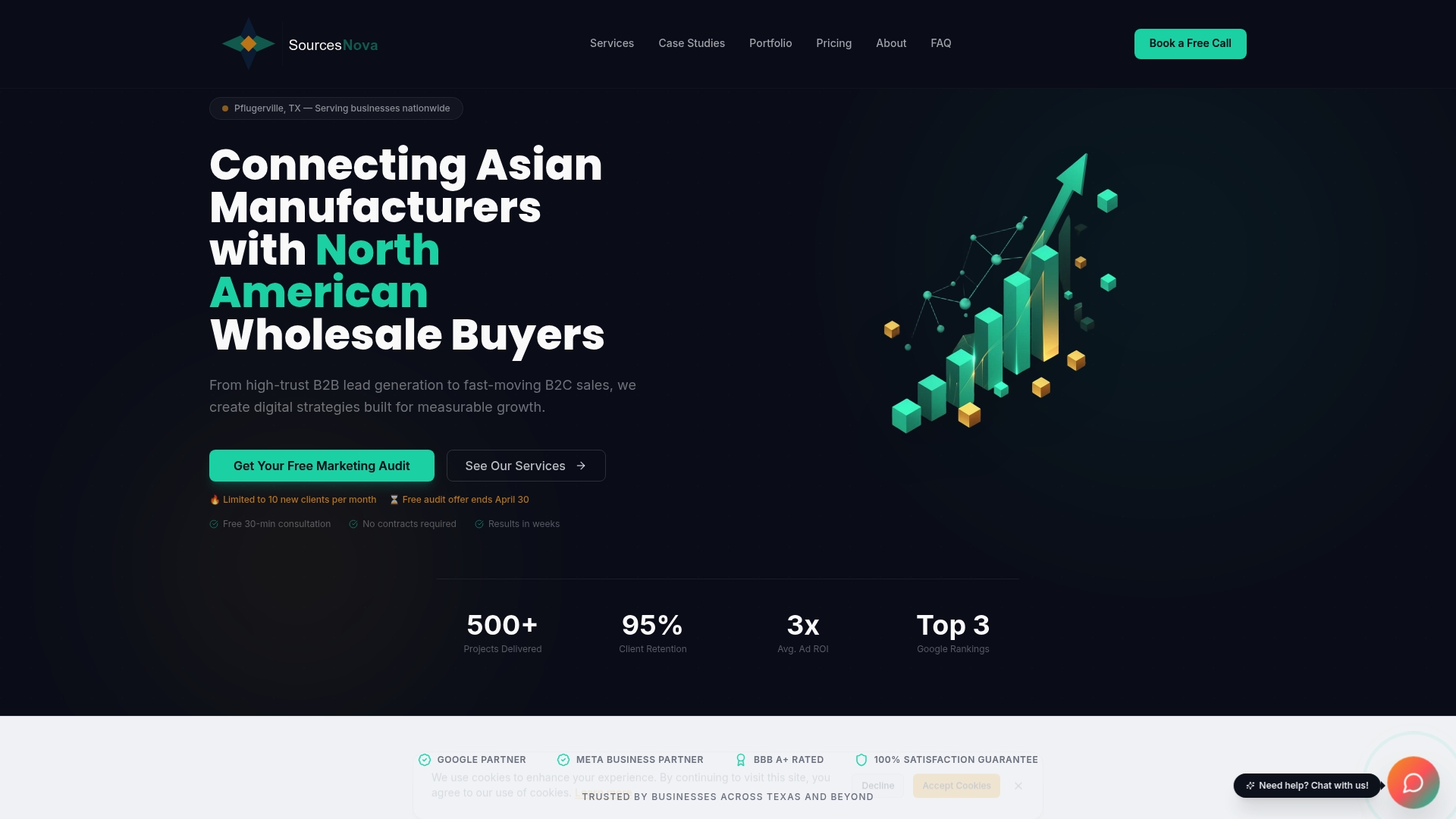
Sourcesnova is a full-service digital growth agency that works with local and small-to-mid-size businesses across industries including retail, e-commerce, beauty, and service businesses. The work is hands-on: clear strategy, real execution, and reporting that tells you what actually changed and why. No monthly contracts that lock you in before results appear, no vanity metrics dressed up as progress.
For businesses ready to move from knowing what good SEO looks like to actually having it, Sourcesnova handles the technical setup, content planning, and ongoing monitoring as a single coordinated effort. Get in touch with Sourcesnova to find out what a focused SEO engagement looks like for your specific business.
Key Takeaways
Effective SEO in 2026 requires technical hygiene, intent-matched content, and genuine authority signals working together, not any single tactic in isolation.
| Point | Details |
|---|---|
| Core Web Vitals thresholds | Core Web Vitals in 2026 require meeting thresholds for LCP (under 2.5s), INP (under 200ms), and CLS (under 0.1) on at least 75% of real user visits. |
| Topical authority over isolated articles | One pillar page linked to multiple related subtopics signals expertise more clearly than standalone content. |
| Mobile-first indexing is the default | Google ranks based on the mobile version of your site, making responsive design and mobile speed baseline requirements. |
| Monitor branded search alongside traffic | AI Overviews can increase brand awareness without generating clicks, so branded search volume is now a core visibility metric. |
| Sourcesnova for hands-on execution | Sourcesnova provides full-service SEO strategy and execution for small and mid-size businesses with no long-term contracts. |