
Every business runs on one of nine core revenue model families: recurring/subscription, transactional, usage-based, marketplace/commission, advertising/affiliate, licensing/resale/markup, freemium, service/retainer, and donation or lead-gen/data models, plus hybrids that blend two or more. The single best rule for choosing among them: if the value you deliver repeats on a predictable schedule, subscription pricing usually wins; if value scales unevenly with how much a customer actually consumes, usage-based pricing fits better.
Here's how the landscape breaks down before you commit to one:
- Predictable, repeating value — subscription, retainer, membership
- Value tied to a single transaction — one-time sales, markup/resale, licensing
- Value that scales with consumption or connection — usage-based, marketplace take rate, advertising, affiliate
Pro Tip: Run a two-week pre-sale test before writing a single line of billing code. Put up a landing page with real pricing, ask for a card or a signed letter of intent, and let actual willingness to pay tell you which model fits.
Key Takeaways
The right revenue model matches how customers experience value, whether repeated and predictable or one-time and transactional, and gets validated cheaply before any billing system gets built.
| Point | Details |
|---|---|
| Match model to value pattern | Repeated, predictable value favors subscription; variable consumption favors usage-based pricing. |
| Validate before building | Test with a landing page, pre-sale, or concierge sale before automating billing. |
| Add hybrids only after stability | Layer a second revenue stream once the primary model shows stable metrics for several months. |
| Track model-specific KPIs | Watch churn and MRR for subscriptions, take rate and GMV for marketplaces, ARPU for freemium. |
| Budget for hidden costs | Freemium support load and hybrid billing complexity often cost more than founders initially plan for. |
Table of Contents
- What Are the Different Types of Revenue Models?
- Revenue Model vs. Business Model vs. Revenue Stream: What's the Difference?
- What Are the Main Types of Revenue Models?
- How Do You Choose the Right Revenue Model?
- When Should You Combine Revenue Models?
- What Metrics Should You Track for Each Revenue Model?
- What Do Real Revenue Model Decisions Look Like?
- How Do You Implement a New Revenue Model?
- What Do Founders Get Wrong About Revenue Models?
- Where Can You Learn More About Revenue Models?
- Sources
What Are the Different Types of Revenue Models?
A revenue model is the specific mechanism a business uses to convert its product or service into cash. It answers one question: how do customers actually pay? A revenue model is distinct from the broader business model, which covers your full value proposition, cost structure, and operations.
Three quick examples show the range:
- A SaaS company charges a flat monthly fee regardless of usage. That's subscription revenue.
- A marketplace takes a percentage of every transaction between buyers and sellers. That's a take-rate model.
- A consulting firm bills a fixed monthly retainer for ongoing advisory work. That's a service revenue model.
Getting this choice right shapes your forecasting accuracy, your gross margin, and how much operational overhead you carry. Pick wrong, and you'll spend a year rebuilding billing infrastructure instead of growing.
Revenue Model vs. Business Model vs. Revenue Stream: What's the Difference?
A revenue model is the mechanism for charging customers. A business model is the full system: value proposition, cost structure, channels, and operations. A revenue stream is one specific inflow of cash within that model.
The distinction matters because each term drives different decisions:
- Revenue model choice determines your billing system and pricing page.
- Business model choice determines your entire operating structure, from hiring to fulfillment.
- Revenue stream tracking determines which KPIs you report to investors or partners.
Picture a SaaS company selling project management software. Its business model is B2B software delivered via cloud subscription. Its revenue model is recurring subscription billing. Its revenue streams are the monthly subscription fees plus a smaller flow from per-transaction payment processing fees layered on top.
What Are the Main Types of Revenue Models?
Below is the canonical catalog most founders need to evaluate. Each model gets a plain definition, its practical trade-offs, and where it tends to show up in the real world.
-
Transactional / one-time sales. You sell a product or service once, and the customer pays once. It's simple to explain and easy for customers to understand, but it gives you zero forecasting reliability and forces constant new-customer acquisition. Retail, e-commerce, and one-off consulting projects run on this model.
-
Subscription / recurring revenue. Customers pay on a fixed schedule (usually monthly or annually) for continued access. It creates predictable recurring revenue and higher customer lifetime value, but it's sensitive to churn and requires billing automation from day one. Subscription pricing dominates SaaS and B2B software because access to the product delivers value continuously rather than once.
-
Usage-based / pay-per-use. Customers pay based on how much they actually consume, measured in API calls, storage, transactions, or compute time. It aligns price directly with delivered value and scales naturally with customer success, but it makes revenue harder to forecast month to month. Usage-based pricing fits products where consumption is measurable and correlates with the value a customer gets, which is why cloud infrastructure, APIs, and AI products increasingly default to it.
-
Freemium. A free tier attracts users; a paid tier unlocks advanced features or removes limits. It drives fast top-of-funnel growth and low-friction adoption, but support costs for free users can quietly erode margin, and conversion rates from free to paid often sit in the low single digits. Cloud storage tools and productivity apps built entire categories on this model.
-
Advertising. You give away content or a product for free and charge third parties for access to your audience's attention. It scales well with traffic and requires no direct payment friction from users, but revenue per user is usually thin and depends entirely on volume. Media publishers, social platforms, and content-driven apps rely on this model.
-
Affiliate / commission. You earn a cut when you refer a customer to another business's product or service. Setup costs are close to zero and there's no inventory or fulfillment burden, but you have no control over the referred product's quality or pricing. Content sites, comparison platforms, and creator businesses lean on this heavily.
-
Licensing. You grant another party the right to use your intellectual property, technology, or brand for a fee. It generates revenue without direct operational involvement in delivery, but negotiating and enforcing licensing terms takes real legal overhead. Software patents, franchise brands, and media content licensing all fit here.
-
Markup / resale. You buy a product at wholesale and sell it at a higher price to capture the spread. It's a well-understood model with straightforward math, but margins are squeezed by competition and supplier pricing power. Retailers, distributors, and import/export businesses run almost entirely on markup economics, a model worth understanding in more depth in SourcesNova's guide to B2B sourcing.
-
Marketplace / take rate. You connect buyers and sellers and take a percentage of each transaction that flows through your platform. It scales without holding inventory, but you need enough liquidity on both sides before the take rate produces meaningful revenue. Two-sided platforms in services, goods, and freelance labor all depend on this.
-
Donation / pay-what-you-want. Customers or supporters choose their own payment amount, including zero. It builds goodwill and works for mission-driven or creator-led projects, but revenue predictability is close to nonexistent and fundraising overhead can eat a large share of what comes in. Wikipedia's own fundraising model is the most visible example of this at scale.
-
Data monetization / lead generation. You collect data or user attention and sell access to it, or you generate qualified leads for other businesses. It can be highly profitable at scale, but it raises real privacy and compliance questions that need legal review before launch. Ad-tech platforms and lead-gen sites in insurance, real estate, and finance built businesses entirely around this.
-
Interest / finance-based. You earn revenue from the spread between what you pay to hold money and what you charge to lend or float it. It requires regulatory licensing in most jurisdictions and real capital reserves, but it can produce strong margins at scale. Fintech lenders, buy-now-pay-later providers, and payment processors use this.
-
Hybrid models. You combine two or more of the above to capture layered value. Many mature SaaS companies now run subscription pricing alongside usage-based fees or transaction charges, because a single model rarely captures everything a diverse customer base is willing to pay for.
Newer 2026-native variants worth watching include outcome-based pricing (you charge based on results delivered, common in AI-driven services) and revenue-share arrangements where a vendor takes a cut of the customer's downstream gains instead of a flat fee. Twelve real-world business model examples show these newer patterns showing up alongside traditional models, particularly in AI tooling and performance marketing.
How Do You Choose the Right Revenue Model?
Run through this checklist in order. Each answer narrows your options before you write a single pricing page.
- What type of product or service are you selling? Physical goods lean toward transactional or markup models. Software and digital services lean toward subscription or usage-based.
- Who is your customer, and how do they buy? Enterprise buyers tolerate retainers and licensing deals; individual consumers respond better to freemium or simple transactional pricing.
- How often does the customer receive value? Continuous value points to subscription. One-time value points to transactional pricing.
- What's your sales motion? Self-serve signups favor freemium or usage-based entry points. High-touch sales favor retainers or enterprise licensing.
- What margin can you tolerate, and what regulatory constraints apply? Thin-margin categories (resale, marketplace) need volume; regulated categories (lending, data) need compliance review before launch.
A five-factor framework covering product type, customer, delivery, sales motion, and margin gives you a repeatable way to run this analysis for any new offering.
Before committing, validate cheaply:
- Build a landing page with real pricing and measure actual signups or pre-orders.
- Run a concierge sale where you deliver the service manually before automating anything.
- Test two or three price points with small ad spend to see where conversion holds.
- Use manual invoicing for your first ten customers instead of building a billing system on day one.
Each checklist item carries its own operational tail. Subscription pricing demands churn tracking and dunning management. Usage-based pricing demands metering infrastructure. Marketplace models demand trust and safety systems before liquidity builds. Match your operational readiness to the model, not just the pricing logic.
When Should You Combine Revenue Models?
Hybrid models make sense once your primary model proves stable and you can see a second, distinct value pool your customers would pay for separately.
Common hybrid patterns include:
- SaaS + usage. Base subscription fee plus metered charges for heavy consumption, common in developer tools and cloud platforms.
- Marketplace + SaaS. Take rate on transactions plus a subscription for premium seller tools.
- Freemium → enterprise licensing. Free self-serve tier that upgrades qualified accounts into custom-priced enterprise contracts.
- Subscription + transaction fee. Flat access fee plus a small charge per completed action, common in fintech and payments.
Three rules keep hybrids from confusing customers: align the second stream with the same value metric customers already understand, keep the billing display simple enough to explain in one sentence, and test any new charge on your most engaged customer cohort before rolling it out broadly. Staged rollouts that instrument metrics before layering on a second stream consistently outperform launching two models at once. A software company adding usage fees, for example, might announce the change to its top 10% most active accounts first, watch churn and support tickets for thirty days, then expand.
What Metrics Should You Track for Each Revenue Model?
Different models live or die on different numbers. Track the ones tied to your actual model, not a generic dashboard template.
- MRR/ARR (monthly or annual recurring revenue): the core health check for subscription businesses.
- ARPU (average revenue per user): reveals whether pricing tiers are pulling their weight.
- Churn rate: rising churn on a subscription model signals a pricing or retention problem before revenue drops show up.
- LTV:CAC ratio: compares what a customer is worth against what it costs to acquire them; unit economics like this explain why some models scale profitably and others don't.
- Gross margin: especially critical for markup and resale models where supplier costs swing directly into profit.
- Take rate / GMV: the marketplace equivalent of revenue, tracking the percentage captured against total transaction volume.
- Usage volatility: how much a customer's consumption swings month to month, a key risk signal for usage-based pricing.
- Freemium conversion rate: the percentage of free users who upgrade, usually the single most-watched number in a freemium business.
What Do Real Revenue Model Decisions Look Like?
A B2B SaaS company selling inventory software for small manufacturers started with a flat subscription. Once usage data showed heavy accounts driving disproportionate support load, the company layered in metered fees for high-volume API calls, keeping the base subscription as the primary value anchor.
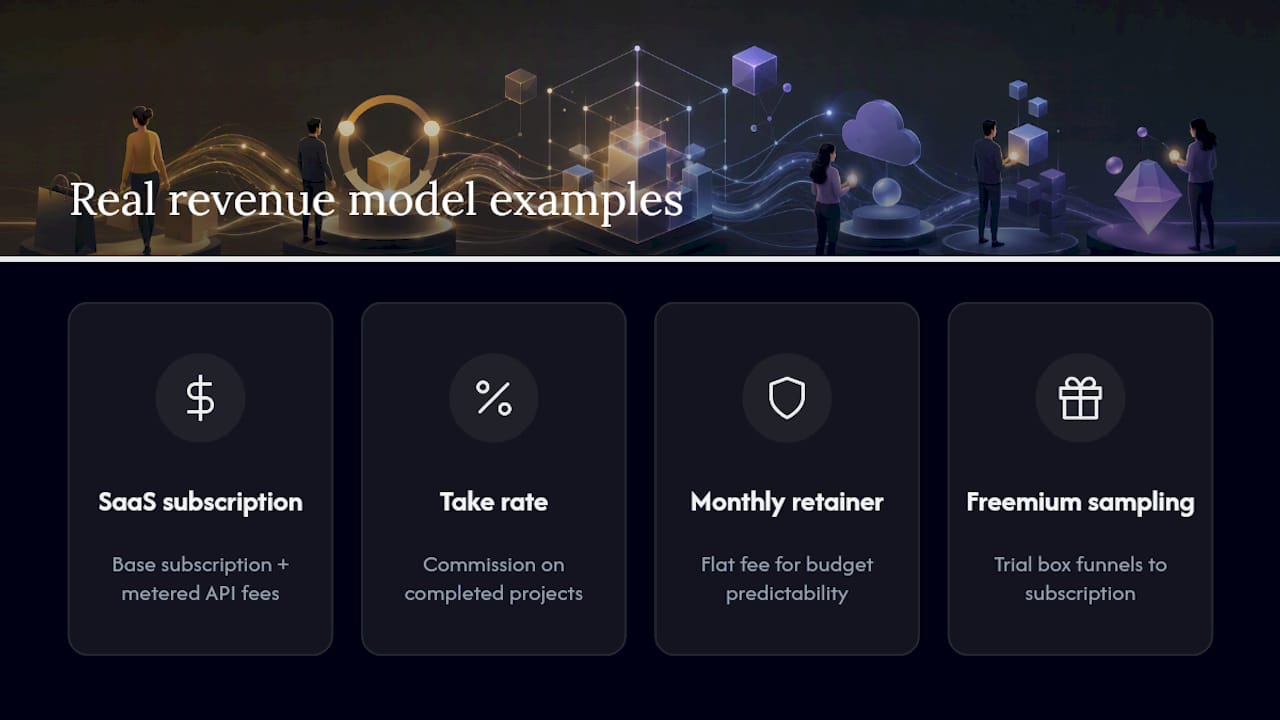
A marketplace connecting freelance industrial designers with manufacturers launched with a straight take rate on completed projects. Liquidity was the real constraint early on, not pricing, so the team spent six months on supply-side recruitment before touching the commission percentage.
A productized compliance consultancy serving import/export businesses chose a flat monthly retainer over hourly billing, because clients wanted budget predictability more than granular invoices. The retainer model also let the firm forecast staffing needs a quarter ahead.
A small consumer subscription box business in the beauty space chose freemium sampling (a free trial box) that funneled into a paid monthly subscription, betting that physical product trial would convert better than a discount code.
Watch for the same friction points across all four: billing complexity creeps in fastest with usage-based add-ons, support costs balloon fastest under freemium, and churn math quietly undermines subscription models that look healthy on the surface.
How Do You Implement a New Revenue Model?
- Set baseline metrics before changing anything: current ARPU, churn, and conversion rates.
- Choose a billing provider that supports your model's complexity, from simple invoicing to metered usage tracking.
- Design a pricing experiment with a control group and a clear success metric.
- Run a tax and compliance check specific to your jurisdiction and product category.
- Build invoicing and dunning flows before you need them at scale, not after.
- Prepare customer support scripts for billing questions before launch, not during the first wave of tickets.
Pro Tip: Skip full billing automation during your first pricing test. Manual invoicing or a simple Stripe payment link gets you real signal in days, and you can build the automated system once you know the model actually works.
What Do Founders Get Wrong About Revenue Models?
The most common mistake is building a hybrid model before the primary one has proven itself. Founders add a second revenue stream to chase a bigger number on a pitch deck, then spend the next two quarters untangling billing confusion instead of growing the core product.
The second mistake is underestimating what freemium actually costs. A free tier isn't free to run. Every free user still generates support tickets, infrastructure load, and churn risk, and teams that don't budget for that discover it the hard way around month four.
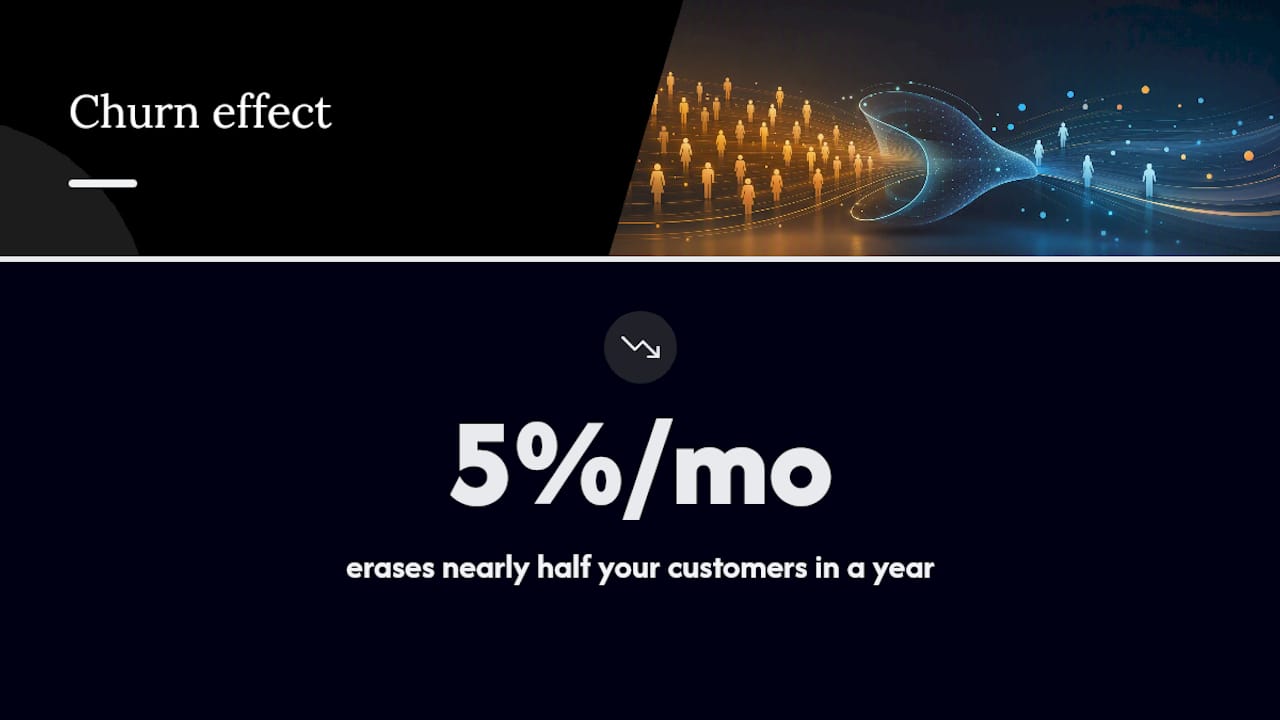
The third is ignoring churn math on subscription models. A 5% monthly churn rate sounds small until you calculate that it erases nearly half your customer base within a year. Founders who track this number weekly catch pricing and retention problems months before revenue actually drops.
Businesses working through a market entry or pricing strategy shift can find structured support through SourcesNova's services, where go-to-market and revenue planning get handled alongside the broader growth work.
Where Can You Learn More About Revenue Models?
For deeper reading beyond this guide:
- Revenue Models (Carnegie Mellon) covers the foundational definitions and taxonomy referenced throughout this article.
- Revenue Models: Types, Examples & How to Choose offers a fuller catalog of models with staged hybrid rollout guidance.
- Revenue Model: Guide to Choosing and Building Yours breaks down the five-factor selection framework used in this guide's checklist.
- Business Model Examples: 12 Real Models With Revenue Math walks through unit economics for a dozen real business types.
- Startup Revenue Models Explained With Examples is useful for founders weighing subscription against usage-based pricing specifically.
For related strategy work, see product sourcing strategies that drive small business growth, why direct-to-consumer models work for manufacturers, and building a repeatable B2B sales engine. Founders looking for a broader view on moving from one-off deals to repeatable revenue can also check Terial's webinar on building predictable growth. If you're weighing market entry alongside your pricing strategy, SourcesNova can help connect the two.
Sources
- Revenue Models
- Revenue Models: Types, Examples & How to Choose (2026)
- Revenue Model: Guide to Choosing and Building Yours - Fullcast
- Business Model Examples: 12 Real Models With Revenue Math
- Startup Revenue Models Explained With Examples - Startupik