
Small business marketing is the most direct path to predictable revenue growth, and the case for investing in it has never been clearer. Done right, it lets you reach the right customers at the right time, without the budget of a Fortune 500 company. Here is why it works, and how to make it work for you.
- Marketing creates a repeatable system for customer acquisition, replacing guesswork with measurable results.
- Digital channels offer real-time ROI tracking, so every dollar you spend is accountable.
- Small businesses can personalize outreach in ways large corporations cannot, building loyalty that sticks.
- Focused marketing lets you do more with limited time and budget by concentrating effort where it counts.
- A clear strategy lets a small business compete directly with larger firms on visibility and credibility.
What does small business marketing actually include?
Small business marketing covers every method a business uses to attract customers, build its reputation, and generate sales, all sized to fit a smaller team and a tighter budget. It is not a separate department or a quarterly campaign. For most small businesses, marketing is woven into daily operations, from how the phone gets answered to how a Google Business Profile looks at 9 PM on a Tuesday.
The core digital components are SEO, social media, email marketing, and content marketing. Each one serves a different purpose:
- SEO improves your visibility in search results so customers find you before they find someone else.
- Social media builds community and keeps your brand visible between purchases.
- Email marketing nurtures existing customers and drives repeat business at very low cost.
- Content marketing (blog posts, videos, guides) establishes authority and answers the questions your customers are already asking.
Beyond digital, small business marketing also includes local tactics like sponsoring community events, collecting online reviews, and building referral programs. The U.S. Small Business Administration recommends that every business maintain a written marketing plan that covers audience, goals, channels, and budget, updated at least annually. That plan is what turns marketing from a vague intention into a working system.
Why does marketing deliver such strong benefits for small businesses?
The advantages of targeted marketing for small businesses go beyond brand awareness. They show up in customer acquisition costs, retention rates, and long-term revenue.
-
Lower acquisition costs. Digital marketing reaches specific audiences without the waste of broad traditional advertising. Marketers allocate 57% of budgets to digital channels precisely because the return is measurable and the targeting is precise.
-
Brand trust that converts. Customers research before they buy. 43% of users look up a brand online before making a purchase decision, which means your online presence either builds confidence or loses the sale before you ever speak to the prospect.
-
Customer retention through personalization. 66% of customers expect personalized experiences from the businesses they buy from. Small businesses have a structural advantage here: you know your customers by name, you remember their preferences, and you can tailor communication in ways a large retailer cannot replicate at scale.
Stat worth noting: More than half of marketing professionals reported a 100% improvement in email marketing ROI after consistent execution, making it one of the highest-return channels available to small businesses.
Small businesses also benefit from speed. Less organizational complexity means you can test a new campaign this week, read the results, and adjust by next week. That agility is a genuine competitive edge over larger firms that require months of approvals before anything goes live.
Which marketing strategies work best for small businesses?
The most effective approach is not to be everywhere. It is to be excellent in a few places. Forbes Advisor consistently points to a focused channel strategy as the defining factor between small businesses that grow and those that stall.
- Local SEO. 46% of Google searches carry local intent, meaning nearly half of all searches are people looking for something nearby, making local sourcing for packaging an important aspect of connecting with local audiences. Claiming and optimizing your Google Business Profile, collecting reviews, and using location-specific keywords puts you directly in front of high-intent buyers.
- Email marketing. Build a list from day one. Even a modest list of a few hundred engaged subscribers outperforms a social media following of thousands in terms of direct sales conversion.
- Social media (selective). Pick one or two platforms where your customers actually spend time. Consistency on one platform beats sporadic posting across five.
- Online reviews and referrals. Ask satisfied customers to leave a Google or Yelp review immediately after a positive experience. Reviews function as always-on word-of-mouth and directly influence local search rankings.
- Content marketing. A well-written blog post or short video that answers a common customer question can drive organic traffic for years. It also positions you as the expert in your category.
For local SEO specifically, the setup is straightforward: claim your Google Business Profile, fill every field completely, add photos, post weekly updates, and respond to every review. That alone puts most small businesses ahead of competitors who have not bothered.
Pro Tip: Link your local marketing efforts to your Google Business Profile from day one. Businesses with complete profiles receive significantly more direction requests and website clicks than those with incomplete listings.
How do you build a small business marketing strategy that actually works?
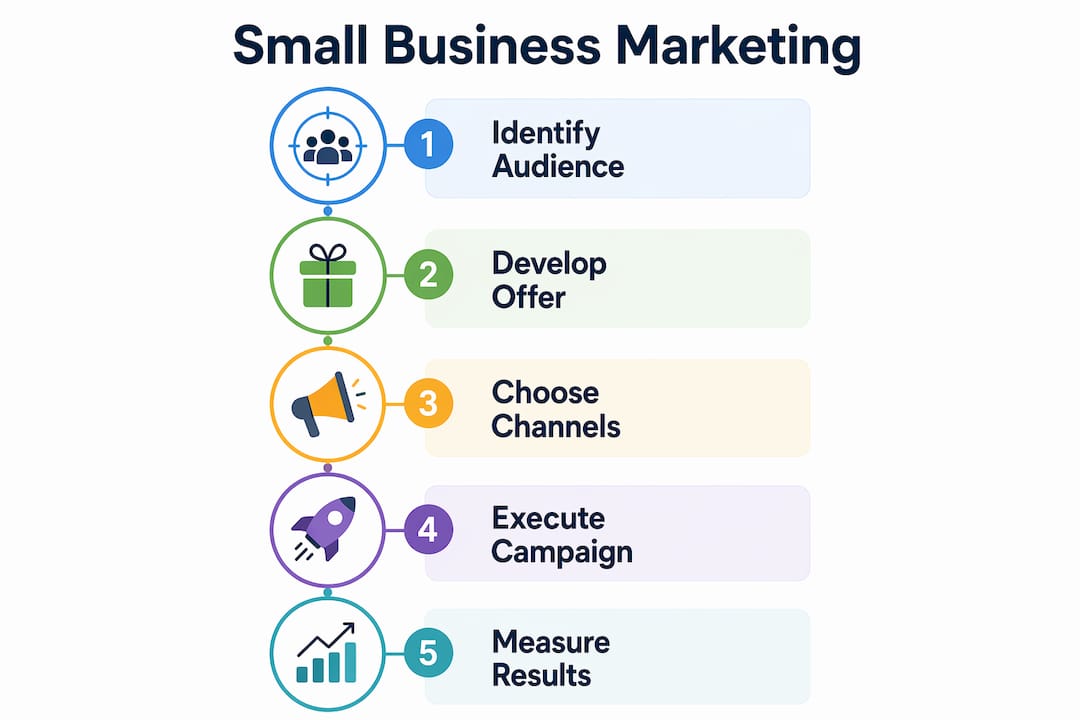
A working marketing strategy starts with clarity, not creativity. Before you choose a channel or write a single post, answer three questions: Who are you trying to reach? What do you want them to do? How will you know if it worked?
The SBA's marketing framework breaks this into a practical checklist:
- Define your audience in detail: demographics, location, buying habits, and what problem they need solved.
- Set measurable goals: email subscribers, monthly website visits, number of new customer inquiries, or revenue from a specific channel.
- Select 3–5 channels based on where your audience already is, not where you wish they were.
- Build a realistic budget with a line item for each channel and a target ROI for each.
- Schedule a monthly review to compare spend against results and adjust accordingly.
Integrating marketing with daily operations is where most small businesses gain an edge. Your staff's customer interactions, your packaging, your follow-up emails after a sale: all of these are marketing touchpoints. Treating them as such, and building your digital brand around consistent messaging, compounds over time.
Authenticity is not a soft concept here. Owner-led storytelling, transparent communication about your process, and genuine responses to customer feedback build the kind of trust that paid advertising cannot buy. Small businesses that lean into this have a real advantage over faceless corporate competitors.

What do the 2026 data trends say about small business marketing?
The numbers paint a clear picture of where small business marketing is heading and where the gaps still are.
| Metric | Data Point | Implication |
|---|---|---|
| Website ownership | 73% of US small businesses have a website | Having a website is a standard expectation, forming the foundation for all digital marketing efforts. |
| Digital budget share | 57% of marketing budgets go to digital | Digital is now the primary channel, not a supplement |
| Local search volume | 46% of Google searches have local intent | Local SEO is a direct revenue driver, not optional |
| Personalization demand | 66% of customers want personalized experiences | Generic outreach loses customers to competitors who personalize |
| Pre-purchase research | 43% research brands online before buying | Your online presence is your first sales conversation |
"Start small and stay focused. Pick three to five marketing channels that align with your audience and execute them consistently before adding more. Spreading effort across too many channels at once is the fastest way to see no results from any of them."
— Forbes Advisor on small business marketing
AI-powered tools are also reshaping what small businesses can do without a large team. Platforms that automate email sequences, generate social media content, and analyze customer behavior are now accessible at price points that fit a small business budget. The businesses gaining ground in 2026 are those using these tools to execute consistently, not those waiting for a perfect strategy before they start.

What challenges do small businesses face in marketing, and how do you fix them?
The three most common obstacles are budget constraints, time limitations, and not knowing what is working. Each one has a practical solution.
Budget. The instinct is to wait until there is more money. The better move is to start with the highest-ROI channels first: local SEO and email cost very little to run and deliver measurable results. Paid advertising can come later, once you have a baseline understanding of what messaging converts.
Time. Marketing falls off when it competes with daily operations. The fix is a simple content calendar: decide what you will post or send each week, batch-create it on one day, and schedule it in advance. Two hours on a Monday morning can cover an entire week of social posts and one email.
Measurement. If you cannot tell what is working, you cannot improve it. Google Analytics 4, Google Search Console, and your email platform's built-in reporting give you enough data to make informed decisions without a dedicated analyst. Track three metrics consistently: website traffic, lead volume, and conversion rate.
Small businesses also tend to underestimate the power of customer testimonials as a marketing asset. A short video review from a real customer, posted to your website and social channels, addresses objections and builds credibility simultaneously.
What do successful small business marketing campaigns look like?
The most effective campaigns share a common structure: a clear audience, a specific offer, and a single call to action. They are not complicated. They are consistent.
A local nail salon that sends a monthly email to its client list with a seasonal promotion and a "refer a friend" discount is running a marketing campaign. It costs almost nothing, and it drives repeat visits and new customer referrals every month. A lighting retailer that posts weekly installation photos on Instagram, tags the neighborhoods where the work was done, and asks customers to leave a Google review after each job is building local SEO authority and social proof at the same time.
What these examples have in common is that they connect marketing directly to the customer experience. The SBA notes that operational details like staff presentation, product origin, and the return process all shape how customers perceive a brand. The businesses that treat every customer interaction as a marketing moment tend to build the strongest word-of-mouth over time.
How should you budget for small business marketing?
Start with a percentage of revenue, not a fixed dollar amount. The SBA and most financial advisors suggest allocating 7%–8% of gross revenue to marketing for businesses generating under $5 million annually, though newer businesses often need to invest more aggressively to build initial awareness.
Prioritize channels in this order based on cost-to-return ratio:
- Google Business Profile (free, high local impact)
- Email marketing (low cost, highest measured ROI among digital channels)
- Organic social media (free, time-intensive but builds community)
- Content marketing / SEO (low cost, long-term compounding returns)
- Paid advertising (scalable, but requires a tested message before spending)
Track every dollar against a specific outcome. If a channel is not generating leads or sales after 90 days of consistent effort, reallocate that budget. The digital marketing strategy that works is the one you can sustain and measure, not the one that looks most impressive on paper.
Key Takeaways
Small business marketing works because it combines targeted reach, measurable ROI, and the personalization advantages that only smaller, agile businesses can deliver consistently.
| Point | Details |
|---|---|
| Start with focus | Limit your efforts to 3–5 channels; consistency on fewer channels outperforms scattered presence. |
| Local SEO is a priority | 46% of Google searches have local intent, making your Google Business Profile a direct revenue tool. |
| Email delivers the highest ROI | More than half of marketing professionals saw 100% improvement in email ROI with consistent execution. |
| Personalization is a structural advantage | 66% of customers want personalized experiences, and small businesses can deliver this more naturally than large ones. |
| Measure and adjust monthly | Track website traffic, lead volume, and conversion rate; reallocate budget away from channels that do not convert within 90 days. |
Sourcesnova works with small and local businesses that are done paying for marketing that produces nothing. If you want a clear strategy, hands-on execution, and results you can actually measure, talk to Sourcesnova about what growth looks like for your business.