
High-quality external links remain one of the strongest signals search engines and AI systems use to judge a site's authority. That single fact is why link building matters for any site competing for organic visibility in 2026. Three reasons stand out immediately:
- Authority and ranking signal. Every editorial link from a credible site acts as a third-party vote of confidence, and Backlinko's analysis shows the top-ranking result has roughly 3.8 times more backlinks than pages ranked #2 through #10.
- Referral traffic and credibility. A well-placed link on a relevant publication sends qualified visitors directly to your site, independent of search rankings entirely.
- Brand and entity signals. Consistent mentions, linked or not, help AI-powered search systems recognize your brand as an authoritative entity in its category.
Key Takeaways
Link building remains one of the most durable authority signals in SEO, and sites that invest consistently in quality backlinks and entity signals outperform those that rely on content and technical SEO alone.
| Point | Details |
|---|---|
| Links still drive rankings | The top-ranking result has roughly 3.8x more backlinks than positions #2–#10, per Backlinko. |
| Quality and diversity over volume | Referring domain count predicts performance better than total link count; prioritize new domains. |
| Entity signals matter too | Unlinked brand mentions now contribute to AI-driven authority signals alongside traditional backlinks. |
| Results take time | Initial ranking movement typically appears in 6–12 weeks; compounding gains build over 6–24 months. |
| Sourcesnova's audit-first model | Sourcesnova starts every engagement with a backlink audit and prioritized outreach plan tied to measurable outcomes. |
Table of Contents
- What link building is and why the terminology matters
- Concrete benefits: how link building moves the business needle
- How search engines and AI systems actually use links
- What makes a backlink valuable
- Ethical, high-impact tactics to earn quality links
- What to avoid: risky and spammy link practices
- How to measure link building impact and realistic timelines
- When to prioritize link building versus other SEO work
- Sourcesnova's approach to link building
- Sources
What link building is and why the terminology matters
Link building, in its simplest form, is the practice of earning hyperlinks from other websites that point to yours. Those links are called backlinks or inbound links, and search engines treat them as editorial endorsements. The practice is distinct from internal linking (connecting your own pages to each other) and from on-page SEO (optimizing content, titles, and structure within your site). Link building is an off-page discipline that depends on what other sites say about you.
A few terms you will encounter throughout this guide:
- Backlink. Any hyperlink on an external website that points to a page on your site.
- Referring domain. The unique website sending the link. One domain linking to you ten times still counts as one referring domain, which is why domain diversity matters more than raw link counts.
- Anchor text. The visible, clickable words of a hyperlink. Anchor text gives search engines context about what the linked page covers.
- Dofollow vs. nofollow. A dofollow link passes ranking authority (often called "link equity") to the destination page. A nofollow attribute tells search engines not to pass that equity, though nofollow links can still drive traffic and brand awareness.
One more signal worth understanding: unlinked brand mentions. When another site references your brand name without a hyperlink, AI-driven search systems can still register that mention as an entity signal. This is the foundation of what practitioners now call Entity SEO, and it means your link building strategy should account for brand mentions alongside traditional hyperlinks.
Concrete benefits: how link building moves the business needle
The benefits of link building are not theoretical. They show up in measurable business outcomes across rankings, traffic, and revenue.
- Search ranking lift. Pages with more high-quality backlinks tend to rank higher for competitive keywords. The correlation is consistent across industries.
- Referral traffic. A link on a high-traffic publication sends readers directly to your site. That traffic arrives pre-qualified because the reader already trusted the source.
- Cumulative domain authority. Each new referring domain adds to your site's overall authority profile. This compounds: a stronger authority baseline makes it easier to rank new pages faster.
- Third-party credibility. Being cited by recognized publications signals legitimacy to both search engines and human visitors. It functions as social proof at scale.
- Faster indexing. Search engine crawlers follow links. A new page linked from an already-indexed, authoritative site gets discovered and indexed faster than one sitting in isolation.
- PR and partnership opportunities. Outreach for links often opens doors to co-marketing, guest contributions, and industry relationships that extend well beyond a single backlink.
Consider a realistic example: a manufacturer's product page earns a placement in an industry trade publication's "top suppliers" roundup. That article sends 400 qualified visitors over 90 days. Of those, 12 request quotes, and 2 convert to contracts. The link itself did not close the sale, but it created the entry point. Pair that with retargeting campaigns for visitors who did not convert immediately, and the referral traffic compounds further.
The compounding ROI argument is straightforward. A link earned today continues to send traffic and pass authority well into the future. Paid advertising stops the moment the budget does. That asymmetry is why early investment in link building tends to outperform short-term paid spend on a cost-per-acquisition basis over a 12–24 month horizon, as industry data consistently shows.
How search engines and AI systems actually use links
Links still matter. Their role has become more nuanced, not less important, as Search Engine Land's 2026 analysis makes clear. Understanding how they function helps you invest in the right kinds.
PageRank basics. Google's original PageRank algorithm treated each link as a vote. A link from a high-authority page passed more value than one from a low-authority page. That core logic still operates inside modern ranking systems, though it is one signal among many.
Why a link is an editorial endorsement. When a site links to yours without being paid or pressured to do so, it signals that an independent party found your content credible enough to reference. Google's Search documentation explicitly describes editorial links as the type it values and spam policies as the mechanism it uses to discount or penalize manipulative link schemes.
Modern signals related to links that search engines weigh today:
- Referring domain diversity. Links from 50 different domains carry more weight than 50 links from the same domain.
- Topical relevance. A link from a site in your industry carries more contextual authority than one from an unrelated niche.
- Co-citation and co-occurrence. Being mentioned alongside recognized authorities in your field, even without a direct link, can reinforce your entity status.
- Anchor text context. The surrounding text of a link tells search engines what the linked page is about.
- Unlinked brand mentions. AI search systems increasingly use these as entity signals, per Search Engine Land's reporting on AI search and link strategy.
The Backlinko data showing the #1 result has roughly 3.8 times more backlinks than positions #2 through #10 is a correlation finding, not proof of causation. Rankings and backlinks can reinforce each other in a loop: higher-ranked pages attract more links, which sustains the ranking. The practical implication is that building links accelerates entry into that loop rather than waiting for organic discovery to do it slowly.
What makes a backlink valuable
Not every link moves the needle equally. Evaluating link quality before pursuing an opportunity saves time and protects your profile from low-value or risky placements.
Key attributes that determine a backlink's value:
- Referring domain authority and reputation. A link from a well-established, trusted publication carries more weight than one from a newly registered site with no traffic.
- Topical relevance. A link from a site covering your industry is worth more than one from a completely unrelated domain, even if the unrelated site has higher authority.
- Placement within the page. In-body editorial links within content carry more weight than footer links, sidebar links, or links buried in boilerplate.
- Anchor text naturalness. Anchor text should describe the linked page accurately and vary across your backlink profile. Over-optimized, keyword-heavy anchor text patterns are a red flag to search engines.
- Link diversity. A profile with links from many different domains, content types, and industries looks natural. A profile dominated by one source type does not.
- Editorial context. Was the link placed because the content genuinely warranted it, or was it placed transactionally? Search engines are increasingly capable of distinguishing between the two.
- Follow vs. nofollow. Dofollow links pass authority; nofollow links do not. However, a nofollow link from a high-traffic publication still drives real visitors and contributes to brand recognition.
- Traffic potential from the source page. A link on a page that receives substantial organic traffic can send meaningful referral visitors regardless of its authority score.
Pro Tip: Referring domain count is a better predictor of ranking performance than total backlink count. Prioritize earning links from new domains over accumulating more links from sites already in your profile.
The value equation also shifts by site type. An e-commerce site benefits most from links on product review pages, comparison guides, and industry directories with genuine traffic. A local business gains more from regional publications, chamber of commerce listings, and local news coverage than from national links with no geographic relevance. A content-focused blog or publisher benefits from editorial citations in academic or trade contexts. Match your outreach targets to your site type.
Ethical, high-impact tactics to earn quality links
Semrush's 2026 link building guide frames tactics into two useful categories: link producers (scalable, lower effort per link) and association producers (resource-intensive but higher editorial value). Both have a place depending on your goals and budget.
- Create linkable assets and original data. Publish research, surveys, original datasets, or tools that other sites will cite naturally. Start by identifying one data gap in your industry and filling it with a publicly shareable report.
- Digital PR and journalist outreach. Pitch stories, expert commentary, and data to journalists covering your industry. Use platforms like HARO or Qwoted to respond to journalist queries; one placement in a major publication can generate multiple secondary citations.
- Guest articles on topic-relevant publications. Write substantive articles for industry blogs and trade publications that include a contextual link back to your site. Vet each publication for real traffic and editorial standards before investing writing time.
- Content partnerships and resource pages. Identify resource pages in your niche that link to tools, guides, or suppliers, then pitch your content as a relevant addition. A short email explaining what your resource adds that the existing list lacks converts better than a generic outreach template.
- Reclaiming broken or unlinked mentions. Find sites that mention your brand without linking, or that link to a page that no longer exists, and request a correction. Use tools like Ahrefs or Semrush to surface these opportunities; they require minimal effort relative to cold outreach.
- Expert contributions and co-citation building. Contribute quotes, data, or analysis to industry roundups, podcasts, and reports. Being cited alongside recognized authorities in your field builds entity signals even when the link itself is nofollow.
- Strategic partnerships and editorially relevant directories. Pursue listings in directories that have genuine editorial standards and real traffic, such as industry associations, accreditation bodies, and curated supplier lists. Avoid any directory that accepts all submissions without review.
Pro Tip: Score outreach targets by three criteria before contacting them: domain authority (relative to your current profile), topical relevance, and estimated organic traffic. A mid-authority site with strong topical alignment and real traffic often delivers more value than a high-authority site with no relevance to your niche.
What to avoid: risky and spammy link practices
Low-quality or manipulative link building does not just fail to help. It can trigger manual penalties or algorithmic demotions that take months to recover from. Google's spam policies are explicit about the link schemes it targets.
Red flags to avoid:
- Purchased links. Paying for a dofollow link that is not disclosed as sponsored violates Google's guidelines and risks a manual action.
- Link networks and private blog networks (PBNs). Sites built specifically to pass links to other sites are detectable and regularly devalued or penalized.
- Mass low-quality directory submissions. Submitting to hundreds of directories with no editorial standards creates a spammy profile that can drag down overall authority.
- Over-optimized anchor text patterns. If a high percentage of your backlinks use the same exact-match keyword phrase as anchor text, it signals manipulation.
- Sudden, unnatural link spikes. A sharp, unexplained surge in backlinks can trigger algorithmic scrutiny, especially if those links come from low-quality sources.
- Link-selling marketplaces. Platforms that openly sell dofollow placements are well-known to search engines and frequently discounted or flagged.
If you discover spammy links already pointing to your site, the response follows a clear sequence: first, attempt to contact the webmaster of the linking site and request removal. Document every outreach attempt. If removal is not possible and the links appear to be causing harm, use Google's Disavow Tool as a last resort, submitting a properly formatted disavow file. Disavowing is not a routine maintenance task; it is a remediation step for confirmed harmful links.
If your site has received a manual action for unnatural links, consult an experienced SEO professional before making changes. Incorrect disavow submissions can remove legitimate links and worsen the situation.
How to measure link building impact and realistic timelines
Tracking the right metrics prevents you from drawing the wrong conclusions. Link building results are not immediate, and confusing short-term noise with long-term signal leads to poor decisions.
Metrics to track:
- Referring domain count. The primary growth metric. Track new referring domains added per month and the quality distribution of those domains.
- Organic rankings for target keywords. Monitor position changes for the specific pages you are building links to.
- Organic traffic by page. Rankings matter less than the traffic they produce. Track sessions and engagement for linked pages.
- Referral traffic from placements. Measure direct visits arriving from the linking page, not just the SEO benefit.
- Domain-level authority metrics. Tools like Ahrefs Domain Rating (DR) or Semrush Authority Score are relative, proprietary metrics, not Google scores. Use them for benchmarking and trend analysis, not as absolute targets.
- SERP and AI visibility. Track whether your brand appears in AI-generated answers and featured snippets for target queries, since entity signals now influence these placements alongside traditional backlinks.
Expected timelines:
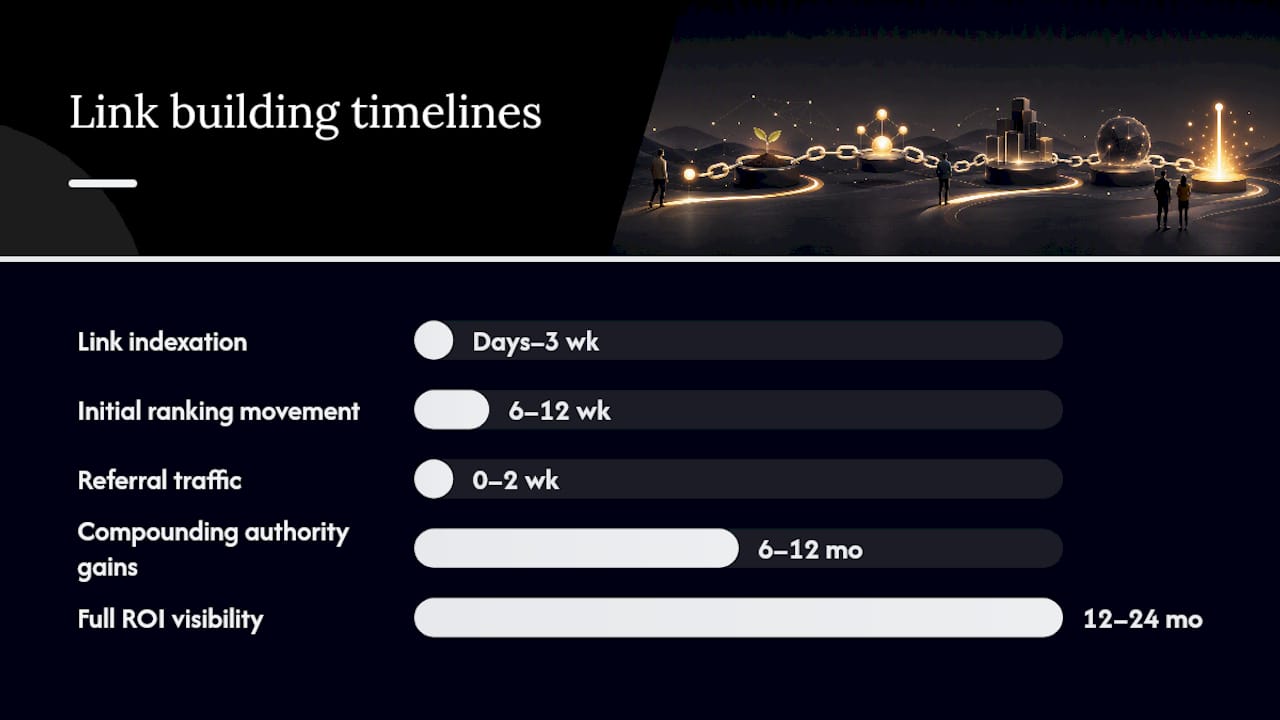
- Indexation. A new link from an active, crawled site is typically discovered within days to a few weeks.
- Early ranking movement. Initial ranking shifts for target pages often appear within 6–12 weeks of earning quality links, per LinkScope's guidance on link building timelines.
- Compounding domain-level effects. Sustained link building over 6–12 months produces cumulative authority gains that accelerate ranking for new pages. The compounding effect becomes most visible in the 12–24 month range.
| Metric | Typical Timeframe | Notes |
|---|---|---|
| Link indexation | Days to 3 weeks | Faster from high-crawl-frequency domains |
| Initial ranking movement | 6–12 weeks | Varies by keyword competition and page authority |
| Referral traffic from placement | Immediate to 2 weeks | Depends on source page traffic |
| Compounding authority gains | 6–12 months | Accelerates as referring domain count grows |
| Full ROI visibility | 12–24 months | Best measured against organic traffic and conversions |
On cost and effort: link producer tactics (reclaiming mentions, resource page outreach, directory listings) scale at lower cost per link but yield modest individual authority gains. Association producer tactics (digital PR, original research, expert contributions) require higher upfront investment in time and content but deliver stronger editorial links from higher-authority sources. A balanced program uses both, with the mix shifting toward association producers as the site's authority baseline grows. For more on how link building fits into broader SEO strategy, technical health and content readiness should be confirmed before heavy outreach begins.
When to prioritize link building versus other SEO work
Link building is not always the highest-leverage activity. The right time to invest heavily in outreach depends on where your site stands technically and editorially.
Prioritize link building when:
- Your site is technically sound (fast load times, clean crawl, no major indexation issues).
- You have content worth linking to: substantive pages, original data, or resources that provide genuine value to an external audience.
- You are targeting competitive keywords where authority is the primary gap between your rankings and your competitors'.
- You are launching a new site or product and need to accelerate authority accumulation.
- You are running a PR campaign or product launch that creates natural outreach hooks.
Pause or delay link building when:
- Your site has significant technical issues that prevent proper crawling or indexing. Fix those first.
- Your core pages are thin, outdated, or lack the depth to earn editorial links. Content investment comes before outreach.
- Your budget is extremely limited and you have not yet established baseline organic visibility. In that case, digital advertising may deliver faster initial traffic while content and technical foundations are built.
Small sites can start with link producer tactics immediately: reclaim unlinked mentions, pursue relevant directory listings, and contribute expert quotes to industry roundups. These require minimal budget and build early authority. Association producer work, such as original research and digital PR campaigns, can be planned in parallel for higher-impact placements once content assets are in place. For a full strategic framework, Sourcesnova's 2026 SMB growth blueprint covers how link building fits alongside content, paid, and technical priorities.
Sourcesnova's approach to link building
Sourcesnova works with businesses that want measurable results from their SEO investment, not a monthly report full of metrics that do not connect to revenue. The approach starts with a backlink audit to establish your current authority baseline, identify gaps, and flag any risky links already in your profile. From there, a prioritized outreach plan targets referring domains by authority, topical relevance, and traffic potential, so every hour of outreach effort goes toward placements that actually move rankings.
Typical deliverables include a full backlink audit, a scored target domain list, outreach templates and follow-up sequences, placement confirmation and reporting, and a monthly performance dashboard tracking referring domain growth, ranking movement, and referral traffic. Pricing is transparent, and reporting focuses on metrics that connect to business outcomes, not vanity scores.
If you are ready to build a link profile that compounds over time, contact Sourcesnova to start with an audit and a clear outreach roadmap.
Sources
These sources cover the core concepts in this guide and are worth bookmarking for ongoing reference:
- How important are backlinks for SEO in 2026? - Search Engine Land
- Link building for SEO: What works in 2026 - Semrush
- What is link building in SEO? - Yoast
- Search engine ranking: Backlinko
- Search documentation - Google Developers