
Market segmentation is defined as the process of dividing a broad market into smaller, distinct groups that share meaningful characteristics, so businesses can deliver targeted marketing instead of generic messaging. The standard industry framework for applying this concept is the S-T-P model: Segmentation identifies the groups, Targeting selects which groups to pursue, and Positioning tailors the message for each one. Tools like HubSpot's marketing glossary and SurveyMonkey's segmentation research both treat the S-T-P model as the operational backbone of any serious marketing program. For marketing professionals and business owners, understanding segmentation is the first step toward spending less and converting more.
What is market segmentation and how does it work?
Market segmentation works by grouping customers based on shared traits, then building campaigns that speak directly to each group's needs. Without segmentation, a business sends the same message to a 22-year-old college student and a 55-year-old executive. That message will resonate with neither. Segmentation fixes that problem by giving marketers a clear picture of who they are actually talking to.
The S-T-P model operationalizes segmentation in three steps. First, you identify distinct groups within your market. Second, you select the groups worth pursuing based on size, profitability, and fit. Third, you craft a positioning statement that speaks to each group's specific priorities. Skipping any step weakens the entire effort. A segment without a tailored position is just a list of names.

Segmented campaigns also make performance measurement far cleaner. When each campaign maps to a defined group, you can test, compare, and reallocate budget based on real results rather than gut instinct. That clarity is one of the most underrated benefits of segmentation.
What are the main types of market segmentation?
Five primary segmentation approaches cover the vast majority of use cases: demographic, geographic, psychographic, behavioral, and firmographic.
Demographic segmentation divides customers by age, gender, income, education, or family status. A luxury car brand targets high-income adults aged 35 and older. A children's clothing retailer targets parents with children under 12. Demographic data is the easiest to collect, but it is also the least predictive of actual purchase behavior.
Geographic segmentation groups customers by location, from country level down to zip code. A regional restaurant chain focuses on customers within a 10-mile radius. A cold-weather apparel brand concentrates spend in northern states during fall and winter. Geography shapes buying habits in ways that demographics alone cannot capture.
Psychographic segmentation goes deeper, grouping customers by values, lifestyle, personality, and interests. A sustainable clothing brand targets environmentally conscious consumers who prioritize ethical production. This approach requires more research but produces messaging that connects on a personal level.
Behavioral segmentation focuses on what customers actually do: purchase frequency, brand loyalty, product usage, and response to promotions. Behavioral targeting outperforms basic demographic approaches because it is grounded in real actions rather than assumed characteristics. A SaaS company targeting power users who log in daily is practicing behavioral segmentation.
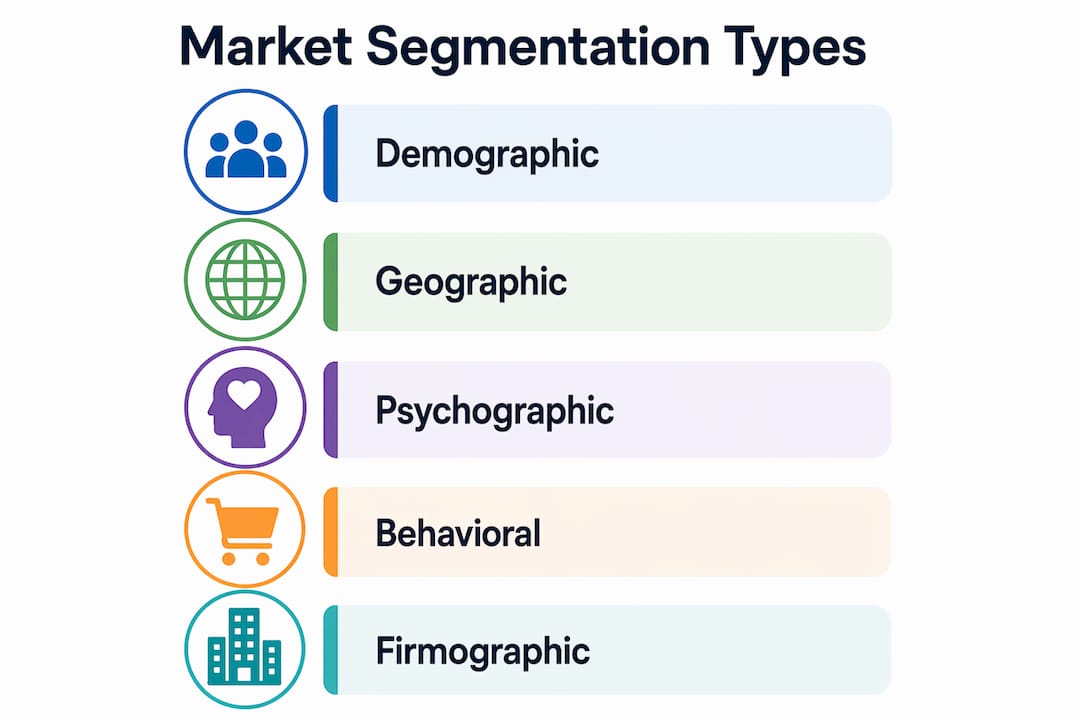
Firmographic segmentation applies specifically to B2B markets. It groups business customers by company size, industry, revenue, location, and organizational structure. 81% of B2B marketers use firmographic data for client categorization. That figure reflects how central this approach has become to B2B go-to-market planning.
| Segmentation type | Primary criteria | Best used for |
|---|---|---|
| Demographic | Age, income, gender, education | Consumer goods, financial products |
| Geographic | Country, region, city, zip code | Retail, local services, logistics |
| Psychographic | Values, lifestyle, personality | Lifestyle brands, wellness, media |
| Behavioral | Purchase history, usage, loyalty | SaaS, e-commerce, subscription services |
| Firmographic | Industry, company size, revenue | B2B sales, enterprise software |
Why is market segmentation important for business success?
Segmentation shifts marketing from broadcasting to precision. Businesses that segment their markets can design products and services that solve specific customer pain points rather than guessing at what the average customer wants. That shift improves engagement, reduces wasted spend, and strengthens competitive positioning.
The financial case is direct. When campaigns reach the right people with the right message, conversion rates rise and cost per acquisition falls. Personalized, segmented campaigns generate significantly higher revenue than mass marketing. That gap widens as markets become more competitive and customer attention becomes scarcer.
Segmentation also uncovers growth opportunities that broad market analysis misses. A business reviewing its customer data by segment might discover that a small psychographic group converts at three times the rate of the general audience. Without segmentation, that insight stays buried.
- Increases campaign relevance and customer engagement
- Reduces wasted ad spend on unqualified audiences
- Improves ROI by concentrating budget on high-value segments
- Reveals underserved niches and new product opportunities
- Enables cleaner performance measurement and faster budget reallocation
The main challenge is data quality. Segments built on outdated or inaccurate data produce misleading results. A second challenge is over-segmentation, which creates groups so narrow they cannot support a profitable campaign.
Pro Tip: Validate your segment data at least once per quarter. Customer behavior shifts faster than most annual planning cycles account for, and stale segments quietly drain budget.
How do B2C and B2B market segmentation differ?
B2C and B2B segmentation share the same goal but require very different criteria and processes. Getting this distinction right determines whether your messaging lands or gets ignored.
In B2C segmentation, the primary variables are demographics, psychographics, and behavior. A consumer makes a purchase decision relatively quickly, often alone, and is influenced by emotion, brand perception, and price. A direct-to-consumer skincare brand segments by age, skin type, and purchase frequency. The data is abundant and the feedback loop is fast.
B2B segmentation is more complex. Business markets require different criteria due to organizational complexity and purchasing dynamics. A single B2B sale may involve a purchasing committee of five to ten people across finance, operations, and IT. Each stakeholder has different priorities, and the sales cycle can stretch from weeks to months.
Firmographic variables drive B2B segmentation: industry vertical, company revenue, employee count, geographic market, and regulatory environment. A cybersecurity firm targeting mid-market financial services companies is applying firmographic segmentation. For a deeper look at how this plays out in practice, B2B marketing strategy resources can help you build a targeting framework from the ground up.
- B2C key variables: age, income, lifestyle, purchase behavior, brand loyalty
- B2B key variables: industry, company size, revenue, buying committee structure, contract size
- B2C decision speed: hours to days, often individual
- B2B decision speed: weeks to months, often committee-based
- B2B added complexity: industry regulations, procurement processes, multi-stakeholder alignment
The practical implication is that B2B marketers need more data points per segment and must account for multiple decision-makers within a single account. A message that works for the CFO will not work for the IT director, even within the same target company.
Common pitfalls and expert tips for effective segmentation
The most common segmentation mistake is treating it as a one-time project. Segmentation is dynamic and iterative. Consumer behavior evolves, new competitors enter the market, and economic conditions shift. A segment that was profitable two years ago may no longer justify dedicated spend today.
A second major pitfall is skipping the positioning step. Segments without corresponding positioning reduce marketing effectiveness to near zero. Identifying a group is only useful if you then craft a message that speaks directly to that group's specific needs and objections.
Over-segmentation is equally damaging. Segments that are too narrow become unprofitable or unreachable through available marketing channels. A useful segment must be large enough to justify the cost of a dedicated campaign, distinct enough to require different messaging, and reachable through channels you actually have access to.
Pro Tip: Start with three to five segments maximum. Prove each one generates returns before adding more. Expanding too fast creates complexity without proportional revenue gain.
Demographic data is best used for market sizing, not campaign targeting. Mature marketing programs prioritize behavioral and psychographic data because those variables predict purchase intent far more accurately than age or income alone. If your segmentation relies entirely on demographics, you are leaving conversion rate on the table.
For B2B businesses specifically, pairing firmographic segmentation with behavioral signals, such as content downloads, product trial activity, or event attendance, produces segments with much higher predictive accuracy. That combination is what separates a list from a real segment.
Key Takeaways
Effective market segmentation requires pairing clearly defined customer groups with tailored positioning and ongoing data validation to produce measurable marketing returns.
| Point | Details |
|---|---|
| Use the S-T-P model | Segment, Target, and Position together. Skipping any step reduces campaign effectiveness. |
| Behavioral data outperforms demographics | Use purchase history and usage patterns for targeting. Reserve demographics for market sizing. |
| B2B needs firmographic criteria | Account for company size, industry, and buying committees. B2B decisions involve multiple stakeholders. |
| Avoid over-segmentation | Keep segments large enough to support profitable campaigns. Start with three to five groups. |
| Treat segmentation as ongoing | Validate and refresh segment data at least quarterly to keep messaging relevant. |
Segmentation works when the data does
The most underrated truth about market segmentation is that the quality of your data determines the quality of your segments. I have seen businesses invest heavily in segmentation frameworks, build detailed personas, and then run campaigns on data that was 18 months old. The segments looked right on paper. The results were poor because the underlying customer behavior had shifted.
The fix is not a more sophisticated model. It is a commitment to continuous data collection and honest segment review. Qualitative research, specifically customer interviews and sales call recordings, consistently surfaces insights that quantitative data misses. A customer survey might show that 60% of your buyers cite price as the top factor. Interviews often reveal that trust and vendor reliability are the real decision drivers, and price is the justification used after the fact.
The businesses that get the most from segmentation treat it as a feedback loop, not a deliverable. They run campaigns, measure results by segment, update their assumptions, and repeat. That process compounds over time. The marketing strategies for small businesses that consistently outperform are built on this kind of disciplined iteration, not on finding the perfect segment on the first try.
— Tran
How Sourcesnova helps you put segmentation into practice
Sourcesnova works with small and mid-size businesses that want marketing that actually produces results, not reports that look good but miss the point.
Sourcesnova builds targeting strategies grounded in real customer data, not assumptions. Whether you are segmenting a local consumer market or navigating the complexity of B2B sourcing and client categorization, the team brings hands-on execution to every engagement. No bloated retainers, no vanity metrics. If you are ready to build a segmentation strategy that drives real growth, visit Sourcesnova to see how the team works and what results look like for businesses in your category.
FAQ
What is the simplest definition of market segmentation?
Market segmentation is the process of dividing a broad market into smaller groups that share meaningful traits, so businesses can deliver targeted marketing to each group.
What are the five main types of market segmentation?
The five primary types are demographic, geographic, psychographic, behavioral, and firmographic. Firmographic segmentation applies specifically to B2B markets.
Why does behavioral segmentation outperform demographic segmentation?
Behavioral data reflects what customers actually do, such as purchase frequency and product usage, making it a stronger predictor of buying intent than age or income alone.
How is B2B segmentation different from B2C segmentation?
B2B segmentation uses firmographic criteria like industry, company size, and buying committee structure. B2C segmentation relies more on demographics, lifestyle, and individual purchase behavior.
How often should you update your market segments?
Segments should be reviewed and validated at least quarterly. Consumer behavior shifts continuously, and outdated segments quietly reduce campaign performance over time.