
Online advertising is the practice of promoting products or services through targeted, measurable ads delivered over the internet to specific audiences based on their behaviors and preferences. Unlike a billboard or a TV spot, digital advertising replaces one-to-many broadcasting with one-to-one personalized conversations between brands and consumers. The industry uses techniques like programmatic advertising, pay-per-click (PPC), and behavioral targeting to serve the right message to the right person at the right moment. For small business owners, understanding this foundation is the first step toward spending smarter and growing faster.
How does online advertising work to reach targeted audiences?
Online advertising works by collecting data about users and using that data to serve relevant ads automatically. Advertising software collects browsing behavior, search history, and demographic information, then uses that profile to decide which ad to show and when. The process happens in milliseconds, often without any human involvement.

The engine behind most of this is programmatic advertising. Automated systems analyze user data to deliver ads at optimal moments across websites, apps, and social platforms. Instead of a media buyer negotiating ad placements manually, software runs real-time auctions for each impression. This makes ad buying faster, cheaper, and far more precise than traditional methods.
Three targeting methods power most campaigns:
- Behavioral targeting: Ads are served based on a user's past actions, such as visiting a product page or watching a video.
- Demographic targeting: Ads reach users filtered by age, location, income, or gender.
- Retargeting: Users who visited your website but did not convert see your ads again on other platforms, nudging them back.
Pro Tip: Before launching any campaign, define your audience segments clearly. A nail salon targeting women aged 25–45 within five miles of its location will outperform a broad "everyone" campaign every time.
Understanding audience segmentation is not optional. It is the difference between a campaign that generates leads and one that burns budget.
What are the main types of online advertising for small businesses?
Online advertising includes search ads, social media ads, display banners, native ads, video ads, and retargeting campaigns. Each type serves a distinct goal and fits a different stage of the customer journey. Choosing the right format depends on your budget, your audience, and what action you want people to take.
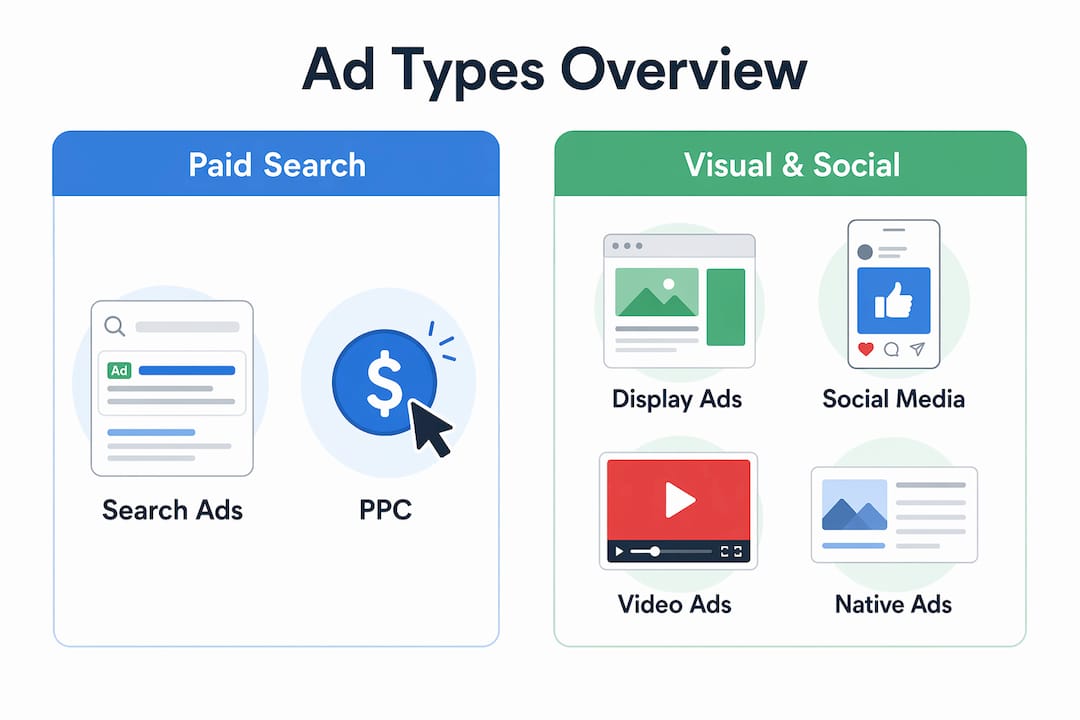
Search ads (PPC)
Search ads appear at the top of Google or Bing results when someone types a relevant query. You pay only when someone clicks, which makes this model highly measurable. A plumber running a Google Ads campaign for "emergency plumber near me" reaches people with immediate purchase intent.
Display and banner ads
Display ads are visual banners placed on websites across the internet. They build brand awareness and work well for businesses that want to stay visible while prospects research their options. Cost models vary between cost-per-click (CPC) and cost-per-thousand-impressions (CPM).
Social media ads
Platforms like Facebook, Instagram, and TikTok let businesses target users by interest, behavior, and demographics with precision. Social ads work especially well for visual products and local service businesses. A retail boutique can reach women in a specific zip code who follow fashion accounts.
Video ads
Video ads run on platforms like YouTube and within social feeds. They communicate more in 15 seconds than a banner can in a week. Short-form video ads consistently outperform static formats for brand recall.
Native ads
Native ads match the look and feel of the content around them. They appear as sponsored articles or recommended posts and generate higher engagement because they do not feel like traditional advertising.
| Ad type | Channel | Cost model | Best use case |
|---|---|---|---|
| Search (PPC) | Google, Bing | Cost per click | High-intent buyers ready to act |
| Display/banner | Ad networks, websites | CPM or CPC | Brand awareness and reach |
| Social media | Facebook, Instagram, TikTok | CPM or CPC | Audience building and local targeting |
| Video | YouTube, social feeds | CPV or CPM | Brand storytelling and product demos |
| Native | News sites, content platforms | CPM or CPC | Content-driven engagement |
| Retargeting | Cross-platform | CPC | Re-engaging past website visitors |
A solid SMB digital advertising guide will help you match each format to a specific business goal before you spend a dollar.
What are the benefits and challenges of online advertising?
The clearest advantage of digital advertising over traditional advertising is cost accessibility. Small businesses can launch targeted campaigns for just a few dollars a day using pay-per-click models, paying only when ads generate clicks. Traditional media like print or broadcast required large upfront commitments with no guarantee of results.
Precise targeting is the second major advantage. Digital ads can be customized to show relevant messages to very specific user segments, which improves both engagement and conversion rates. A local HVAC company does not need to pay to reach people three states away. It can target homeowners within 20 miles who searched for "AC repair" in the last 30 days.
The challenges are real, though. Three stand out for small businesses:
- Ad fatigue: Users who see the same ad repeatedly show lower engagement rates and declining response over time. Rotating creative content every few weeks prevents this drop-off.
- Privacy regulations: New regulations affect the data advertisers can collect and how they use it. Cookie restrictions from browsers and laws like GDPR and CCPA limit some behavioral targeting options.
- Click fraud and wasted spend: Without proper campaign structure and negative keyword lists, budgets disappear fast on irrelevant clicks.
"While online advertising offers affordability and precise targeting, brands must creatively combat consumer ad fatigue and navigate increasing privacy restrictions to succeed."
Pro Tip: Set frequency caps in your ad platform settings. Limiting how many times one person sees your ad in a week protects your budget and keeps your brand from feeling intrusive.
The businesses that win with digital advertising treat it as a system, not a one-time campaign. They test, measure, and adjust continuously.
How can small businesses implement online advertising strategies?
Effective digital advertising starts with clarity before it starts with spending. Small businesses must continuously monitor and optimize campaigns using key performance metrics such as click-through rates (CTR), conversion rates, and cost per acquisition (CPA). Without tracking these numbers, there is no way to know what is working.
A practical digital marketing strategy for small businesses follows a clear sequence:
- Define your goal. Are you driving website traffic, phone calls, store visits, or online sales? Each goal requires a different campaign structure and success metric.
- Set a realistic budget. Start small and scale what works. A $10 per day test campaign on one platform teaches you more than a $500 launch across five platforms at once.
- Build your audience profile. Identify your ideal customer by location, age, interests, and online behavior. The tighter the profile, the more relevant your ads.
- Choose the right format. Match the ad type to the goal. Use search ads for high-intent buyers. Use social ads for awareness and community building.
- Write a clear call to action. Every ad needs one specific next step: "Book a free consultation," "Shop the sale," or "Get a quote today."
- Launch and track from day one. Connect your ads to Google Analytics or your platform's native dashboard. Monitor CTR, conversion rate, and CPA weekly.
- Optimize based on data. Pause underperforming ads. Increase budget on top performers. Refresh creative every three to four weeks to prevent ad fatigue.
- Test one variable at a time. Change one headline, one image, or one audience segment per test. Testing multiple variables at once makes it impossible to know what drove the result.
Automation tools built into platforms like Google Ads and Meta Ads Manager handle bid adjustments and audience expansion automatically. Use them, but review their recommendations before applying. Automation works best when it operates within a clear strategy, not as a replacement for one.
For a broader view of how digital advertising fits into your overall growth plan, the 2026 SMB digital strategy blueprint from Sourcesnova covers channel prioritization and budget allocation in detail.
Key Takeaways
Online advertising delivers measurable results for small businesses when campaigns are built on clear goals, precise audience targeting, and continuous data-driven optimization.
| Point | Details |
|---|---|
| Core definition | Online advertising uses data and automation to serve personalized ads to specific audiences online. |
| Targeting precision | Behavioral, demographic, and retargeting methods improve relevance and conversion rates. |
| Ad format selection | Match the ad type to your goal: search ads for intent, social ads for awareness, retargeting for re-engagement. |
| Managing ad fatigue | Rotate creative content every few weeks and set frequency caps to maintain engagement. |
| Continuous optimization | Track CTR, conversion rate, and CPA weekly, then adjust campaigns based on what the data shows. |
What I've learned about online advertising after years of working with small businesses
Most small business owners approach online advertising the same way: they set up a campaign, spend a few hundred dollars, see mediocre results, and conclude that "it doesn't work." That conclusion is almost always wrong. The campaign did not work. The strategy did not work. Online advertising itself works very well when it is set up correctly.
The mistake I see most often is skipping the audience definition step. Business owners pick a platform, write an ad, and target "everyone in my city." That is the digital equivalent of mailing a flyer to every address in town. It is broad, expensive, and mostly wasted.
The second mistake is treating a campaign as a set-and-forget task. Privacy regulations are tightening every year. Cookie-based targeting is becoming less reliable. The advertisers who adapt, who build first-party data through email lists and loyalty programs, will outperform those who rely entirely on platform data.
The most effective campaigns I have seen combine tight audience targeting with creative that actually speaks to a real problem. Not "we're the best," but "here's exactly what we solve for you." That specificity, backed by consistent measurement and creative rotation, is what separates businesses that grow through digital advertising from those that waste their budget on it.
— Tran
Sourcesnova helps small businesses advertise with confidence
Running paid ads without a clear strategy is one of the fastest ways to burn a marketing budget. Sourcesnova works with local and small-to-mid-size businesses to build digital advertising campaigns that are grounded in data, matched to real business goals, and managed with full transparency.
From search and social to display and retargeting, Sourcesnova handles campaign setup, audience targeting, creative direction, and ongoing optimization. No jargon, no vanity metrics, and no bloated retainers. If your business needs to get found online and turn visitors into customers, explore Sourcesnova's services to see how a focused digital advertising strategy can deliver measurable growth.
FAQ
What is online advertising in simple terms?
Online advertising is the practice of paying to show promotional messages to specific audiences across the internet, including search engines, social media, and websites. It uses data to target users based on their behavior, location, and interests.
How does online advertising differ from offline advertising?
Offline advertising, such as print, TV, or radio, reaches broad audiences with limited targeting and no real-time performance data. Online advertising targets specific users, tracks every click and conversion, and allows budget adjustments in real time.
What are the most cost-effective digital ad types for small businesses?
Pay-per-click search ads and social media ads are the most cost-effective starting points for small businesses. Both allow daily budget caps and charge only for measurable actions, making them accessible at almost any budget level.
What is ad fatigue and how do you prevent it?
Ad fatigue occurs when users see the same ad too many times, causing engagement to drop. Rotating creative content every few weeks and setting frequency caps in your ad platform prevents this decline.
How do small businesses measure online advertising success?
The three core metrics are click-through rate (CTR), conversion rate, and cost per acquisition (CPA). Tracking these weekly through platform dashboards or Google Analytics shows exactly which campaigns are generating returns.